
STARRY'S ASTRONOMY PICTURE OF THE DAY
The pictures posted are taken by myself from my Observatory in Coonabarabran using a digital SLR camera. I am happy to post astro pictures from others if they wish. Leave your email address in my guestbook.
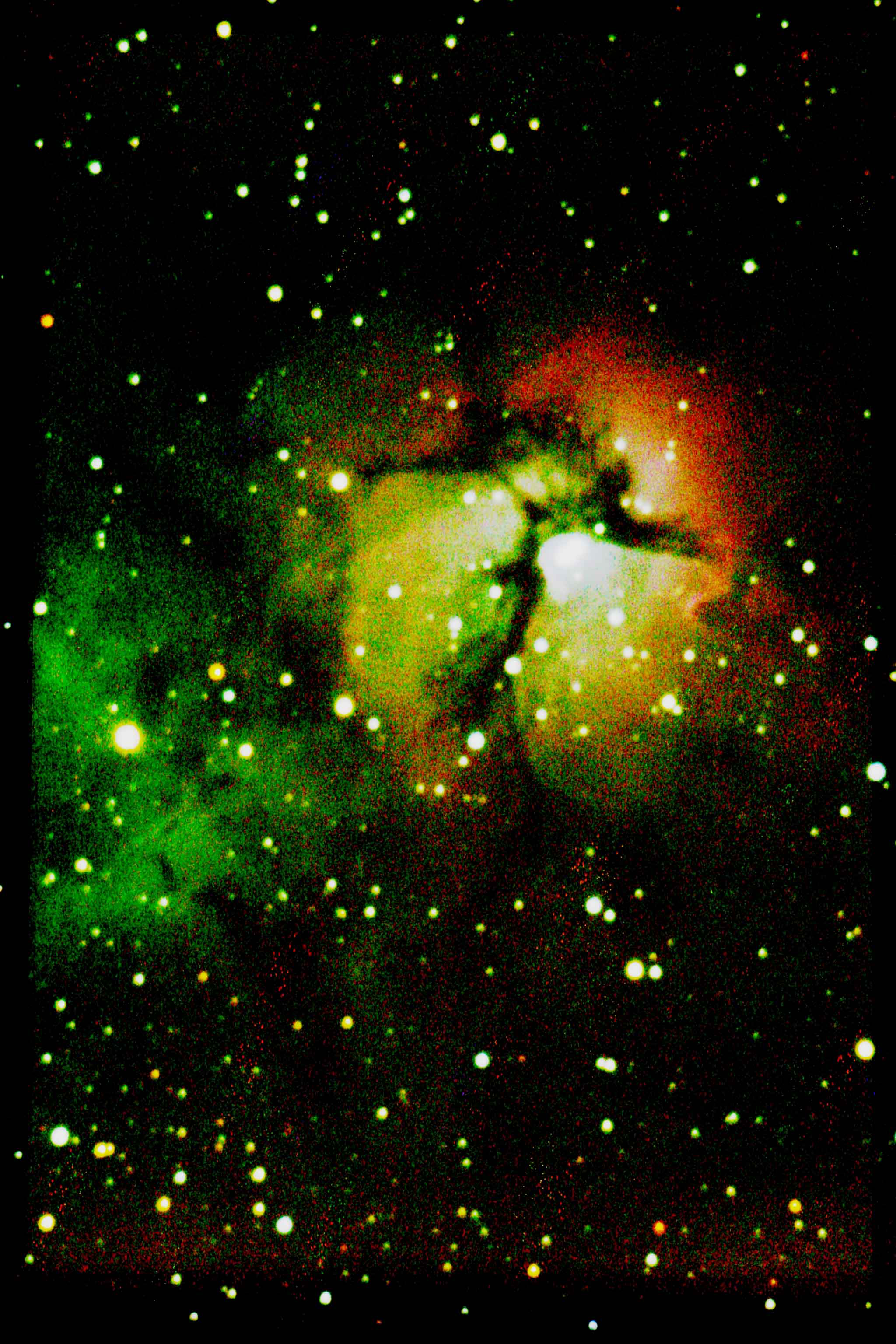
The Triffid Nebula (also known as M20 or the clover nebula)is a giant cloud of gas and dust predominantly made up of hydrogen. This nebula is found in the constellation of Sagittarius. It lies som 5200 light years from Earth.
The red potion of the nebula is produced by hydrogen emission. UV light from the stars within excite the thin ionised hydrogen gas and in turn balmer lines are emitted at 656nm when free electrons combine with the hydrogen ions. We see this as the red colour. The density of the gas is around 10 000 atoms per cubic cm.
The green portion is really blue. It appears green here as not enough light was captured by the camera. A longer exposure is needed. This nebula is caused by cooler hydrogen gas and fine dust grains about 500nm across refelecting light from background stars. This is called a reflection nebula. The blue colour arises from the blue light being scattered more efficiently than the red light. A similar affect causes the blue colour of our sky.
The Triffid Nebula is famous for the darl lanes that split up the centre of the nebula. These are areas of cold gas ( 10 -100 kelvin) and dense dust where ultimately new solar systems will emerge.
This picture was taken at prime focus using a 14" Meade LX200GPS Telescope and a canon 300D camera near Coonabarabran NSW Australia on 11/03/2005. The photo is made up of 40 30 second exposues equivalent to an exposure time of 20 minutes. Processing was done using Maxim DL software..