
STARRY'S ASTRONOMY PICTURE OF THE DAY
The pictures posted are taken by myself from my Observatory in Coonabarabran using a digital SLR camera. I am happy to post astro pictures from others if they wish. Leave your email address at [email protected].
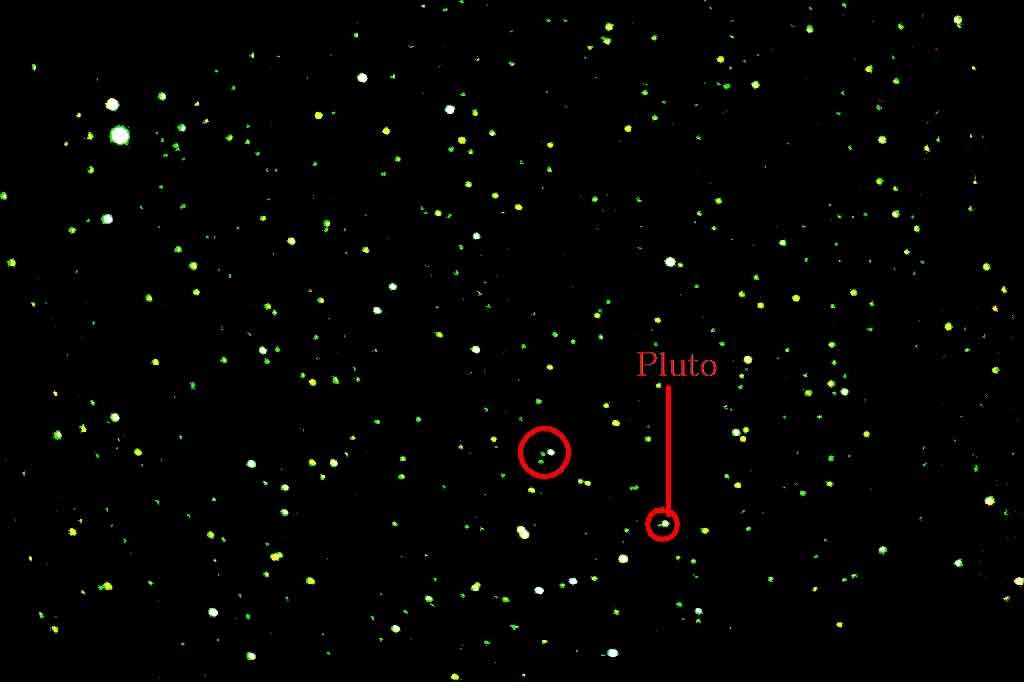
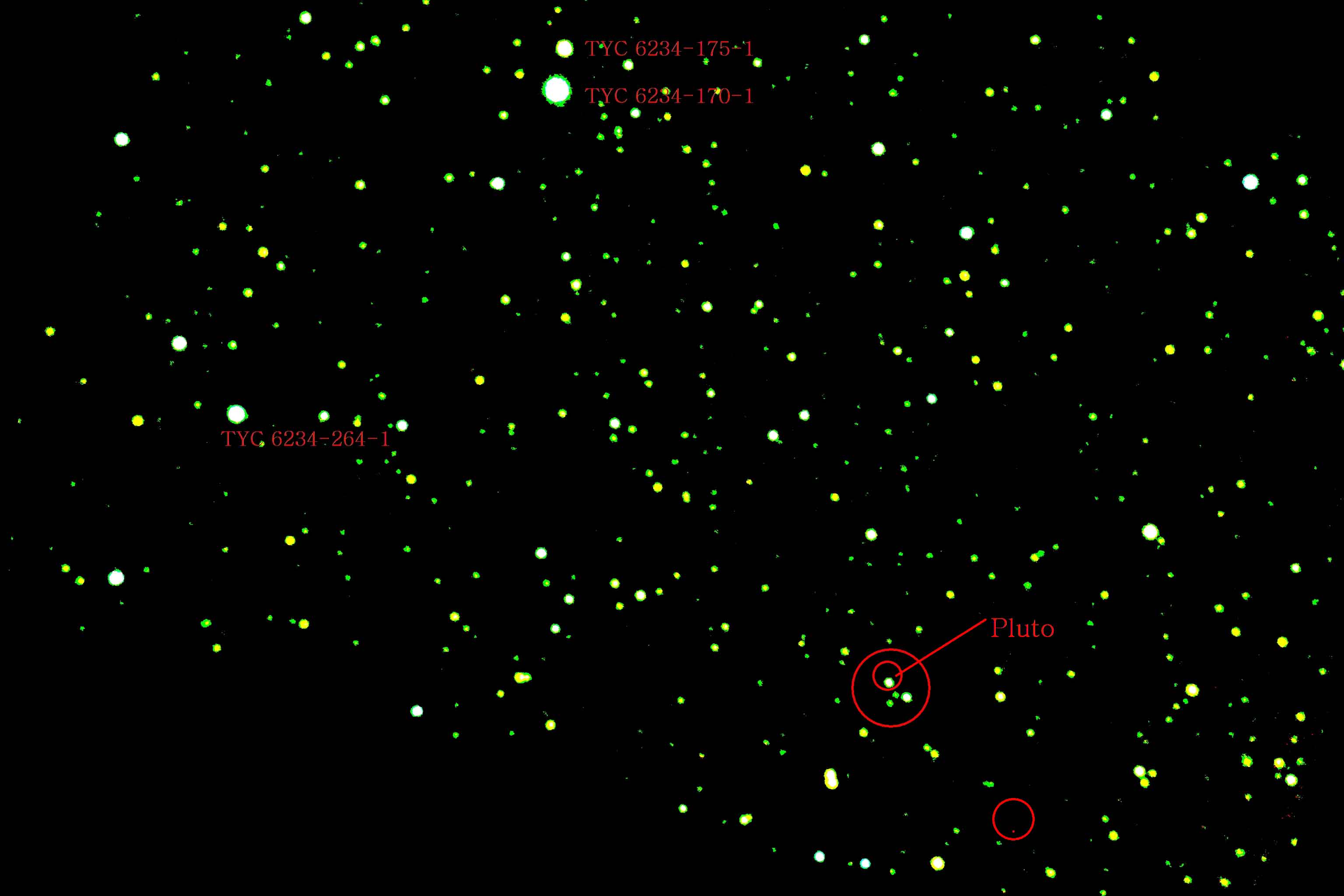
Pluto is the 9th planet from the sun and can be seen with the aid of a telescope in the constellation of Sepens (2005). Pluto can only be seen as a point of light in the pictures above. This is because of the distance to the pluto and because Pluto is tiny compared to the other planets. Many astronomers consider Pluto not to be a planet but a member of many similar objects called kuiper objects ly ing in the Kuiper Belt. Pluto is a mere 2300 km in dimeter and is smaller than our moon by a 3rd.
But what is the definition of a planet?
If it is defined as a body that orbits the sun and not around another planet. Then we have thousands or millions of planets.
If it is also a body that has sufficient mass to form a spherical body then we have many more than 10 planets as many asteroids are spherical as well as many Kuiper belt objects.
If it also has an atmosphere then Mercury would not be classified as a planet. What defines an atmosphere. All bodies have some degree of vapour pressure.
My view is that the sun contains a continous range of masses orbiting the sun. They range from Jupiter size to that of a grain of sand. We could attempt to group them in a different way based on their composition and type of orbit. e.g. Gas Giants (Jupiter & Staurn), Ice giants ( Uanus & Neptune), rocky planets (Mercury, Venus, Earth, Mars, Ceres, Pallas), icy planets (Pluto, Quoar, Sedna), etc
The photos above are taken 2 days apart and Pluto can be seen clearly moving against the background stars. Pluto. It is magnitude 13.7, and is 30.2 AU away at the time the photo was taken. Its path around the sun is an ellipse ranging between 40 and 50 AU. At its closest approach it lies within the orbit of Neptune. It rotates on its axis every 6.4 days and orbits the sun every 248 years. Pluto also has a moon named Charon 1100 km in diameter.
This picture was taken using a canon 300D digital camera which was mounted on top of a 14" Meade LX200GPS Telescope at Tenby Observatory, Coonabarabran, NSW Australia. It consists of 20 30 exposures which are aligned and stacked using Maxim DL. The image was taken on 26th and 28th of July 2005.