
STARRY'S ASTRONOMY PICTURE OF THE DAY
The pictures posted are taken by myself from my Observatory in Coonabarabran using a digital SLR camera. I am happy to post astro pictures from others if they wish. Leave your email address in my guestbook.
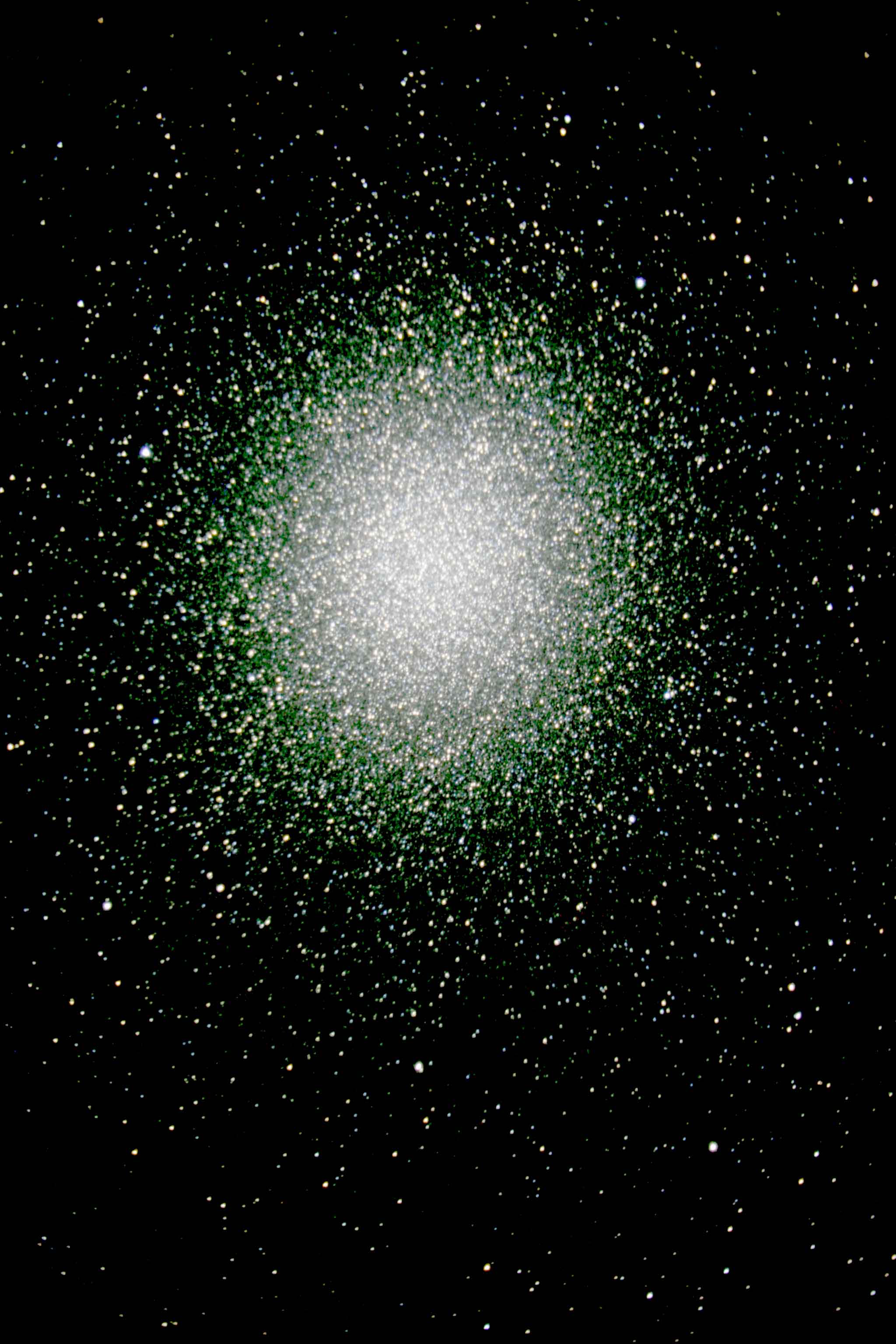
Omega Centauri was first designated as a globular cluster. It is found in the constellation of centaurus in the southern skies. It is visible to the naked eye as a fuzzy star. A telescope reveals this as a spherical group of 10 million stars. The group of stars lies 17 000 lightyears distant and is 150 lightyears across. It was discovered by Edmund Halley in 1677.
Globular clusters (GCs) are found outside the plane of the galaxy and orbit the centre of the galaxy on highly elliptical orbits analagous to comets orbiting the sun. 147 of them have been observed swarming around the Milky Way (MW). There are probably many more but cannot be seen from our position within the galaxy. GCs formed at the same time the MW formed some 13 billion years ago. The stars that are seen now are the ones born from that time. They are 13 billion year old stars! No new star formation occurs within in them as all of the original gas condensed to form the stars.
Most galaxies have GCs, Andromeda has some 450 of them. they are a natural part of the galaxies formation.
Current theory is that omega is in fact the remnants of a dwarf galaxy that has been captured and stripped by our much larger galaxy. It was once 100 000 times larger. This is not unusual as it is thought that the Milky Way Galaxy has consumed many small galaxies and will continue to do so. The Large Magellanic Cloud (LMC) (an irregular galaxy easily seen in the southern hemisphere) is currently being torn apart by the Milky Way. A stream of hydrogen gas has been detected by radio astronomers linking the 2 galaxies together. Eventually the LMC will be consumed.
Evidence for the ancient galaxy theory are the shape of the cluster, it is not as spherical as other GCs, it is 10 times larger than other GCs, and that newer populations of stars have been observed within it.
This picture was taken at prime focus using a 14" Meade LX200GPS Telescope and a canon 300D camera in Coonabarabran Australia. A f/6.3 focal reducer was used