
STARRY'S ASTRONOMY PICTURE OF THE DAY
The pictures posted are taken by myself from my Observatory in Coonabarabran using a digital SLR camera. I am happy to post astro pictures from others if they wish. Leave your email address in my guestbook.
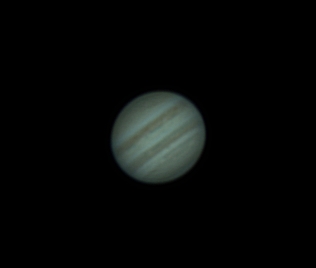
The planet Jupiter is the 5th planet from the sun. It is the largest planet in our solar system and is larger than the sum of all of the other planets combined, 2.5 times more. Jupiter is easily seen with the naked eye and appears usually as the brightest "star" in the sky. It is only outshone by Venus, the moon and of course the sun. As do all the planets, Jupiter appears to change position against the background stars over a period of weeks.
Jupiter can be easily seen through a pair of binoculars along with its 4 largest moons (Io, Europa, Callisto, and Ganymede. Even they change position dramatically from night to night. Its like viewing a minature solar system.
Jupiter is a gas giant and does not have a solid surface as we know it. It is predominantly made up of hydrogen and helium similar to the ratio found in the sun. There are also smaller amounts of methane an ammonia which give the cloud belts there colour. The hydrogen is so compressed in Jupiters interior it becomes liquid metal and generates the planet's intense magnetic field. The planet is still contracting from its formation and this in turn generates heat. the planet releases more energy than it receives from the sun.
Jupiter's famous red spot is actually a storm that has lasted at least a 3 hundred years. It has changed in size and colour during this time as it interacts with other weather systems on the planet. It is the size of 3 Earths and rotates every 6 hours in an anticlockwise direction.
Distance from the sun Max 5.5 AU (1AU = Earth - sun distance) Min 4.95 AU
Orbital Speed 13.1 km/s
Length of Year 11.86 Earth years
Length of Day 9 hours 50 minutes
Diameter 11.2 Earths (143000km)
Mass 317.8 Earths (1.9 E 27 kg
Density 1.326 times that of water
Temperature. -108 C at the cloud tops.
This picture was taken at prime focus using a 14" Meade LX200GPS Telescope and a Lunar planetary imager video camera near Coonabarabran NSW Australia on 11/03/2005. The photo is a composite of 5 frames. Processing was done using Maxim DL software.