
STARRY'S ASTRONOMY PICTURE OF THE DAY
The pictures posted are taken by myself from my Observatory in Coonabarabran using a digital SLR camera. I am happy to post astro pictures from others if they wish. Leave your email address in my guestbook.
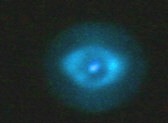
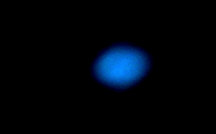
Planetary Nebulae have nothing to do with planets other than there appearance through small telescopes. They are usually bluish green similar to the colour of Uranus and Neptune through a small telescope.
They are actually what happens to stars like our sun once they have exhausted their nuclear fuel. The star expands and loses its outer layers. Its these outer layers that we observe. The gas in them is lit up by the ultraviolet light from the white dwarf at the centre. This is what is left of the core of the star. Its surface temperature is around 200 000 degrees.
The colour is caused by oxygen in the gas which is doubly ionised.
there are about 10, 000 of these in our galaxy and they last for about 25 000 years. They are thought to form from stars about 20% more massive than the sun.
The Ghost of Jupiter is one of the most striking.It is also known as NGC 3242. It is named as such as its angular size is similar to that of Jupiter from our perspective. To me it looks like an eye in the sky looking down at us. It is 1400 light years distant where as the planet Jupiter is a mere 14 light minutes. It is in the constellation Hydra and has a magnitude of 9. The central white dwarf is magnitude 12. The nebula is expanding at rate of 23 km/sec and is moving away from us at 5km/sec.
The saturn nebular (NGC 7009) got its name also from its shape and ist extended rays which look like almost edge on rings of saturn. These are not visible above.. It is magnitude 8 and lies some 2400 light years distant in the constellation aquarius. It has a central white dwarf of magnitude 11.
This picture was taken at prime focus using a 14" Meade LX200GPS Telescope and a canon 300D camera in Castle Hill, NSW Australia. It is a single exposure of 2 seconds.