
STARRY'S ASTRONOMY PICTURE OF THE DAY
The pictures posted are taken by myself from my Observatory in Coonabarabran using a digital SLR camera. I am happy to post astro pictures from others if they wish. Leave your email address in my guestbook.
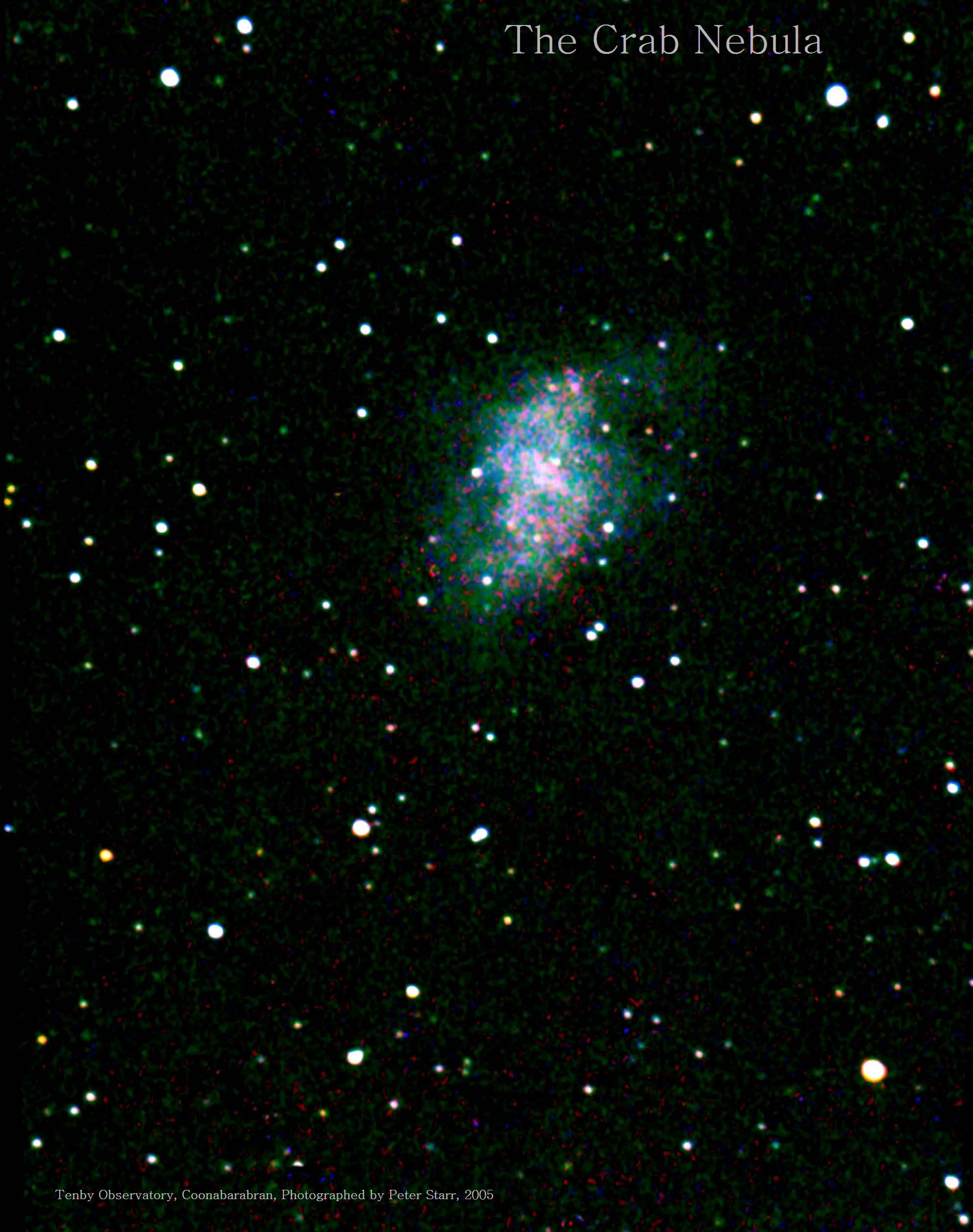
The crab nebula also known as M1 or LGM 1is a supernova remnant. It was first seen as a star 4 time brighter than the planet Venus in the year 1054. At magnitude �6 it could be seen during the datime for 3 weeks, thereafter as a naked eye star for 2 years before fading out of view. All we see now is a nebula that is rapidly expanding.
This object was once a very massive star. Towards the end of its life it was producing iron in its core from lighter elements in a process called nuclear fusion. This process yields extreme amounts of energy which we see as visible light. This energy keeps the star inflated by creating an outward pressure. This is counterbalanced by gravity acting inward. The result is an equilibrium and a star of a certain size.
However on this day in 1054 (actually 6,300 years earlier as it took the light that long to arrive on Earth) the core of the star run out of nuclear fuel to produce iron and energy and therefore no outward force. In a fraction of a second gravity took over and the star imploded onto the core. The core was crushed and the atoms within were squashed so much that the electrons combined with the protons in the atomic nuclei to form neutrons. As atoms are mainly empty space the core shrunk from the size of a planet down to 10km across. If the star was massive enough the neutrons would have been crushed so tightly a blackhole would have formed. However there was insufficient mass and the matter of the star rebounded of the core resulting in a supernova explosion.
The core was a neutron star spinning so rapidly (once every 33 milliseconds) while the gas of the star was expanding outwards at km/s. The spinning neutron star sends out beams from its magnetic poles. They were observed on Earth as radio wave pulses. It was thought they were from some extra intelligence and named the object LGM 1 (little green men.)
This picture was taken at prime focus using a 14" Meade LX200GPS Telescope and a canon 300D camera in Castle Hill, NSW Australia. It is a single exposure of 2 seconds.