
STARRY'S ASTRONOMY PICTURE OF THE DAY
The pictures posted are taken by myself from my Observatory in Coonabarabran using a digital SLR camera. I am happy to post astro pictures from others if they wish. Leave your email address in my guestbook.
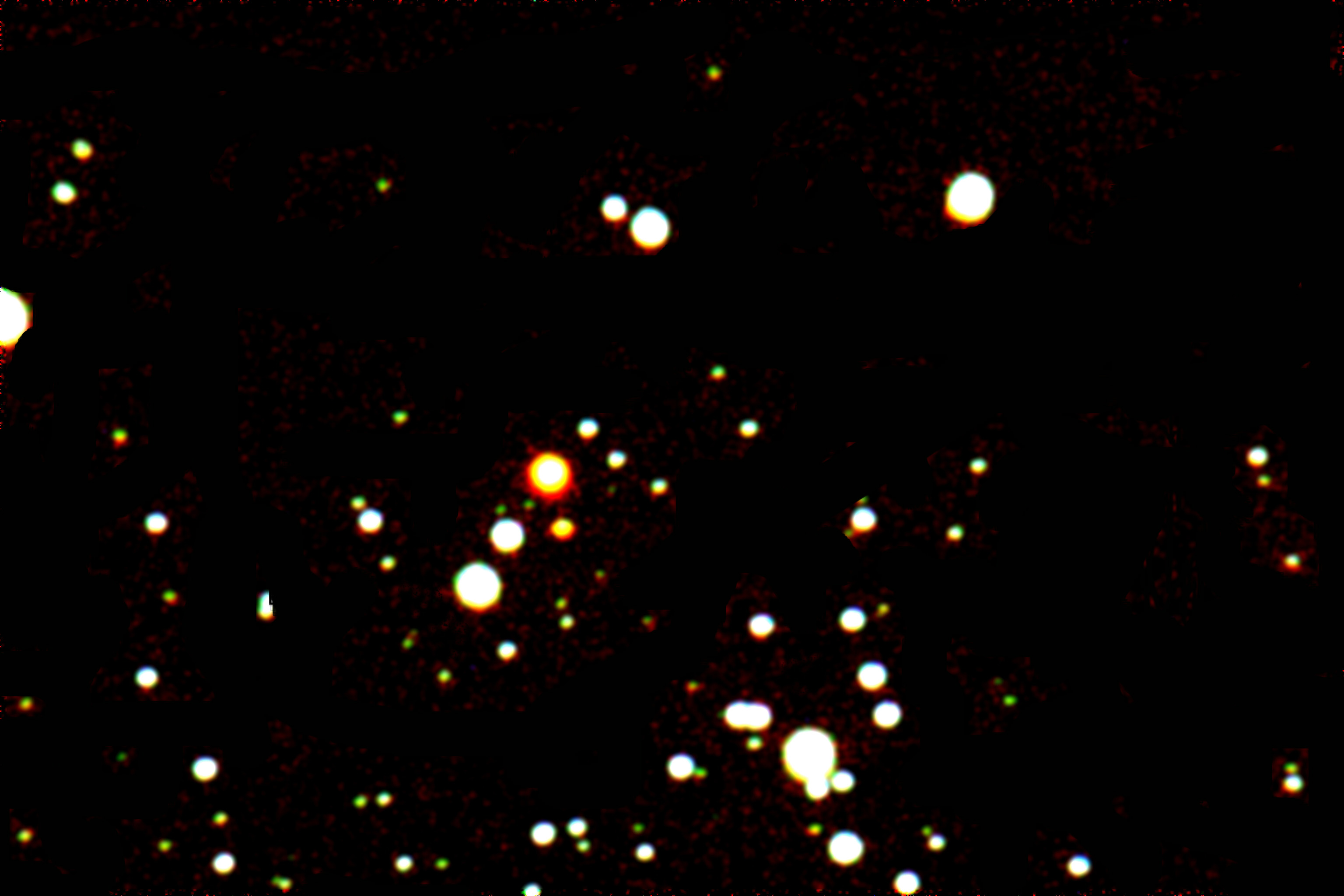
The jewel box cluster, also known as the Kappa Crucis cluster lies in the constellation of the southern cross next to the second brightest star beta crucis. It can be viewed with binoculars but its full glory can be seen through a small telescope.
It is a group of around 100 stars that were all born at the same time from a cloud of dust and gas around 10 million years ago. They are just babies compared to our sun aged 5000 million years.
The cluster is 7500 light years distant and is 25 light years across. The central orange - red star is a red supergiant. This star must be truly massive as its life is almost over after 10 million years. Its true radius is unknown but it must be more than 50 times larger than the sun. The more massive a star is the faster and brighter it burns and the shorter it lives. The largest stars like eta carina live for only 1 million, our sun will live for 10 billion years, and stars as small as proxima centauri (our nearest neighbour one tenth the size of the sun) will live for 100 billion years. This star will be the first in the cluster to go supernova.
The cluster looks like the letter A, here on its side with the apex almost out of view (unfortunately). This star has a diameter 50 times that of our sun.
The picture was taken from Starr Observatory near Coonabarabran using a canon 300D digital camera which is mounted at the prime focus of a 14" meade LX200GPS telescope. The exposure was for 30 seconds with an iso setting of 1600.