
|
|
|
|
Did you over do it?
|
Iron Body TrainingI am putting this page together so there is a lot more coming. Check backThe secret to iron body training is proper breathing. Now that you know the secret you can close this and go elsewhere Proper breathing comes in Hindu or Pranayama, or Chinese or Qui Gong exercises. These are actually one and the same. Through missunderstanding certain techniques were developed that harden the body and at the same time destroy the nerves and nerve endings. This is wrong and will result in problems when you get older. Being an artist I refused to do these techniques because it would ruin my hands. Further study of Chinese texts has confirmed this to me. The Cinese traditional martial arts taught strengthining specific nerve points to protect against Dim Mak (Death Touch). One of the techniques involves relaxation. If you harden the body you can not counter attack quickly. You must be able to respond immediatly. As it is said, If you cut your finger, does the entire body bleed? No of course not. Why then contract all the muscles in the entire body? Qi gong exercises teach to harden only those points at impact. Never look up to or down on your teacher or opponent. When you go into combat, you have an equal chance to win. It is your reslove that allows you to win. You may not be better than anyone else, you must be better than you were.
How do you find good instruction?
One of the most famous masters of the ancient iron palm, reportedly could break bricks selectively in a stack. Iron palm falls short only when it comes to breaking flexible objects (wood, baseball bats) and objects with spacers. example- the palm slap can move anything it strikes one half an inch. Since cement cannot flex, it breaks. If the object, such as wood, can flex farther than that, it will not break. As for spacers, the palm has difficulty sending energy through "hollow" area. That requires focus to drive your energy down through the objects you want to break. PART ONE
PART TWORemove the bag so that you are now striking the cement/cinder support covered with the towel.
Optional training:(Not Recommended)You can supplement with a bucket of sand. Straight punch the sand 30 times and repeat with the backfist. Do 100 spearhand thrusts into the sand. You can also rub the sand between you hands to toughen the skin. Some iron palm practitioners feel that it is unwise to train the knuckles of the fist because of the long term joint damage. This is fine for strict iron palm fighters, however if you must, and you want to train in any fist striking art, it may be wise to strengthen your knuckles. Chinese acupressure teaches that training the fingertips can weaken the eyes. Different teachers advocate different numbers of strikes per session. Some use hundreds or even thousands of repetitions. Some say to train three times a day, others say you must train the exact same time everyday without missing a day. Maybe these routines are ideal. You can train whenever and even miss a day or two. The less days you miss, the better it will be for you. You should achieve impressive results after 100 days of training. At that point, you should be able to break a single patio block with a flat palm slap (use a towel padding at first). If it helps, mark the days off on your calendar. If you don't keep a record, you may not be training as often as you think. Good Luck! Makiwara Training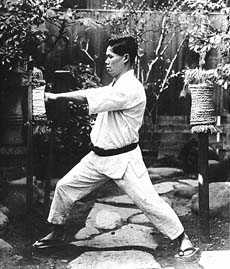 Karate conditioning, focuses primarily on the use of the makiwara. Makiwara come in various sizes and shapes, but basically consist of a slightly flexible wood post wrapped with rope. The makiwara is struck repeatedly with increasing intensity, resulting in toughened, calloused hands and enlarged (calcified) knuckles. Seiken (fore-fist) and tegatana (knife-hand) are the two primary techniques, but any surface such as palm heel, elbow, knees, and kicks may be used. You can also do knuckle push-ups, although hundreds are required. These will strengthen the wrist as well. They will also build calloused knuckles although slower, will do so without damaging your hand. Makiwara should be trained daily, but there is no strict set regimen. The key is not hitting the makiwara so hard that you hurt yourself or tear the skin on the knuckles, but repetition and consistency are very important. If you hurt yourself you set your training back a lot. How to TrainWhen striking the makiwara during your training, it is important to stay relaxed. Allow your hand to drop onto the surface.Do not tense the arm or shoulder, or exert extra strength while striking. Always breath out as you strike. Exerting strength or failing to breath out is said to stress the heart. Train at your own risk.
You should apply dit da jow to hands (available through martial arts stores) and massage before and after each set |

