Netjer
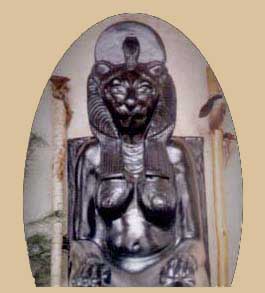
"Netjer," a Kemetic
word meaning "divine power," is the One Self-Created Deity which
manifests in myriads of forms, which we call Names (Kemetic
Orthodoxy is a monolatry, a specialized form of
polytheism that is NOT monotheism -- . The actual number of Names,
sometimes more simply (but misleadingly) called "gods" and
"goddesses," figures in the thousands.
Ancient Egyptian
religion is very complex. We know much more now about the beliefs and practices
of the people of Ancient Egypt
It’s very easy to be tempted to think that the Ancient Egyptians were
polytheists (See Below).
What is true is that it
is now very widely accepted throughout Egyptology that the Ancient Egyptians
were in fact monolatrists. Monolatry
is the belief that the many different representations seen in a religion, such
as that of the Ancient Egyptians, are actually intermediaries or attributes of
this Supreme Being or Unknowable Central One. At the pinnacle of the Egyptian
religious belief system is a God or simply called Netjer. This Netjer is unique, Self-Created, and
inaccessible in the depths of Its Own Being. The individual Names of Netjer gave form and
"personality" to the Vastness of the All, which is unfathomable to
the minds of humanity.
Polytheism
Polytheism
Polytheism is belief in, or worship of,
multiple gods or divinities. The word comes from the Greek words poly+theoi, literally "many gods." Most
ancient religions were polytheistic, holding to pantheons of traditional
deities, often accumulated over centuries of cultural interchange and
experience. Present-day polytheistic religions include Hinduism (but see
below); Shinto; some forms of Wicca; Vodun; and Asatru. Buddhism is regarded by some non-practioners as polytheistic although this view of the
religion is rejected by most believers. Some Jewish and Islamic scholars regard
the Christian doctrine of the trinity as bordering on polytheism, a view that
Christians in general strongly reject.
Ancient polytheism
Well-known polytheistic pantheons in history include the
Sumerian gods; the Greek and Roman gods; the Egyptian gods; the Norse Aesir and Vanir; the Yoruba Orisha; the Aztec gods; and many others. Today, most
historical polytheistic religions are referred to as "mythology",
though the stories cultures tell about their gods should be distinguished from
their cults or religious practice.
Few ancient religions, indeed, were not polytheistic. Those that weren't
include the monotheistic Abrahamic religions,
dualistic Zoroastrianism and Mithraism, and possibly the short-lived Atenism promulgated by Akhenaton in
In many civilizations, pantheons tended to grow over time.
Deities first worshipped as the patrons of cities or places came to be
collected together as empires extended over larger territories. Conquests could
lead to the subordination of the elder culture's pantheon to a newer one, as in
the Greek Titanomachia, and possibly also the case of
the Aesir and Vanir in the
Norse mythos. Cultural exchange could lead to "the same" deity being
renowned in two places under different names, as with the Greeks, Etruscans,
and Romans; also to the introduction of elements of a "foreign"
religion into a local cult, as with Egyptian Osiris worship brought to ancient Greece.
Gods and Divinity
Many more philosophical polytheists come to regard their
multiplicity of gods as representing aspects or facets of a greater divine
unity: not a personal god as in the monotheistic religions, but an ultimate
reality of the divine. The best known example is Brahman in Hinduism. Modern Neopagan polytheists also often follow this model.
Although many forms of Buddhism include veneration of bodhisattvas,
these are not regarded as divine entities. Rather bodhisattvas are considered
to be human beings who have reached a high stage of enlightenment and one of
the tenets of Buddhism is that over the course of many lifetimes, any human
being can also reach a similar state of enlightenment.
That a person believes in multiple gods doesn't imply that
he or she necessarily worships them all. Many polytheists believe in the
existence of many gods, but worship only one. This variant of polytheism is
termed henotheism. Some people view henotheistic polytheism as a form of
monotheism; some historians have argued that the monotheistic religions
originated in henotheism. Practically all Jews, Christians and Muslims today,
however, view henotheism as polytheism.
|
|

Click
here to return to the AVE
MARIA! – Egyptian
Book of the Dead
Osiris | Thoth
| Atum-Ra
| Netjer
| Ptah |
Kali
| Sekhmet
| ISIS
| Hathor
| Ma’at
|Nut|
Virgin
Mary | Kali-Joya