 Joya Comeaux, (Kali-Joya), was given the spiritual name,
"Kali" by her Spiritual Master, "Swami Kaleshwar,"
during her seven month initiation into the aspect of the Divine Mother Goddess
and the Hindu/Muslem teachings of his teachers, "Satyha Sai Baba" & "Shirdi Sai Baba."
Joya Comeaux, (Kali-Joya), was given the spiritual name,
"Kali" by her Spiritual Master, "Swami Kaleshwar,"
during her seven month initiation into the aspect of the Divine Mother Goddess
and the Hindu/Muslem teachings of his teachers, "Satyha Sai Baba" & "Shirdi Sai Baba."
The worship of a
mother goddess as the source of life and fertility has prehistoric roots, but
the transformation of that deity into a Great goddess of cosmic powers was
achieved with the composition of the Devi Mahatmya (Glory of the goddess), a text of the fifth to
sixth century, when worship of the female principle took on dramatic new
dimensions. The goddess is not only the mysterious source of life, she is the very soil,
all-creating and all consuming.
Kali makes her 'official' debut in the
Devi-Mahatmya, where she is said to have emanated
from the brow of Goddess Durga (slayer of demons)
during one of the battles between the divine and anti-divine forces.
Etymologically Durga's name means "Beyond
Reach". She is thus an echo of the woman warrior's fierce virginal
autonomy. In this context Kali is considered the 'forceful' form of the great
goddess Durga.
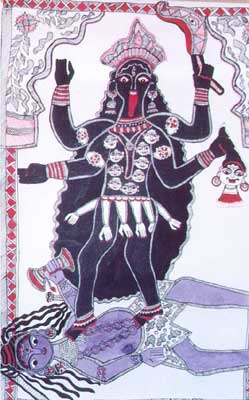 Kali is represented as a Black woman
with four arms; in one hand she has a sword, in another the head of the demon
she has slain, with the other two she is encouraging her worshippers. For
earrings she has two dead bodies and wears a necklace of skulls
; her only clothing is a girdle made of dead men's hands, and her tongue
protrudes from her mouth. Her eyes are red, and her face and breasts are
besmeared with blood. She stands with one foot on the thigh, and another on the
breast of her husband.
Kali is represented as a Black woman
with four arms; in one hand she has a sword, in another the head of the demon
she has slain, with the other two she is encouraging her worshippers. For
earrings she has two dead bodies and wears a necklace of skulls
; her only clothing is a girdle made of dead men's hands, and her tongue
protrudes from her mouth. Her eyes are red, and her face and breasts are
besmeared with blood. She stands with one foot on the thigh, and another on the
breast of her husband.
Kali's fierce appearances have been the subject of extensive
descriptions in several earlier and modern works. Though her fierce form is
filled with awe- inspiring symbols, their real meaning is not what it first
appears- they have equivocal significance:
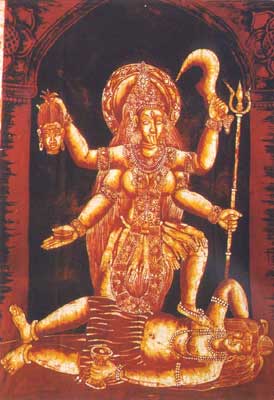
Kali's blackness symbolizes her all-embracing, comprehensive
nature, because black is the color in which all other colors merge; black
absorbs and dissolves them. 'Just as all colors disappear in black, so all
names and forms disappear in her' (Mahanirvana Tantra). Or black is said to represent the total absence of
color, again signifying the nature of Kali as ultimate reality. This in
Sanskrit is named as nirguna (beyond all quality and
form). Either way, Kali's black color symbolizes her transcendence
of all form.
A devotee poet says:
"Is Kali, my Divine Mother, of a black
complexion?
She appears black because She is viewed from a distance;
but when intimately known She is no longer so.
The sky appears blue at a distance, but look at it close by
and you will find that it has no color.
The water of the ocean looks blue at a distance,
but when you go near and take it in your hand,
you find that it is colorless."
... Ramakrishna Paramhansa
(1836-86)
Kali's nudity has a similar meaning. In many instances she is
described as garbed in space or sky clad. In her absolute, primordial nakedness
she is free from all covering of illusion. She is Nature (Prakriti
in Sanskrit), stripped of 'clothes'. It symbolizes that she is completely
beyond name and form, completely beyond the illusory effects of maya (false consciousness). Her nudity is said to represent
totally illumined consciousness, unaffected by maya.
Kali is the bright fire of truth, which cannot be hidden by the clothes of
ignorance. Such truth simply burns them away.
She is full-breasted; her motherhood is a ceaseless
creation. Her disheveled hair forms a curtain of illusion, the fabric of space
- time which organizes matter out of the cchaotic sea of quantum-foam. Her
garland of fifty human heads, each representing one of the fifty letters of the
Sanskrit alphabet, symbolizes the repository of knowledge and wisdom. She wears
a girdle of severed human hands- hands that are the principal instruments of
work and so signify the action of karma. Thus the binding effects of this karma
have been overcome, severed, as it were, by devotion to Kali. She has blessed the devotee by
cutting him free from the cycle of karma. Her white teeth are symbolic of
purity (Sans. Sattva), and her lolling tongue which
is red dramatically depicts the fact that she consumes all things and denotes
the act of tasting or enjoying what society regards as forbidden, i.e. her
indiscriminate enjoyment of all the world's "flavors".
Kali's four arms represent the complete circle of creation and
destruction, which is contained within her. She represents the inherent
creative and destructive rhythms of the cosmos. Her right hands, making the
mudras of "fear not" and conferring boons, represent the creative
aspect of Kali,
while the left hands, holding a bloodied sword and a severed head, represent
her destructive aspect. The bloodied sword and severed head symbolize the
destruction of ignorance and the dawning of knowledge. The sword is the sword
of knowledge, that
cuts the knots of ignorance and destroys false consciousness (the severed
head). Kali
opens the gates of freedom with this sword, having cut the eight bonds that
bind human beings. Finally her three eyes represent the sun, moon, and fire,
with which she is able to observe the three modes of time: past, present and
future. This attribute is also the origin of the name Kali, which is the feminine form of 'Kala', the Sanskrit term for Time.
Another symbolic but controversial aspect of Kali is
her proximity to the cremation ground:
O Kali, Thou art fond of cremation
grounds;
so I have turned my heart into one
That thou, a resident of cremation grounds,
may dance there unceasingly.
O Mother! I have no other fond desire in my heart;
fire of a funeral pyre is burning there;
O Mother! I have preserved the ashes of dead bodies all around
that Thou may come.
O Mother! Keeping Shiva, conqueror of Death, under Thy feet,
Come, dancing to the tune of music;
Prasada waits With his eyes
closed
... Ramprasad (1718-75)
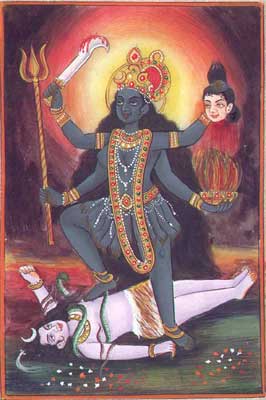 Kali's dwelling place, the cremation ground denotes a place where the five
elements (Sanskrit: pancha mahabhuta)
are dissolved. Kali
dwells where dissolution takes place. In terms of devotion and worship,
this denotes the dissolving of attachments, anger, lust, and other binding
emotions, feelings, and ideas. The heart of the devotee is where this burning
takes place and it is in the heart that Kali dwells. The devotee makes her image in her
heart and under her influence burns away all limitations and ignorance in the
cremation fires. This inner cremation fire in the heart is the fire of
knowledge, (Sanskrit: gyanagni), which Kali
bestows.
Kali's dwelling place, the cremation ground denotes a place where the five
elements (Sanskrit: pancha mahabhuta)
are dissolved. Kali
dwells where dissolution takes place. In terms of devotion and worship,
this denotes the dissolving of attachments, anger, lust, and other binding
emotions, feelings, and ideas. The heart of the devotee is where this burning
takes place and it is in the heart that Kali dwells. The devotee makes her image in her
heart and under her influence burns away all limitations and ignorance in the
cremation fires. This inner cremation fire in the heart is the fire of
knowledge, (Sanskrit: gyanagni), which Kali
bestows.
The image of a recumbent Shiva lying under the feet of Kali
represents Shiva
as the passive potential of creation and Kali as his Shakti.
The generic term Shakti denotes the Universal feminine
creative principle and the energizing force behind all male divinity including Shiva. Shakti
is known by the general name Devi, from the root
'div', meaning to shine. She is the Shining One, who is given different names
in different places and in different appearances, as the symbol of the
life-giving powers of the Universe. It is she that powers him. This Shakti
is expressed as the “i” in Shiva's name. Without this “i,” Shiva becomes Shva, which in Sanskrit means a corpse. Thus
suggesting that without his Shakti, Shiva
is powerless or inert.
Kali is a particularly appropriate
image for conveying the idea of the world as the play of the gods. The
spontaneous, effortless, dizzying creativity of the divine reflex is conveyed
in her wild appearance. Insofar as kali is identified with the phenomenal
world, she presents a picture of that world that underlies its ephemeral and
unpredictable nature. In her mad dancing, disheveled hair, and eerie howl there
is made present the hint of a world reeling, careening out of control. The
world is created and destroyed in Kali's wild dancing, and the
truth of redemption lies in man's awareness that he is invited to take part in
that dance, to yield to the frenzied beat of the Mother's dance of life and
death.
 O Kali, my
Mother full of Bliss! Enchantress of the almighty Shiva!
O Kali, my
Mother full of Bliss! Enchantress of the almighty Shiva!
In Thy delirious joy Thou dancest, clapping Thy hands
together!
Thou art the Mover of all that move, and we are but
Thy helpless toys!
...Ramakrishna Paramhansa
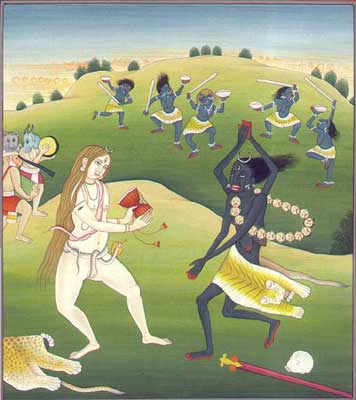
Kali and her attendants dance to
rhythms pounded out by Shiva (Lord of destruction) and his animal-headed
attendants who dwell in the
Many stories describe Kali's dance
with Shiva as one that "threatens to
destroy the world" by its savage power. When Shiva asks his wife Parvati to
destroy this demon, she enters Shiva's body and transforms herself from the
poison that is stored in his throat. She emerges from Shiva as Kali, ferocious in appearance, and
with the help of her flesh eating retinue attacks and defeats the demon. Kali however
became so intoxicated by the blood lust of battle that her aroused fury and
wild hunger threatened to destroy the whole world. She continued her ferocious
rampage until Shiva
manifested himself as an infant and lay crying in the midst of the
corpse-strewn field. Kali, deceived by Shiva's power of illusion, became
calm as she suckled the baby. When evening approached, Shiva performed the dance of
creation (tandava) to please the goddess. Delighted
with the dance, Kali
and her attendants joined in.
This terrific and poignant imagery starkly reveals the
nature of Kali as the Divine Mother. Ramaprasad expresses his feelings thus:
Behold my Mother playing with Shiva,
lost in an ecstasy of joy!
Drunk with a draught of celestial wine,
She reels, and yet does not fall.
Erect She stands on Shiva's bosom,
and the earth Trembles under Her tread;
She and Her Lord are mad with frenzy,
casting Aside all fear and shame.
... Ramprasad (1718-75)
Kali's human and maternal qualities continue to define the
goddess for most of her devotees to this day. In human relationships, the love
between mother and child is usually considered the purest and strongest. In the
same way, the love between the Mother Goddess and her human children is
considered the closest and tenderest relationship with divinity. Accordingly, Kali's devotees
form a particularly intimate and loving bond with her. But the devotee never
forgets Kali's demonic, frightening aspects. She does not
distort Kali's nature and the truths she reveals;
she does not refuse to meditate on her terrifying features. She mentions these
repeatedly in her songs but is never put off or repelled by them. Kali may
be frightening, the mad, forgetful mistress of a world spinning out of control,
but she is, after all, is the Mother of all. As such, she must be accepted by
her children- accepted in wonder and awe, perhaps, but accepted nevertheless.
The poet in an intimate and lighter tone addresses the Mother thus:
O Kali! Why dost Thou roam about nude?
Art Thou not ashamed, Mother!
Garb and ornaments Thou hast none;
yet Thou Pridest in being King's daughter.
O Mother!
Is it a virtue of Thy family that Thou
Placest thy feet on Thy
husband?
Thou art nude; Thy husband is nude; you both roam cremation grounds.
O Mother!
We are all ashamed of you; do put on thy garb.
Thou hast cast away Thy necklace of jewels, Mother,
And worn a garland of human heads.
Prasada says, "Mother! Thy fierce beauty has
frightened
Thy nude consort.
... Ramaprasad
The soul that worships becomes always a little child: the
soul that becomes a child finds God oftenest as mother. In a meditation before
the Blessed Sacrament, some pen has written the exquisite assurance: "My
child, you need not know much in order to please Me.
Only Love Me dearly. Speak to me, as you would talk to your mother, if she had
taken you in her arms."
Kali's boon is won when humans confronts or accepts her and the
realities she dramatically conveys to them. The image of Kali, in a variety of ways, teaches
humans that pain, sorrow, decay, death, and destruction are not to be overcome
or conquered by denying them or explaining them away. Pain and sorrow are woven
into the texture of human life so thoroughly that to deny it is ultimately
futile. For humans to realize the fullness of their being, for men and women to
exploit their potential as a human being, they must finally accept this
dimension of existence. Kali's boon is freedom, the freedom of the
child to revel in the moment, and it is won only after confrontation or
acceptance of death. To ignore death, to pretend that one is physically
immortal, to pretend that one's ego is the center of things, is to provoke Kali's mocking
laughter. To confront or accept death, on the contrary, is to realize a mode of
being that can delight and revel in the play of the gods. To accept one's
mortality is to be able to let go, to be able to sing, dance, and shout. Kali is
Mother
to her devotees not because she protects them from the way things really are
but because she reveals to them their mortality and thus releases them to act
fully and freely, releases them from the incredible, binding web of
"adult" pretense, practicality, and rationality.
|
|

Click
here to return to the AVE
MARIA! – Egyptian
Book of the Dead
Osiris | Thoth
| Atum-Ra
| Netjer
| Ptah |
Kali
| Sekhmet
| ISIS
| Hathor
| Ma’at
|Nut|
Virgin
Mary | Kali-Joya