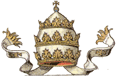

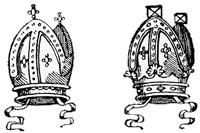
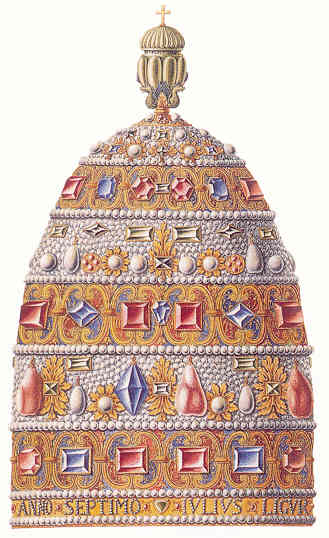
The Papal Tiara has never been intended for liturgical use (like the mitre) but is rather a symbol of the universal authority of the Pope, used for state occasions as the sovereign of Vatican City, or when addressing the entire global Catholic faithful. Until recent times it was worn when the Pope gave the "Urbi et Orbi" blessing from St Peter's. It was also worn whenever a Pope made an infallible statement from the Throne of Peter, though this is a most rare event.
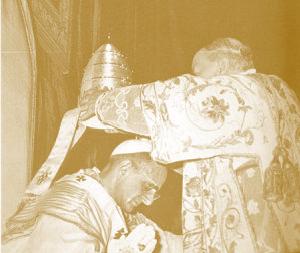
However, the most significant use of the tiara is in the traditional (6 hour long) ceremony of the coronation of a new Pope. Most were crowned in St Peter's Basilica, though Pope Pius XII chose to be crowned on the balcony for all to see. When the crown is placed on the head, the new pope is told, "Receive the tiara adorned with three crowns and know that thou art Father of princes and kings, Ruler of the world, Vicar of our Saviour Jesus
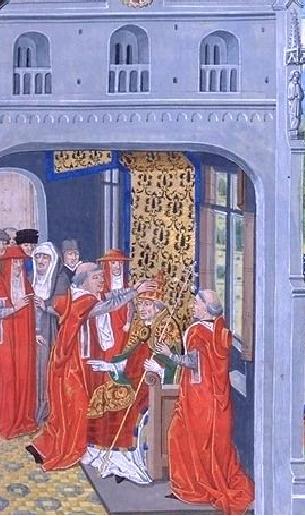
The Papal Tiara has had a long and strange history in the Church. Pope Innocent VIII was obliged to pawn his tiara to raise money for a penniless papacy. After the sack of Rome by Protestant German forces Pope Clement VII was forced to sell off most of the tiaras to raise money for the huge ransoms demanded by the imperial troops. Pope Pius VII was given a tiara from Napoleon Bonaparte, decorated with jewels the French dictator had earlier stolen from the Vatican itself. During the long and difficult reign of Blessed Pope Pius IX, when the Papal States were invaded and conquered by the Piedmontese, the tiara became a symbol of the temporal authority which had been taken from the Pope. As Pio Nono declared himself the "prisoner of the Vatican" tiaras were given to him by the people of Belgium, his Palatine Guard and even Queen Isabella II of Spain, who was not exactly a champion of the Catholic Church. The continued use of the tiara was a bit of an act of defiance by the Popes, who wished to show the world that no earthly power could take away the authority given to them by God.
The last papal coronation was that of Pope Paul VI. Like most popes, his tiara was a gift to him, and one made to reflect his own personality. Paul VI had long voiced his displeasure about many of the "papal trappings", once even suggesting that the Holy See be removed from the Vatican and toying with the idea of disbanding the Pontifical Swiss Guard. As such, his tiara was a very sleek, simple design. During the reign of Paul VI, the Second Vatican Council reached its finale, and along with it, a growing opposition to many traditional Catholic ideas, in particular
Many also came to view the Papal tiara as a symbol of the previous claim of the papacy over the Patrimony of St Peter, or in general the idea that the Pope held temporal as well as spiritual authority. In effect, "authority" was fast becoming a bad word during the time of the Second Vatican Council.