 |
|
|
|
|
|
|
|
|
|
|
|
|
|
|
|
|
|
|
|
 |
|
|
The Kingdom of Spain
Hearth of Catholicism |
|
|
|
|
|
 |
|
|
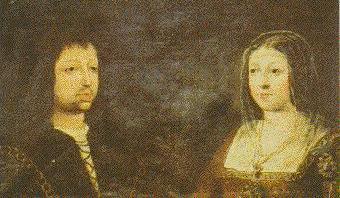
Few countries have such a strong history of Catholic devotion as the Kingdom of Spain. This can be traced in large part to the efforts of the Catholic monarchs, King Ferdinand and Queen Isabella, who won the final victory in the re-conquest of Spain from the Islamic Moors who had taken the country in the time of the Visi-goths. Originally evangelized by St James, when Ferdinand and Isabella liberated and united the modern Kingdom of Spain, they ensured it would be governed as a Catholic monarchy with great emphasis placed on the Church. |
|
|
|
|
From that time on, Spain earned a reputation for unfailing loyalty to the Church and the principles of Christian monarchy. Although Ferdinand and Isabella have been criticized for instituting the Spanish Inquisition, the image portrayed is an entirely false one. Although more zealous than in other nations, the historical records show that the Spanish Inquisition was in no way the terror it is often portrayed as. Many criminals would actually blaspheme before the secular court just so they could be sent to the inquisitors who had a greater reputation for justice and forgiveness. Penance was given ten times more often than execution, which in any event was carried out by the government.
Through wise leadership Spain grew rapidly in power, aided to a great extent by Isabella's idea to take a risk on a daring explorer named Christopher Columbus. From the Lutheran revolution in Spain, to the Turkish invasions in the Balkans and Mediterranean to the Protestant war in Holland, Spain was always at the front in the defense of the Church and the traditional idea of Christendom. |
|
|
|
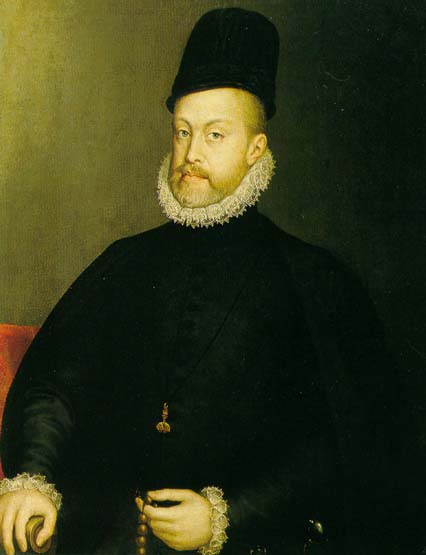
The peak of Spanish power came during the reign of Philip II, after whose time things would never be quite the same again. Under King Philip II Spain was the wealthiest nation in Europe, with the largest empire, the most powerful navy and the most feared and respected army, particularly the much vaunted Spanish pikemen. His marriage to Queen Mary I seemed to be the begining of a new era for Christendom, but the Queen's early death thwarted this. It was also then that Philip made his most crucial mistake: urging his wife to allow her sister Elizabeth to succeed her. Queen Elizabeth I would prove to be the king's most dangerous enemy, despite the fact that she owed her life and crown to the Spanish monarch.
Spain continued to be a major world power, but never quite as it had been under Carlos V or Philip II. By the time of the Napoleonic Wars Spain was ruled by an unimaginative and liberal despot named Fernando VII. During his reign Spain lost all of Mexico (which was much larger then than now) and his unbending desire to illegally place his daughter, rather than his brother, on the throne after him caused great turmoil in Spain. |
|
 |
|
|
|
|
For many, many years after Spain would be torn by civil war as the conservatives and liberals battled each other in the series of Carlist Wars (named for the man who would be king-Don Carlos). Although the Carlists enjoyed widespread support, they were never quite strong enough to defeat the government forces and Spain went ahead with an attempt at a liberal monarchy. Of course, such an unnatural thing soon collapsed and Spain fell into the nightmare of republican rule. Communists and anarchists massacred Spanish Catholics and conservatives by the thousands. More Christians were killed in the first few months of the Spanish Republic than in 300 years of the 'notorious' inquisition. The Carlists, for their devotion to the Church and traditional monarchy were a particular target. Yet, the many conservative opposition groups were not strong enough to stop the Communist republicans. |
|
|
 |
|
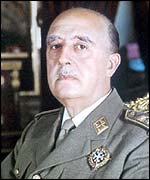
However, that all changed with the arrival of General Francisco Franco of the Falange party. A colonial army officer, he came home to Spain and forged a coalition of conservative groups to overthrow the republican regime, which was being propped up by the Soviet Union and Communist mercenaries from around the world. The republicans were shocked by his success, Franco did not fight like the Carlists had, he was prepared to fight fire with fire and use any means neccessary to drive out the Communists. Atrocities were committed on both sides and when Franco accepted military aid from Hitler and Mussolini, many unfairly judged him 'guilty by association'. In fact, both Hitler and Franco strongly disliked each other, despite the cosmetic similarities between their regimes. |
|
|
|
|
Franco, it must be remembered, never intended to set up a 'thousand year empire' or start a new world order. His goal was to act as a bridge so that the traditional Kingdom of Spain could be restored. Ultimately, he was successful and became the absolute leader or "El Caudillo" of Spain. He cracked down on the socilaist elements, restored the Church to its former place of honor in Spain and was a major force in the global war against Stalinism. However, he also made arrangements to restore the Spanish monarchy after his death, in the person of Prince Juan Carlos de Borbon. He |
|
|
was a man accepted by the vast majority of Spanish parties and he would not disappoint them.
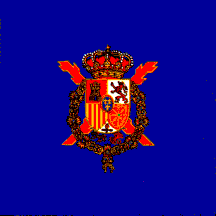
When General Franco died the Spanish Cortes swore in their new head-of-state King Juan Carlos I. Monarchists around the world cheered for the restored kingdom and the people of Spain were equally jubilant to see that their new king was devoted to bringing democracy and constitutional government to Spain. He suppressed a military coup which intended to stop the process of democratization, and guarded the Spanish government as they voted on a new constitution, which would grant democratic freedom to the people while maintaining a role for the king in government. Today, Spain continues to serve as an example for Catholic monarchists. |
|
 |
|
|
|