
San Patricio Battalion
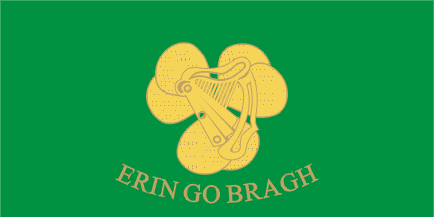
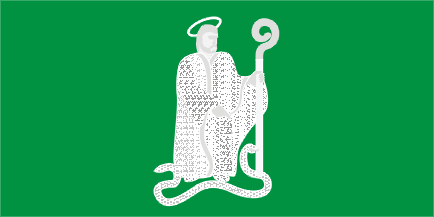
Like most of the Anglo-Mexican era of conflict, there are very few real specifics that can be proven beyond doubt about this event, but the basic facts are these: In 1846 some 200 men from the army of General Zachary Taylor, predominately Irish, deserted under the leadership of Sergeant John Riley, an Irishman from County Galway. They joined with the Mexican forces and formed their own unit under the now Captain John Riley. Since the Mexicans weakest branch of the service was the artillery, they trained as gunners and became one of the most crack units in Mexican service. They named their outfit St Patrick's Battalion, or San Patricio. However, since many of the men were red-headed, many of their Mexican comrades referred to them as los Colorados.
Perhaps the most controversial issue surrounding the San Patricio Battalion is why they deserted in the first place and joined the Mexican army. Most often, American historians have dismissed them as simply traitors of the worst kind. Sergeant Riley, it is claimed, left in a spoiled rage, indignant at a reprimand he had received from a superior officer. Of course, being Irishmen, many Americans at the time claimed that alcohol was at the root of the problem. The actual facts as to what motivated these men is simply a mystery, but in Mexico however, they tend to assume the best. In their history books, the Colorados were moved by the plight of the Mexicans, shamed by American aggression and brutality and decided to abandon the army of conquerors and fight for the "right side" instead. Actually, the situation is most certainly more complicated than either of these views.
Most Irishmen of this era came to America looking for a better life than what they had living at home, in poverty and under oppressive British rule. Although in America they had their "freedom", in truth their situation in the New World was not a drastic improvement. They were treated as the lowest class, some even comparing them to a northern version of the African slaves used in the south. In predominately Anglo-Saxon, Protestant America the Irish were the wrong ethnicity and the wrong religion; cheap laborers who were alternately portrayed as taking away American jobs, being useless drunks and even as the vanguard of an invading army that was going to conquer America for the Pope.
These anti-Irish and even moreso anti-Catholic prejudices carried over into army life, where they were joined by such circumstances as low pay and brutal discipline where flogging was still a common punishment. Harassed for being Catholics, these men were at the same time faced with promises from Santa Anna for free land to those who abandoned American arms and fought for Mexico. These broadsides stressed that Mexico had not attacked America (despite the 1836 treaty they still considered Texas part of Mexico) and painted a rosy picture of life south of the border, free of the racial inequality that existed in America. While this was certainly far from an accurate portrayal of life in Mexico, the Irishmen could certainly face the facts that confronted them. They were being persecuted by their own army and fighting against a nation that seemed very familiar. Here was Mexico, a poorer Catholic nation fighting against a much wealthier and industrialized Anglo-Saxon nation of Protestants. That could not have but hit close to home. Since fairly early on in the conflict, Texas was completely secure, and to many on both sides of the border, the rest looked like a simple land grab.
Yet, whatever their motivation, the men of the San Patricio Battalion fought for Mexico and fought hard, aided no doubt by the certain knowledge that defeat would mean death for every one of them. They fought bravely at Buena Vista, Monterrey and were the core defenders at Churubusco at which battle their conduct so impressed General Santa Anna that he declared afterwards, "Give me a few hundred more men like Riley's and I would have won the victory". The San Patricios fought fiercely, inflicting aproximately 139 Americans killed, 876 wounded and 40 MIA. As more U.S. troops poured over the rampart the determined Irishmen attacked their Mexican comrades with knives when they attempted to raise the flag of surrender. In one of the ironies of war, at one point they were confronted by a unit of Mexican deserters now employed in the American army in a unit known as the "Spy Company". The Irishmen fought almost completely to the death. By the end of the battle, out of a battalion of 260 men, only Captain Riley and 74 of his artillerymen were taken alive.
Even as the final act was played out at Chapultapec castle, while American soldiers and marines were storming the very 'halls of Montezuma', the San Patricios faced punishment. Placed in 8pd iron collars they faced a court martial for desertion and treason. Riley and those who had deserted before hostilities began were branded with a large "D" on their face, stripped, shaved, flogged and sentanced to work as laborers for as long as the army remained in Mexico after which time they would be dismissed from the service of the United States. They would also dig the graves for their 50 comrades who were executed in a mass hanging just as the Americans seized control of Chapultapec. Some reportedly cheered as the American flag was raised.
Treated as unwelcome foreigners in a new land, and held in contempt by their own army for their nationality and for their faith, the men of the San Patricio Battalion fought brilliantly by any standard of judgement. Mexico honored them for coming to their defense in a losing war and the men of the San Patricio Battalion stand next only to Los Ninos, the boy cadets of the Mexican Military Academy as the most famous unit of that war. Still today, in Mexico City, stands a monument in their honor: a cross bearing a gamecock for bravery, dice for the gamble upon which they bet their lives and the skull and crossbones of their death.

