
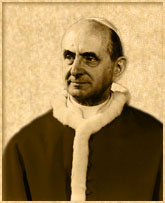
Paul was born Giovanni Battista Montini in Concesio, Italy on September 26, 1897. After becoming a priest he served as Archbishop of Milan and Cardinal Secretary of State of the Vatican. After his election to the Throne of Peter on June 21, 1963 it was left to the new Pope, Paul VI, to conclude the Second Vatican Council and begin dealing with the changes and problems which were a sure result. Controversy was sure to be in ample supply. Paul VI had always been known for his opposition to certain Papal traditions, at one time he even suggested that the Pope be removed from the Vatican. He gave up the Papal Tiara, ancient symbol of the Pope's authority and did away with numerous other things he viewed as out of step with modern times, from the Papal court to the military corps.
Naturally, changing so much so fast caused some painful divisions, most famously the schism of Archbishop Marcel Lefebvre who opposed any changes to the Tridentine Mass. The traditionalists were outraged while the liberals seemed to think that the changes of the Council, put into effect by Paul VI, gave them free reign to pretty much do as they pleased with the apastolic blessing of the Pope himself. However, Paul VI was to prove almost as good at attracting progressive condemnation as he was the traditionalist sort. He began to travel around the world calling for Christian unity and worked feverishly on paper after paper explaining the documents Vatican II had produced.
One of these was the great encyclical Humanae vitae, issued in 1968 which in no uncertain terms, firmly and strongly condemned any methods of artificial birth control or human interference in the process of life. Contraception, Paul VI wrote, far from being part of women's liberation, removed all responsibility from the man and reduced women to being simply objects of pleasure for men. Needless to say, the "free love" crowd of the 60's was very unhappy with this stern warning from a Pope they thought was going to let them do whatever they wished. Pope Paul further defended the traditional of priestly celibacy, which many of the Vatican II spin doctors had predicted would be dropped. This caused further uproar among the liberal community.
Pope Paul VI broke plenty of new ground during his reign. He was the first pope to travel to the United States, where he met President Kennedy and held mass in Yankee Stadium. He was the first pontiff to travel by way of planes and helicopters, the first pope of modern times to go to Israel, the first to ever visit India and the first to address the United Nations, which the Vatican joined as a permanent observer. However, this was a time of great hardships and instability, for both the world and the Church. The Cold War was raging, Southeast Asia was covered by war, international terrorism was on the rise and the Church was torn by divisions. In 1970 the Pope himself had been the subject of an assassination attempt in Manila. Paul VI lamented that, "the smoke of Satan" had entered the Church.
Paul VI was certainly not traditional, but neither could he be called a modernist as he upheld consistantly fundamental Church teachings. The worst thing he could be accused of is seeing the hold modernists had gained in the Church and failing to take any direct action to stop them as St Pius X had done. He was very aware of this, but feared that making use of his disciplinary authority would only drive more people away. Instead, he reacted in the pastoral was he was most comfortable with, writing encyclicals upholding Catholic doctrines. For defending human life at any stage, the special role of the family, which he called "the domestic Church" and condemning contraception he was just as often attacked for being old fashioned as he was for failing to remove modernists from authority. He was the favorite whipping boy of many for all the problems of his time.
Pope Paul VI died on August 6, 1978 after suffering a heart attack while hearing mass at Castel Gandolfo.