
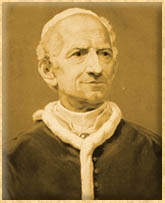
Leo XIII was born Gioacchino Vincenzo Pecci in Carpentino on March 2, 1810. Prior to his election to the Holy See he served as Papal nuncio to Belgium and was the camerlengo following the death of Blessed Pope Pio Nono. No time in the history of the world can hardly ever be seen as unimportant, and indeed, the years of Leo's reign seemed to have been a particularly crucial period in the history of the Church. Rome was an occupied city, the old Papal States had been conquered, the Pope was a prisoner in the Vatican and many nations were adopting anti-Catholic attitudes, particularly so in the new united Germany where the scheming Chancellor Otto von Bismarck launched the kulturkampf against the Church.
The international situation was, perhaps, the Pope's biggest problem. He tried tirelessly to reach agreements with Belgium, Germany and Russia, but European politics were particularly unstable during this period of nationalist competition and making lasting accomodations proved extremely difficult. However, if there was one role which Pope Leo XIII excelled at, it was as the first teacher of Christianity. He showed the faithful how to oppose the evils of the modern world without turning their back on society and progress. He urged the Catholics monarchists of France to stop holding aloof and work with the republic. However, as he was himself a devoted monarchist, he advised this in order that a royalist majority could be properly elected and the kingdom restored.
Misunderstanding of this, as well as his most famous encyclical, Rerum Novarum, which accepted the use of trade unions and the need for workers' rights advocates, caused some to label Leo XIII as a "liberal" pope. In fact, he was simply a man of fairness and compassion who did just as much good that could be called "conservative" as "liberal". He was deeply concerned by the exploitation carried out during the height of industrialization and his beliefs on human dignity demanded that he stand up for the workers who were being taken advantage of. He also urged all countries to finally end the shameful use of African slavery and condemned such dangerous organizations as the Freemasons, socialists and the rising Communist Party. In 1899 he solemnly dedicated the whole of humanity to the Sacred Heart of Jesus and taught that there should be no conflict between Christianity and science.
Pope Leo XIII also called for a return to Christian unity and offered friendship to the East Orthodox and Protestant communities, he being the first to call Protestants, "our seperated brethren". However, he was just as adamant in his defense of the rights and authority of the Catholic Church. He would tolerate no dissent once he had adopted a policy, often with the friendly reminder that, "ergo sum Petrus". He conducted the Papal court with all of the custom and majesty that the Throne of Peter deserved. People knelt when presented and kissed his foot, and no one was to sit down in his presence uninvited. The strictest standards of respect were to be maintained at all times.
Leo XIII, who wrote more than any other pope, lived to the age of 93 having a reign of 25 years, 4 months and 29 days. Although increasingly frail, by the power of the Holy Spirit his mental abilities never wavered in the least. Until the last he was a perfect example of the firm but compassionate, wise yet realistic and spiritual man who makes an ideal pontiff.