
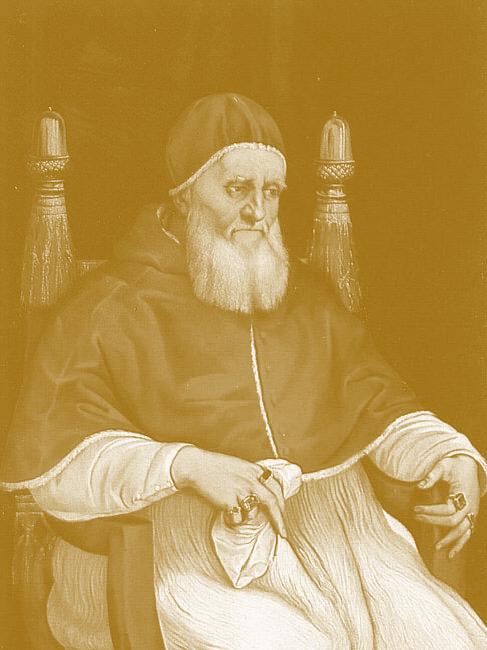
Giuliano della Rovere was born on December 5, 1453 in Albissola, Italy. He came from a humble background but quickly rose through the Church hierarchy thanks to the influence of his uncle Francesco della Rovere who became Pope Sixtus IV. Already a cardinal at the age of 18, Giuliano proved himself to be a survivor in the family/political/religious rivalries of 16th Century Italy. He served as legate to France for his uncle Sixtus IV and rose to great heights during the reign of Innocent VIII. However, he was forced to retreat to France after the election of the Borgia Pope Alexander VI, a bitter enemy of the Rovere family.
However, Alexander found that Giuliano could not be destroyed. He was well connected with the most powerful families in Italy and was then associating with King Charles of France. The two managed to come to a truce before Alexander's death. Then, at the age of 50, Giuliano was elected Pope on November 1, 1503 taking the name Julius II. He soon was to earn his militant nickname when he launched a campaign to eliminate the Borgia fiefdoms and drive the French and German presence out of Italy. Julius II led his armies in person, arrayed in armor with a retinue of extremely uncomfortable cardinals trailing behind him. Through military skill, political bargaining and a little luck, he managed to accomplish most of his goals. It was also during his reign that a formal contract was signed to provide mercenaries from Switzerland to the Pope, thus founding the famous Papal Swiss Guard.
Julius II also gave permission for England's future King Henry VIII to marry Catherine of Aragon, an act which was to change Britain forever ultimately. He also sought to renew the city of Rome. He commissioned Michelangelo to work on the Sistine Chapel and the dome of St Peter's, he also commissioned Bramante to work on the basilica and the Vatican as well as Raphael to decorate the papal apartments. Despite all of his wars and artistic expenses, Julius II was a much better treasurer than his predecessor and more than made up for the debt he had inherited. By the end of his pontificate the Papacy was out of debt and had money to spare. In 1512 Julius II opened the 18th General Council of the Church, but did not live to see its conclusion. He died on February 21, 1513 after reigning for 9 years, 3 months and 20 days.