 |
|
|
|
|
|
|
|
|
|
|
|
|
|
|
|
|
|
|
|
|
|
|
|
|
|
|
|
|
|
|
|
|
|
 |
|
|
|
|
The Land of the Rising Sun and
The Kingdom of the Eternal Son |
|
|
|
|
|
|
 |
|
|
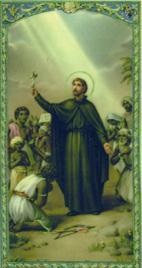
������� The Empire of Japan first made contact with the Christian world through Portuguese merchants, seeking wealth in the Far East. However, Christianity did not begin to take root until the arrival of St Francis Xavier, who planted the seeds of a much persecuted but strong and still surviving Catholic community. Yet, the faith could not really grow as long as Japan isolated itself from the rest of the world and Japanese patriotism was tied to the worship of the Emperor as a god.
Saint Francis Xavier, the "Apostle to the Far East", was born in 1506 at Javier, Spain and became an early member of the Society of Jesus, being a close friend of the founder, St Ignatias of Loyolla. He studied philosophy at the University of Paris, and could have had his pick of any successful future due to his great intelligence and popularity. However, he decided to serve God and to go to the very ends of the earth of his time to spread the Catholic faith.
One of his first mission fields was the subcontinent of India, which had just been opened to Europe by the Portuguese as well. He preached, worked with the people, healed the sick, built up communities and won record numbers of souls to Christ. Whole villages at a time were converted and baptized. However, he always had the urge to do more and go farther. He was to Africa during his travels and upon coming back to Europe actually gave his own patron, the King of Portugal, a tongue lashing for his establishment of the slave trade. He warned the king that his soul was being endangered by this plundering of a helpless people. Before his death in China, he had travelled to almost every country of the Far East. Today, he is the patron saint of Japan. |
|
|
|
|
|
|
 |
|
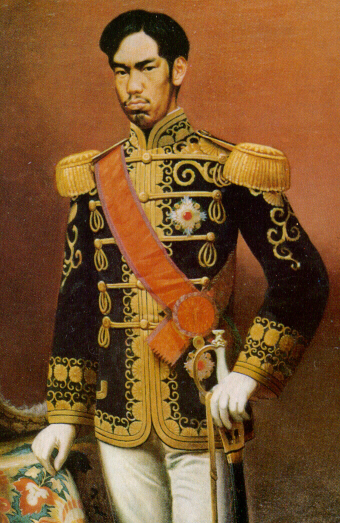
��������� There were good times and bad for the Japanese Christians, but the situation did not really change until the accession of the Meiji Emperor, Mutsuhito, who brought Japan into the modern world in a dramatic way. For the first time in history Japan was not only open to new ideas, but was adopting them en masse as part of a new national policy. Emperor Mutsuhito wanted Japan to become the equal of the western powers and brought in German, French and British experts to modernize all apsects of Japan. However, the new Meiji Restoration also brought about a new form of Shintoism as the state religion, which renewed the emphasis on the Emperor as a descendant of the Sun goddess, who was sacred, divine and inviolable. It was a continuous struggle for Japanese Christians to worship their God and still stress their imperial loyalty. |
|
|
|
��������� The Catholic community began to grow and formal relations were established between Tokyo and the Holy See. However, the idea that the Emperor was a living god still posed a problem. Japanese Christians ran the risk of being viewed as traitors for worshiping another God and refusing to see the Emperor as a religious as well as secular figure. This also put the Vatican in a difficult position, since they had to take into account how Japanese Catholics would be treated if their diplomacy offended Tokyo. |
|
|
|
��������� Situations such as this have been a constant problem for the Church, in cases from World War II to the Second Persian Gulf War. The Church could not be as forceful as other countries in dealing with Japan for fear that the government would retaliate against the totally innocent Christian minority in Japan. However, especially regarding World War II and the Japanese atrocities in China and Manchuria, there was much more to the situation that meets the eye. |
|
|
|
|
|
��������� Japan has always been a country with a beautiful and truly admirable culture. There is a multitude of principles in the Japanese tradition, which any Christian would find familiar and praiseworthy. They had an inherent respect for family, an ideal of duty and honor as well as civility, virtue and even peace and tranquility, though this was purposely de-emphasized by the militarists of the World War II era. However, the Church, having a longer experience with Japan than anyone else, recognized that this militant Japan was an aberration rather than a natural movement. |
|
|
|
��������� This knowledge of basic Japanese ideals gave the Church, particularly Pope Pius XI, the foresight to see that Japan would prove to be a vital ally against the much more dangerous, but often overlooked at the time, enemy of Communism. So, when the |
|
|
Church is criticized for recognizing the Japanese sponsored State of Manchukuo, people must look beyond what was happening at the time and consider how beneficial it would be today to have a modern, democratic constitutional monarchy like Japan in between China and North Korea. |
|
|
 |
|
|
|
|
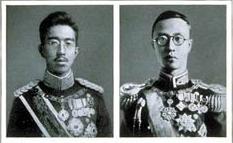
��������� The Pope naturally had no idea that any atrocities were being committed in China by the Japanese. The army did not exactly broadcast these events to the world. Even the Japanese and Manchurian emperors were unaware of what was going on at the front. However, the Pope knew that there was a Christian community in the area which had to be protected, and he knew that Communism was the most dangerous enemy in the long term and that traditional monarchies surrounding China and Russia would be the best defense against future Communist expansion in Asia. |
|
|
Hirohito of Japan Kang Teh of Manchukuo |
|
|
|
|
|
��������� Only today can we see how much better things would have been if the Japanese had not been so demonized by the war. Naturally, they had to be defeated, their militant regime had to be destroyed and those guilty of such ghastly crimes against humanity had to be punished. None of that should be in dispute. What should also be considered though is how much more smoothly the "Cold War" could have passed with independent, traditional style nations left intact in Manchuria, Mongolia, Korea, Indochina and perhaps even having allowed Japanese forces to aid in the defeat of the Maoists in China. |
|
|
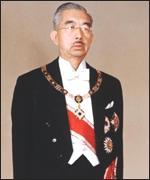
��������� Alas though, as the Japanese pulled out across Asia, the Communists pulled in. However, the Christians in Japan, though still in danger for sharing the religion of Japan?s enemies, were greatly relieved when Emperor Hirohito renounced his divinity and told his people, he was not a god. This made it much easier to spread Christianity, since it no longer seemed a conflict to be a faithful Catholic and loyal subject of the Emperor. Churches began to flourish in the new Japan. Many new converts were made. Even the man who led the attack on Pearl Harbor, Mitsuo Fuchida, became a Protestant Christian. He told his fellow Japanese:
"The biggest mistake we Japanese made in the past was to consider the emperor
as God and the whole world as destined to come under the imperial roof. This was
wrong! God is above everyone, including the emperor. It is God's world and all in it
must be brothers....God wants everyone to come back to him through Jesus Christ.
We all love our emperor, yes, but he is human, so he too lives under the grace of
God. He too must receive Christ to be born again. And when this takes place, the
slogans of our ancestors, 'All the world under one roof'...will really come true." |
|
|
|
 |
|
|
|
|
|
From Son of God to Symbol |
|
|
|
|
|
Flight Commander Fuchida received the congratulations of the Bishop of Osaka but refused an invitation to join the Catholic Church, being unaware of Church history or the origin of the many Christian denominations. He was approached by the Communists but rejected them, and was condemned by a few old comrades as a traitor to Shinto and the emperor, but he took no notice of them. It is noteworthy that, as a missionary, Fuchida considered machismo and science to be the two greatest blocks on spreading Christianity in Japan. |
|
 |
|
|
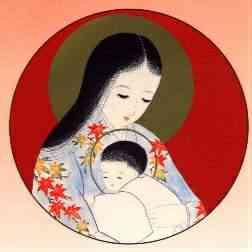
However, despite the problems of modern times, we know that Japan has a very important role to play in God's plan for salvation. This was made abundantly clear in a series of events which occured from 1973 to 1981 in Akita, Japan. As authenticated by Bishop John Shojiro Ito of Niigata, Mother Mary made a series of appearances, giving messages of great importance. The first was to Sister Agnes Katsuko Sasagawa on June 6, 1973. Other messages were received, which followed the basic pattern of almost every appearance by the Holy Mother (people do seem hard-headed when it comes to personal reform), which included warnings of impending judgement, the need for stronger faith and loyalty to the Church, a daily rosary with prayers for the Pope, bishops and priests as well as warnings that Satan would try to divide and infiltrate the Church, even at the highest levels. If mankind does not repent, there absolutely will be a severe punishment to follow.
It is shameful that mankind requires so much 'nagging' to do the right thing, but we must also be able to marvel at the great charity of God that He would send Our Lady of Japan to give us these warnings and remind us of the opportunity we have to repent, be absolved and obtain the Kingdom of Heaven. |
|
|