
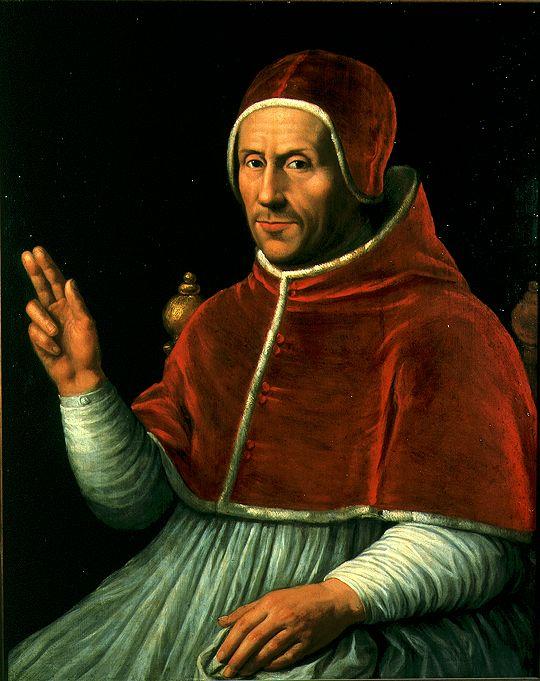
A native of Utrecht, in the Netherlands, born on March 2, 1459 as Adrian Florensz Dedal, he was the son of a carpenter and had a distinguished career before his election to the Holy See. After joining the priesthood he served as Chancellor of Louvain University, as an Inquisitor in Spain, regent for the Kingdom of Aragon, tutor to the future king of Spain (and Holy Roman Emperor) Charles V (for whom he was acting as regent) as well as becoming a cardinal before his election on January 9, 1522 as Successor of the Prince of the Apostles. He was 62 years old.
Obviously, the French were none to happy with the choice of Hadrian VI, whom they feared would be biased toward them and favor his former pupil the Emperor. In fact, the new pope himself was far from overjoyed upon hearing the news, saying he had "many reasons to be saddened". Indeed, when many Romans learned of his election they were outraged that a "northern barbarian" would be coming to rule the Eternal City. Yet, Pope Hadrian VI was to win more than a few enemies during this rather debased period of history for his simple holiness and moral integrity. As soon as he arrived he cut back the lavish ceremonies and celebrations which cost so much money. He also cut favors.
Many came to admire him for his austerity, frugality and opposition to any form of corruption. However, others were inflamed against him by those elites who had lost their influence at the Papal court thanks to the reforming Dutchman. The all too frequent lapse into Church nepotism was immediately halted, Hadrian bluntly informing relatives who came seeking favors that, "he had not become pope in order to give away the property of the Church to his relatives". When confronted with anger from the Italian clergy over his cuts in spending Hadrian VI replied, "The pope is supposed to adorn churches with prelates, not prelates with churches."
Aside from this campaign of reform, with his history as an inquisitor, the Pope also made his primary focus the struggle against the Lutheran heresy spreading in Germany. He called on the princes to unite with the Emperor in opposition to anything which would divide Christendom, particularly in the face of the Muslim threat as the Turks had recently taken Belgrade. However, many of the princes had already embraced Lutheranism and the Pope's efforts were largely thwarted. He also uncovered a plot by the French to take the Kingdom of Naples, however, before the situation could be settled Pope Hadrian VI died in 1523 after barely two years on the Petrine throne. His reign had been short, and often unpopular, but in an age when many Church leaders were hardly upstanding examples, Hadrian VI left behind a legacy of personal virtue. He was a man of impeccable moral character, zealous devotion to the Church and upholding her doctrines as well as being one of too few who recognized the danger of the Protestant movement.