

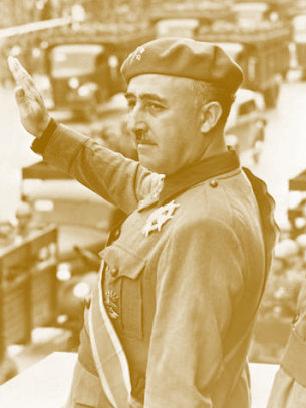
Franco was, to begin with, a self-made man. He was born on December 4, 1892 into a naval family, his father later abandoned the family and so, being the second oldest child, he had responsibility thrust on him at an early age. He went to a Catholic school (Sacred Heart) and was known as a very tough, ambitious, intelligent and very driven young man. Due to the economic crisis of 1898 a naval career was out of the question, so he opted for the army and attended the Academy of the Alcazar in Toledo where he managed to overcome a great deal of difficulties and earned the respect of his class-mates. Shortly after graduation, he requested and was posted to service in Morocco, at that a Spanish possession. While there he came to be known as a very quiet, somewhat shy but calculating and assertive officer, qualities which won him promotion in 1916 and which brought him to even greater attention after his role in suppressing the uprising in the Asturias in 1917.
In 1920 he joined the newly formed Legion of Millan Astray in which he served in Africa, winning further praise and recognition. King Alfonso XIII gave him the rank of colonel and he took command of the Legion when he was only thirty years old. He was so well-known and admired at court that in 1923, when he married Carmen Polo, King Alfonso was his best man. In 1926 he earned promotion to brigadier general and the distinction of being the youngest man in Europe of that rank. When Primo de Rivera restored the Academy of Zaragoza, Franco was given the post of director and made it one of the best institutions of its kind in the world, though it was later abolished again when Spanish radicals overthrew the monarchy and created the Republic of Spain. Franco was very much opposed to this change in regime, but being a dutiful soldier, kept his political views to himself and determined to serve his country no matter what. His position was well enough known however that he was denied promotion by the new authorities. It was also during this time that some claim Franco tried to join the Masonic society. If this is true he was obviously not accepted as he was never a Freemason.
When a more conservative government was elected in 1933 Franco was promoted to major general and helped to put down a rebellion in 1934 with his colonial troops and as a reward was given supreme command of the forces in Spanish Morocco. However, when the so-called "Popular Front", a collection of radical leftists, republicans and communists, managed to take power, he was sent into defacto exile in the Canary Islands as the new authorities were very much afraid of having such a talented, respected officer in command of veteran troops so near to the Iberian Peninsula. Meanwhile, the government became increasingly despotic and "Bolshevik" in nature. Spanish republicans seized Church property, attacked and executed Catholics, monarchists and anyone else opposed to their hold on power. In a matter of months the Spanish Republic executed many times more people than even the supposedly "infamous" Spanish Inquisition of the Renaissance. These harsh measures had two major consequences, they united conservative opposition to the regime; moderates, monarchists, Carlists and Fascists, and also made Franco decide that he could no longer remain inactive but had to take steps to save his country from becoming a Communist Soviet satellite in Western Europe. On June 17th the Spanish army in Morocco rose up in opposition to the republic and the Spanish Civil War commenced.
