
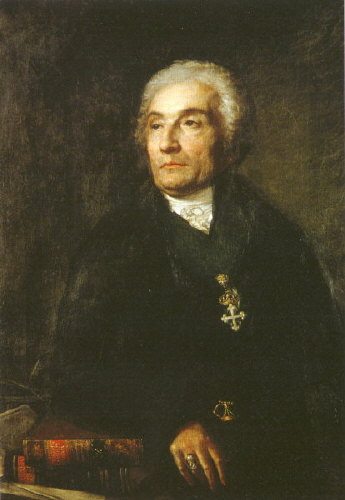
Joseph-Marie de Maistre was born in Chambrey, Savoy in 1753, the first of ten children. Educated by the Jesuits, he grew up with a devotion for religion, unbending loyalty for throne and altar and a healthy disdain for 18th century philosophical rationalism. He entered local government in 1774 eventually becoming a senator in 1788 at the age of 35. After the French invasion he worked for the King of Sardinia, ultimately becoming the keeper of the great seal in 1799. He later served as minister plenipotentiary to the Russian Imperial court in St Petersburg where he became a friend and admirer of Czar Alexander. He returned to Turin in 1817 to resume his duties as keeper of the seal and minister of state.
Of course, de Maistre is known for his writing, but surprising to some given his reputation, his first works were aimed against the established powers. He had nothing but praise for instance of the Americans
In "Considerations sur la France" he relates, based on French history, the belief that France occupies a special place in the world, and in the eyes of God, as the 'principal instrument of good and of evil on earth'. He does not mindlessly defend the ancien regime, but states that the revolution was a punishment for the failure of the French society (king & court included) to benefit mankind, instead giving toleration to the Enlightenment philosophes and liberal elites. He was confident that after this purge, the kingdom would be restored and past wrongs would be corrected.
Much like Bossuet, the Comte de Maistre recognized God as being the central force in human history and development. He was a monarchist in the traditional Christian mold, noting that a king must reign supreme but treating his subjects tenderly, keeping in mind that his authority is a gift of the Almighty that must not be misused. However, his masterpiece and most famous work without doubt was "Du Pape", which became something of a handbook for the ultramontane movement of the 19th Century. He emphasized the monarchial nature of the Pope, whose authority must like any monarch be beyond question. He wrote early on about Papal Infallibility, stating that, "no sovereign pontiff, speaking freely to the Church, has ever made a mistake in the matter of faith."
Joseph de Maistre, in his political and religious writings, also pointed out that physical evil exists only because of moral evil. He is condemned by liberals for his devotion to the Church and to monarchist government, despite the fact that a typical argument, such as acts of violence being rooted in greed and social injustice, would likely find him in full agreement. From him, we can see the principle that law can help but not solve problems of 'physical evil' but rather, a change in public morals is what is needed, and in this, as a social problem, the Church can be helped by the establishment of proper Christian governments.
However, the Comte de Maistre will always remain an icon of the conservative, traditional and counterrevolutionary parties simply because of his loyal adherence to the principle of the ancient and holy institution of traditional authority. His was an attitude in keeping with the most proud Christian traditions of the High Middle Ages, of a state that is truly free under the dual guidance of an effective monarch and an exalted Church. His emphasis on Papal supremacy also countered the problem of Gallicanism, which Bossuet, despite his later efforts, was never able to fully accomplish. Joseph de Maistre set the tone for Christian politics of his time: in the monarchist camp, concerned with issues of social welfare and placing the spiritual authority of the Church above all question. He truly is a philosopher for the ages.