

"The Lost Cause"
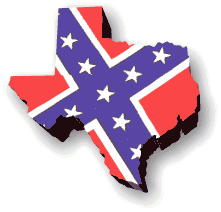



When Abraham Lincoln was elected President of the United States, without even having enough support to appear on the ballot in most southern states, southerners felt that the freedom of their states and their livlihoods were threatened and so, starting with South Carolina, voted to secede from the Union. In 1860/1 the states of Georgia, Florida, Mississippi, Alabama, Louisiana and Texas joined South Carolina in forming the Confederate States of America in Montgomery, Alabama. After General Beauregard (a Louisiana Catholic) forced the surrender of the federal garrison at Ft Sumter, Lincoln quickly called for 75,000 troops to invade the south and force them to submit to his administration. However, this aggressive action only caused the new Confederacy to grow as Tennessee, Arkansas, Virginia and North Carolina left the Union as well. Fearful of the potential outcome, Union troops occupied Baltimore, Maryland to prevent their legislature from voting on the issue of secession (so much for democracy) and states such as Missouri and Kentucky remained divided.
The Confederacy had several pockets of Catholic populations, particularly in Louisiana, Florida and Texas which had all once belonged to Catholic kingdoms. Many high-ranking Confederates were Catholics, such as Secretary of the Navy Stephen Mallory, General Pierre G.T. Beauregard, and Raphael Semmes, captain of the legendary CSS Alabama. Jefferson Davis, the Confederate President, had been given a Catholic education, simply because Catholic schools had always been the best. After the war ended in defeat for the south and Davis was being held in a military prison, Pope Pius IX sent him a package to comfort him in his time of trial. In many ways, the war itself was about Catholic government, whether the Catholic principle of subsidiarism; local rule as opposed to centralized power, could survive in America. It cannot be denied that slavery played a role in causing the conflict, but even this was still a states' rights issue. The Virginia legislature for example had already heard arguments calling for the abolition of slavery, and likewise the number of abolitionists in the north were very few; the vast majority of Americans, including Lincoln, simply did not believe in racial equality. What was an issue was not slavery itself, but whether or not the federal government could force a state to abolish it.
At the outset, particularly in the east, superior leadership and higher quality soldiers more than made up for the vast wealth, industry and numerical superiority of the north. In battle after battle, 1st Manassas, the Seven Days, 2nd Manassas, Sharpsburg, Fredericksburg, Chancellorsville, the Union forces were defeated. The Confederates had a harder time in the west, where an invasion of Kentucky ended in stalemate and disappointment and the Union penetrated further down the Mississippi. July, 1863 was a critical month. In two days, General Lee had suffered his first defeat as commander of the Army of Northern Virginia at Gettysburg, Pennsylvania and General John C. Pemberton had been forced to surrender Vicksburg, Mississippi, effectively cutting the Confederacy in half. Still, the south had a real chance for victory by 1864 simply because the north had become so weary of such horrific losses and humiliating defeats that they were on the verge of agreeing to a peaceful solution with the Confederacy. The capture of Atlanta changed this though and carried Lincoln and the war party to reelection.
Ultimately, the vastly superior resources of the north began to show, and no amount of courage could stop their seemingly endless supply of manpower. The Confederacy was slowly starving to death due to the Union blockade, and rapidly running out of manpower. General Sherman led a campaign of butchery and pillage throughout the Deep South. Known as "the March to the Sea", he looted, sacked and burned every city, town, plantation and farmhouse between Atlanta and the coast, leaving a 60 mile-wide path of scorched earth behind him. By 1865, it was all over and General Robert E. Lee surrendered his army to Ulysses S. Grant, followed soon after by General Joseph Johnston who surrendered to the hated General Sherman. Of all the Confederate states, Texas was the only one which was never successfully invaded by northern forces.
After the war, the south was occupied, stripped of all rights and generally treated as a conquered territory. However, it was not until recently that the honor of the south began to be attacked. In contrast to men like Generals Sherman, Sheridan, Custer, or Benjamin "the Beast" Butler, the southern commanders like Robert E. Lee, Joe Johnston and Pierre Beauregard were known for their gallantry and chivalry. When Lee marched into the north, he ordered that nothing be taken from the populace without payment. At the battle of Shiloh, Confederate General Albert S. Johnston bled to death on the field after ordering his own surgeon to care for the wounded enemy. The Confederacy had been conquered, but only because the time had passed when courage and skill were enough to win a war. Southern society was forced to change somewhat, but the South never forgot their brief but glorious time as a seperate country, and would forever after romanticize the "lost cause" and the pre-war south of dapper southern gentlemen and elegant southern belles.