
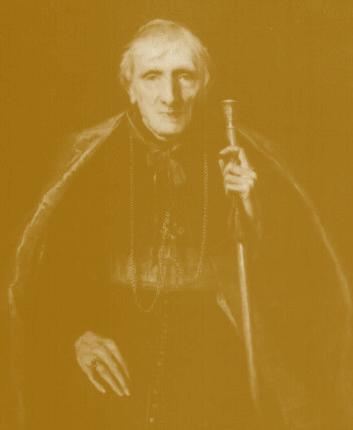

Cardinal Newman was born in London on February 21, 1801 and his background and upbringing made his future as one of the greatest Catholic writers of all time seem all the more extraordinary. He was raised with a very Calvanistic brand of Protestantism, had brothers who became Deists and atheists and by his own admission became a very superstitious young man. He was also though a very deep thinker who pondered possibilities few others would even consider. Was he really who he thought he was? Was the material world simply an illusion? Perhaps life really is just a dream? He finally came to believe that the only two absolutes were himself and his creator. He had a conversion sort of experience at the age of 15 and became a zealous (even anti-Catholic) Protestant.
Newman went to school at Oxford and came to a much deeper understanding of his Christian faith, learning about things like the Apostolic succession and coming to identify himself more with the conservative Anglicans. He had a unique understanding of humanity and wrote eloquent sermons which were very popular, though he himself was wary of populist movements of any kind. In 1824 he was ordained in the Church of England but had come back to Oxford by July 14, 1833 when the "Oxford Movement" began. He travelled alot and came to see that Christianity was in a desperate position and that the Church of England in particular needed some sort of revival to survive. However, he had studied enough and seen enough to know that it was not another more radical Protestant revival that was needed, but a Catholic revival, one that would take the Church of England back to the roots of Christianity, the problem for Newman was, these roots lay clearly in the Church based at Rome.
Newman nonetheless undertook this effort, taking his motto from a phrase from the Iliad, "They Shall Know the Difference Tomorrow". He began to slowly move closer and closer back to Catholicism, first by moving back to the origin of the Church of England, the via media between Rome and Geneva. He came to admire most the High Churchmen and their champions, particularly of course, King Charles I and Archbishop Laud. He also wrote many things that outraged his fellow Protestants, such as the belief that the pagan myths and literature were a way God had of preparing their people for the Gospels and that everything we see is a representation for the senses of the spiritual existence surrounding us. In time, it became harder and harder to avoid the Catholic Church which was at the heart of his studies of the history of Christianity, and more and more difficult to confine all of his beliefs and ideas to the relatively new and changing Church of England.
Eventually, Newman's writing earned him the wrath of many Anglicans as it became more and more clear to others that he was defending Catholic principles and attacking Protestant ones. His study of history had proven to him that the "via media" was a lie that had been used by many heretics for centuries to justify their rebellion against the one, holy, Catholic and apostolic Church. By 1841 Newman was quite convinced that the Church of England was not the Church Christ had founded, nor did it stand for what he now knew to be right. He had come to the points converts know too well; realizing the need for a change.
