 |
|
|
|
|
|
|
|
|
|
|
|
|
 |
|
|
Why Even the Bad Popes are Nothing to Worry About |
|
|
|
|
 |
|
|
|
|
It never ceases to amaze me how someone can ask how I can be a monarchist with so many examples of bad kings or a Catholic with so many stories about bad popes when these same people think nothing of the number of wicked and degenerate presidents and preachers (particularly televangelists, who I personally cannot stand by and large). First of all, Catholics should read their history and rest assured that the vast majority of popes have been very holy and upright men, fully aware of their position and duties and the example they have to set. Even if some were not as effective as others, they were still good, decent men.
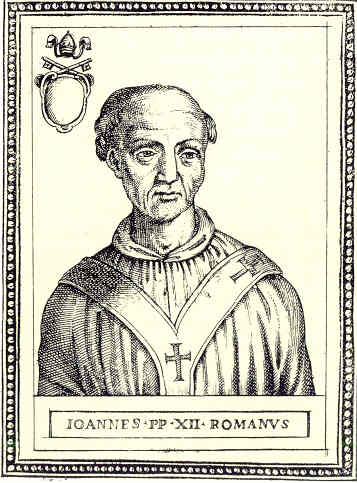
However, like everyone and everything, the Papacy has had a few bad apples in her 2,000 year history. Some of the most well known 'worldly popes' have been, to a degree at least, judged unfairly. However, one who probably lives up entirely to his reputation, though not always remembered, is Pope John XII. Born Octavian, and formerly a Senator and Princeps of Rome, John XII reigned as Supreme Pontiff and Vicar of Christ from 955-964 A.D. without any, in all probability, theological training of any kind. He was only in his twenties and would prove a huge embarassment. |
|
|
|
 |
|
|
|
|
|
Although his reign contained some important events in the Church, particularly concerning the roles of the Pope and the Holy Roman Emperor, John XII is mostly remembered for his avarice and debauchery. Wild parties were going on and people complained that the Papal Palace had become a brothel under his rule. When John XII died, during the very act of adultery no less, many people claimed it had been a result of Satan hitting him on the back of the head. His reign was a scandal, yet, the Church survived and continued on to even greater things in the future. Interesting. |
|
|
|
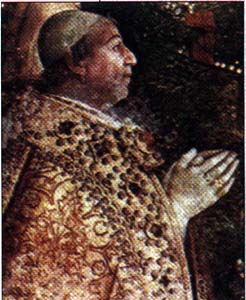
Another example, and probably the best known and most cited 'bad pope' in Church history is the Spanish pontiff of the Borgia family, Pope Alexander VI. Although there is no doubt much to fault Alexander for, his case has been, in all fairness, somewhat blown out of proportion. Most of his lust and corruption was done before coming to the Papal throne, and while he was undoubtedly a sinful man, he was also an extremely capable leader. Had he been considered as just another Renaissance prince, he would be known as one of the greatest, yet as a spiritual leader his example leaves much to be desired. He had a big problem with resisting women, by whom he had several illegitimate children that were able to rise to great heights because of dad's position. His most famous bastard was Cesare de Borgia, the vile creature upon whom Machiavelli based his book "The Prince". When it comes to horror stories about the dirty papal laundry, I think I have heard it all, and done my best to find what is fact and what is fiction, however, there have been bad popes no doubt. |
|
 |
|
|
|
|
|
|
When I was on my way to becoming a Catholic, there were certain things I had to struggle with, but a few corrupt popes never made the list. In fact, as others have pointed out before me, I found that having one or two men like John XII and Alexander VI actually made the case of the Catholic Church stronger. Consider for a moment, that these men were in positions of total and absolute power over the Church and yet none of them ever changed one single article of Catholic teaching. No matter how bad they might have been in their own lives, and though their bad example hurt the Church, no doctrine was so much as tarnished by all this. Considering how ignorant people were in the Dark Ages, would it not have been a simple matter for Pope John XII to declare that celibacy is no longer required? Yet, he did not, none of these men ever changed any part of Church teaching. Some, like Pope Vigilius, even had a radical change of heart once becoming pope and went, in some cases quite literally, from being a sinner to a saint.
For Catholics, the fact that the Church and the teaching of the apostles was able to survive the odd John XII is only further proof of the divine nature and infallibility of the Church, over which Christ promised, "the gates of Hell will not prevail". As a matter of Biblical fact, of the men who were closest to Jesus, 1 in 12 was a traitor. Every Christian understands the facts behind this ratio, yet what would be the response if even 1 in 20 or 1 in 50 popes were the same as Judas? In every single instance, all through the Bible, individual character perfection has never been a requirement to be a servant of God. The actions of the wicked always have consequences, but David's sin did not mean the sacred royal line was corrupted, nor did the betrayal of Judas and the resulting arrest of Christ imply that Jesus was wrong to have entrusted these men to be His apostles.
The laity often excuse the sin in themselves but seem to expect perfection from their spiritual leaders, whereas Christ taught that when it comes to sin and salvation we are all the same, we are all guilty and we all are able to have salvation. Rather, it is a sign of the strength of the Church and the power of Christ that this body is able to overcome the sin which clings to all members, be they lay, ordained or even the Pope himself. No church on earth is populated by angels, and anyone looking for one is bound to be disappointed (in fact, Catholics know themselves so well we are glad to have all the saints and angels in Heaven to pray for us). This should not be taken as an excuse for corruption by any means, but simply to reaffirm that no one is blameless and we must all be vigilant in the constant struggle for purity and to keep in mind that an occasional sinful messenger does not taint the sanctity of the message. Noah drank too much, the Prophet Samuel was a bad father, King David had a lust problem, Moses had an anger problem and even St Peter folded under pressure. The beauty of Christianity is that the perfection of God makes up for the imperfection of His people and in fact, He even uses our own imperfection to teach us all about His glory and holiness. |
|