'Adaptability is his greatest talent' - Dravid
|
|
|

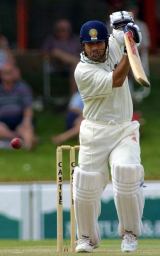
I first saw Sachin Tendulkar
when I was 14, in an U-15 game between West Zone and South Zone at
In the early nineties
satellite television had just come in, and we all watched Sachin's progress
with a great deal of interest and took inspiration from him. Here you were,
struggling to score runs in a Ranji Trophy game, and there he was, taking on
the best attacks in the world, a teenager with the maturity and understanding
of a veteran.
I believe his success was
also beneficial to us in another way. After him a lot more young cricketers
started getting fast-tracked into Ranji sides. Previously you would have to
wait till you were 19 or 20 at least before you were considered. I got into my
state side at 17; Sourav Ganguly did so at much the same age; Vinod Kambli got
an early opportunity to play Test cricket ... more opportunities were available
to young players than before.
Sachin has been a great
influence on my career. I made my debut for India in 1996 and after a while settled
into the No. 3 slot in both forms of the game, and since he opened in one-day
cricket and batted at four in Tests, we've spent a lot of time batting
together, during which I've always regarded myself fortunate to have the best
seat in the house. In Test cricket, three and four are key positions in the
batting order, and it is important that the two men there have games that
complement each other. Just his entry would create a stir in the opposition,
who would then focus almost entirely on getting him out. This allowed me to go
about quietly doing my job at the other end.
Like most other great
batsmen, Sachin possesses the ability to control where the bowlers bowl to him:
sometimes by taking chances and going on the attack against them, like he did
against Shane Warne at Chennai in 1998, or even with a more defensive strategy,
like leaving balls outside off stump alone and forcing bowlers to bowl
straighter at him.
Sachin's greatest attribute
is his ability to adapt to different situations. It doesn't matter if the
wicket is low and slow, or fast and bouncy - he just works out what shots he
has to play and goes about it. I remember how once in the West Indies in 1997
we played a one-dayer at Trinidad in which we had to bat first against Curtly
Ambrose, Courtney Walsh, Ian Bishop and Franklyn Rose on a pitch on which the
ball was doing all sorts of things. Sachin sized up the situation quickly and
unleashed a flurry of strokes to disconcert the bowlers. He was out for 44, by
which time he had already hit 10 fours.
The hallmark of a great
player is how you perform in different situations, and also how you perform
when you're not playing at your best - like Sachin's double-hundred in
Australia when he was going through a lean trot. He just decided to eschew certain
shots and piled up a big score. That is why I have little patience with those
who say that Sachin these days doesn't often bat with the dash and flair of
old. I've never seen any batsman play in one way right through his career -
your responsibilities change, your body changes, the way you think changes.
Finally the most important measure of an innings is its value to the side. Many
of Sachin's knocks, like that double-hundred at Sydney, even if more restrained
and not as pleasing to spectators as some of the blazing innings of old, have
been contributions as crucial and significant as any he has made before.
In fact, it is interesting
to watch the way Sachin still scores at a very high rate in the one-day game,
but in a slightly different way from before - without hitting over the top as
much as he used to - because he has learned how to work the ball around at
will: he achieves the same results with a different method. In particular, the
emergence of Virender Sehwag as his opening partner in the one-day game has led
to Sachin adjusting his game slightly. I think he sees a young Tendulkar in
Sehwag, and wants him to have the license to play freely; besides, he knows
that you don't have to go bang-bang at both ends to keep the scoreboard
rattling along.
Even now, his technique and
in particular his balance are impeccable. That flick he plays behind square leg
to the fast bowlers, often taking the ball right off his stumps, is all about
perfection of balance. No other batsman in world cricket can do it quite like
him.
