CONTAMINATED OIL
In our present day and age consumers
are paying greater attention to the maintenance on their vehicles as budgets
dictate they will be extending the time line of ownership to 10 years. Clean
engine & transmission oil is number one on the preventative maintenance list
and this is achieved by following regular (manufacturer suggested) oil
changes.
There are other methods
also, but lets first look at what is achieved by changing the oil at regular
intervals. The dust, carbon and broken down oil additives are removed along with
some of the metal contaminants. Research indicates that consumers believe if the
vehicle's oil and filter is changed, they will remove impurities from the engine
system. Although a large number of contaminants are removed during the oil
change, a significant number remain on the inner surfaces of the engine. These
inner surfaces include rocker arms, push rod ends, the tops of hydraulic
lifters, as well as the inside of lifters, oil galleys, cam and crankshaft
bearing surfaces, front and rear engine seals and many other surfaces and areas
that allow viscous engine oil to cling or gather. When new oil enters the
system, contaminants are picked up and begin the wear cycle again.
DAMAGE
DONE BY 10 MICRON SIZE IRON/STEEL PARTICLES
The most damaging
contaminant size is ten microns and smaller enabling the contaminant to flow
within the film of oil and enter high-pressure areas of the engine ploughing and
tearing the surfaces. The most damaging of the metal contaminants are the hard
metals; iron and steel which are ferrous metals.
NEW
ENGINE OIL CONTAMINATED THROUGHOUT MANUFACTURING PROCESS
Metal contaminants are
introduced into the engine at the time of manufacture, as the fine grindings are
impossible to flush out. New oil is contaminated with ferrous metal contaminants
under the ten-micron range when it is pumped from the ground to the refining
process. The oil is pumped by metal pumps through metal pipelines and stored in
metal reservoirs then transferred into containers for sale from quart size
containers to forty five-gallon drums.
HOW
STOCK CAR FILTERS FUNCTION
Although oil filters are not usually
advertised with a filtration rating our research has identified they are
generally rated at a 25-micron capability. That is, they will remove
contaminants 25 microns in size and higher. It is important to note this is an
average rating not an absolute. If the filter micron rating is lowered, the flow
of lubricant is reduced and the system will starve or bypass.
ENGINE
FAILURE CAUSED BY OIL CONTIMINATED BY 10-MICRON SIZE PARTICLES
From a number of
important new field and lab studies we can now conclude that lube oil
contamination is the primary cause of engine-wear, and begins what is referred
to as the chain-reaction to failure. In diesel engines, high local stresses
associated with sliding contact wear result in abrasive removal of material
surfaces. When loads are concentrated on the effective area of a small particle,
the resulting surface stresses can be greater than 500,000 pi. Oil film
thickness between which particles can reach and attack surfaces, are typically
in the 10-micron range. This explains why, according to a wear study by
Cummins Engine Corp., particles smaller than 10
microns generated about 3.5 times more wear (rods, rings, and
main bearings) than particles greater than 10
microns.
An independent European
University study, as published in Lubrication Engineering Magazine, reports a
reduction in diesel engine wear by a factor of 14 when better lube oil
cleanliness is maintained. In reference to gas turbine engines, the U.S.
Department of Defence states that "approximately 30 percent of all engine
failures are caused by metal particulate contamination in lubricating oil
systems."
REMOVE
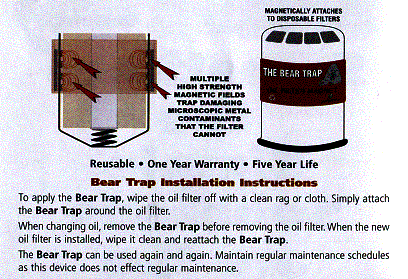
ENGINE OIL CONTIMINATION WITH BEARTRAP
The most effective
method to remove the Iron and Steel contaminants is when the engine is running.
The oil while under pressure picks up all the contaminants and funnels them
through the filter. Alone the filter will remove the contaminants over 25
microns, but with the assistance of The Bear
Trap a Magnetic device attached to the filter, the most damaging
contaminants under 25 microns, the Iron and Steel will be removed. When these
hard contaminants are removed the wear cycle is slowed down. Oil analysis has
identified when the hard metal count is reduced; the soft metal count is
lower.
The Bear Trap is especially effective when used new or rebuilt engines, as the break-in
stage will produce a large amount of tiny ferrous metal contaminants.
Application of a Bear
Trap will remove the ferrous contaminant during the break-in stage
thereby extending the engines life and reducing future maintenance
costs.
CONCLUSIONS
The hard metals; iron
and steel are the most damaging of all contaminants and deserve closer attention
in relation to the filtration of oil. There is a lot of "grey area information"
regarding the filtration of oil that needs filtering. Engine technology has
improved dramatically over the past thirty years with higher manufacturing
tolerances and harder working engines. The oil has improved also but the common
oil filter has not improved much. The Bear
Trap will greatly improve your filtration capability and extend the
life of your equipment. This will protect your investment, reduce maintenance
costs and increase the operational time over the length of ownership.
PRICING
BT500 S$43 per piece with free delivery via post &
handling for email orders to Singapore addresses only. International orders
please email for parcel post & handling rate.
VIDEO
DEMO
Video link for Beartrap
demonstration, Click
here
Return
to main page