Zero-Gravity Warfare
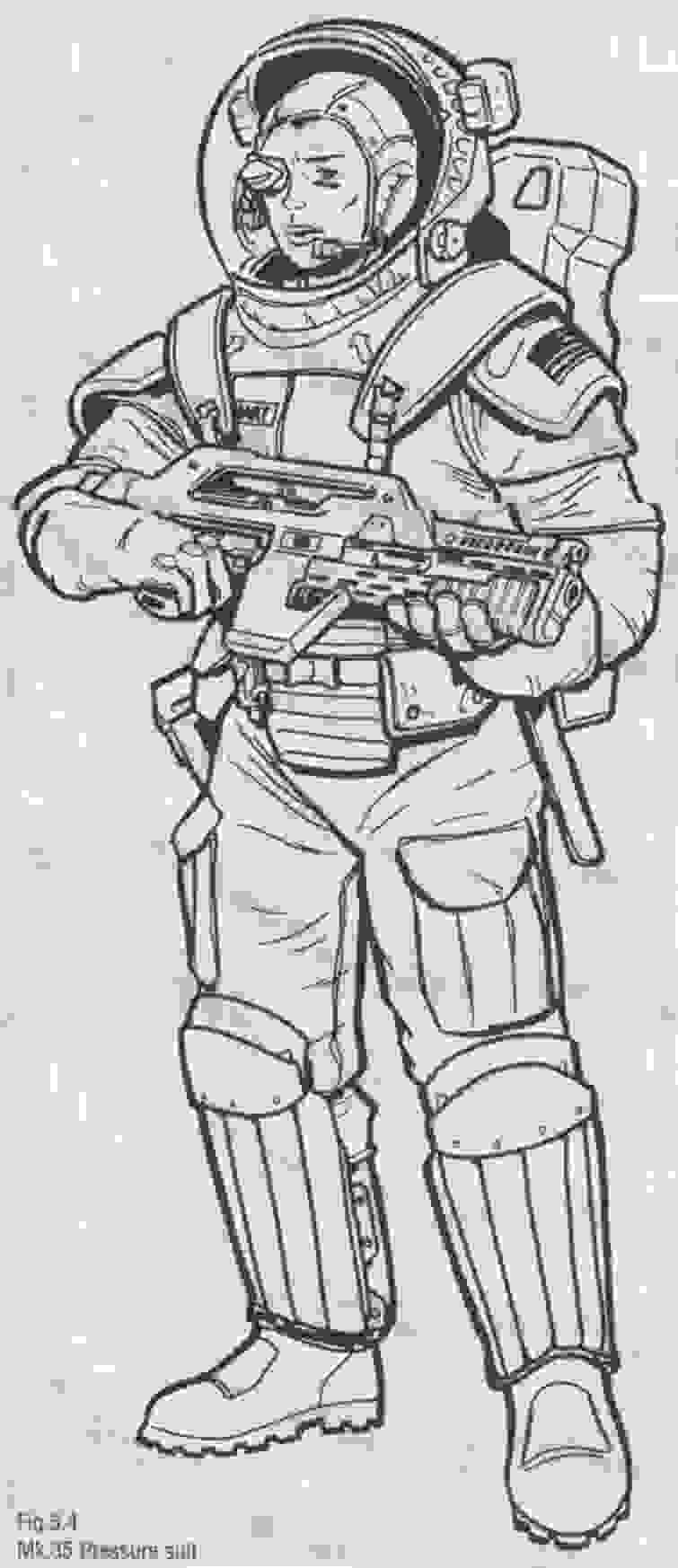
In zero-gravity, normal tactics, manuevers, and weapons suffer from an extreme loss of effiecency. FORCE has designed special suits, compression fields, weapons, tactics, and units to better suit attacks on damaged ships that have loss their gravity and in alien eviroments. Also, these troops can be used to deploy mines on other hostile ships covertly to disable them, simliar to old Earth navy seal manuvers.

Fighting in Alien Enviroments
Over the past 20 years, the Earth FORCE Marine Corps. has conducted military operations on more than four dozen worlds and has deployed to troubled spots on many more. In all cases, regardless of whether the world has an Earth-like ecosphere or has been an airless, barren rock, the Imperial Marines have to be prepared to fight. Marines are trained and equipped to cope with as many varied enviroments as possible- with extreme heat, cold, radiation, and pressure.
Atmospheric Standard
The Atmospheric Standard (AS) is a practical measure to the FMC feild commander of how well or badly his Marines and equipment will perform in an atmosphere. New Terra's own Atmospheric Standard is the baseline upon which nearly all FMC material is designed, and all weapon and equiment specifications described in this network are given in terms of performance on New Terra and/or Earth.
The two primary components that make up a worlds AS rating are its density and composition. Atmospheric density and pressure- themselves a function of the worlds gravity and temperature- have obvious effects on the physiology of an unprotected Marine. For practical purposes, a healthy man or woman cannot be expected to operate for prolonged periods at pressures of less than 76 KPA. If the pressure of air ddrops much below 76 KPA (equivelent tp 3,000 m altitude on Earth) breathing can become so labored that exertion will entirely exhuast a rifleman in a very short time. At this point, oxygen supply is essential if Marines are expected to fight effectively. As airpressure drops, if Marines are not on a full oxygen supply they can suffer the effects of decompression sickness as bubbles of nitrogen form in their bloodvessels and joints; saturation of the body with oxygen can aid in avoiding this.
As pressure drops to very low levels, extreme effects begin to occur. Bartrauma is caused as expanding gases withing the body cavaties begin to rupture tissues; if a Marine is exposed suddenly to such pressures without being decompressed the effects can be catastrophic. At 6.3kpa, ebullism sets in; pockets of gascoalesce beneth the sklin and body tissues began to vaporize and boil. Additionally, in a thin atmosphere, the effects on thermal and other radition injury from the local sun can become acute as there is less atmosphere to provide protection. Generally, such enviroments are considered extreme enough to require the wearing of some kind of enviromental suit.
Atmospheric density also has varying effects on equipment and weaponsry. At high pressures, the performance of projectiles and aerospace vehciles is considerably reduced by the effects of drag. The effects of blast and concussion, such as from a grenade or artillery round, is noticeably greater, as is the hazard from proejctile launchers with blackblast. Beam weapon and laser sensor preformace degrades significantly due to the increase in the radiation absorbtion rate and the greater degree of beam scatter.