

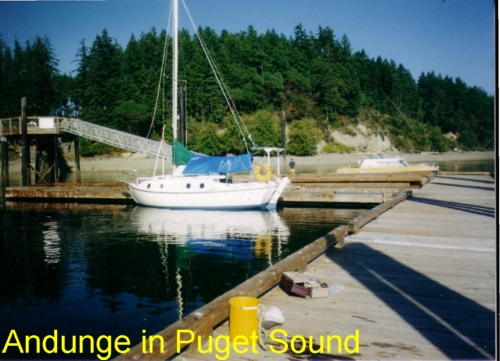
I did my share of armchair cruising from a small farm tucked into the Chehalem Mountains of northern Oregon. During this period of little cash, I formed a rather detailed picture of a thirty-some foot classic sloop that would carry us off to the southern seas.
At the same time I got on the water as best I could by building inexpensive gunk holers. It required a little patience and innovation but there was a simple, easy going beauty to these boats that enabled not only a carefree exploration of thin waters but also construction materials and design
.
When I finally set out with a healthy bank account I found it wasn�t the Cape Dory. Bristol or Alberg 30 that I wanted, but the smallest, simplest craft that fulfilled my needs. Reforming my ideas of the perfect cruiser had begun unconsciously and now I set about dining my needs on paper. A list, the first on many:
1. Seaboat- sisterships have made passages, strongly built and upgradeable.
2. Gunkholer-to explore juncture of sea and land. This was, after all, where I planned to spend my time.
3. Small-Anchor can be raised without mechanical aide, pushed off groundings,
sails easy to handle solo, easy to manage with sweep , leaves funds for unlimited travel,
less initial costs as well as upgrades and upkeep.
4. Big-Even more subjective, basically room to live comfortably for an extended
time-complete galley, food and water for several months, library, all tools an materials
for repairs, gear for diving, hiking, fishing-basic colonizer kit for independent
living wherever we should roam, small space to stand {possibly with head out companionway}.
5. Simple-no engine, few electronics, no thru hulls, no built in water tanks, no areas inaccessible
to repair or cleaning, able to careen, maintain and repair in the wild
Basically a blue water dingy that can hold a ton of gear and still be comfortable to live aboard. Few boats fit the list and fewer still fit me. The parker-Dawson was a candidate
briefly. She drew only 20� yet had crossed oceans. Roomy and well built with an interesting worm drive swing keel; I was excited to find one close to home. Unfortunately I found her lacking in one way or another as all the other candidates I was able to track down.
I had a rather long affair with the multihull idea and collected boxes of notes, owner reports and study plans. Eventually I drifted away. The closer I looked the more elusive the inexpensive cruiser became and the small beachables seemed too cramped, wet to sail and wouldn�t carry the load well. Further they are not known for their handiness and it seemed likely one would need to rely on an outboard to maneuver in tight quarters. It is a dream that dies hard and I still doodle out ideas.
While I had sailed a Hobie cat I�d never been on a twin keeled boat. Looking through old boxes of notes I came across articles by John Letcher which I had skimmed years before. This time I took a closer look at the Aleutka file. His philosophy articulated my thinking and his extensive travels in Aleutka bolstered my confidence in going engineless.
I had been aware of the twin keel concept but had not appreciated the ramifications. I took a closer look and discovered many of these gunkholers not only made passages but a tiny, 18 foot, Caprice had circumnavigated. Being and English phenomena, for the most part, many were not exactly common names on the west coast of the USA, but some had been imported and I began adding them to the list of potential candidates. It did seem the usually came up for sale on the east coast and I began to contemplated starting a journey there when fate handed me an alternate route.
The Westerlys are, perhaps, the best known twin keelers in the U.S., as a significant number had been imported to both coasts in the 1960�s. I had surveyed a Centaur and knew their reputation as a well built passage maker ( a local Centaur owner claims to have made four circumnavigations) but I was undecided and leaning toward the smaller Nomad as being more suited to my purpose. Patience with a little luck finally paid off; a Nomad became available just 150 miles away and I was first in line.
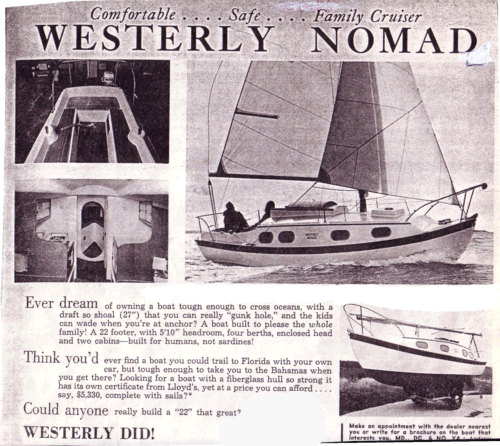
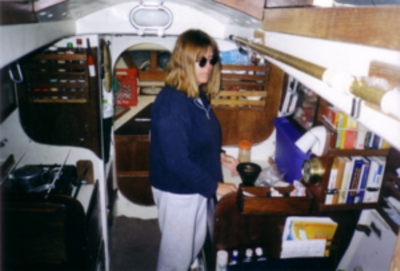
Down below she was a study in mold, headliner drooping and various parts scattered about, but the companionway, bulkheads, and furniture were constructed of African teak; even in the dim, green filtered winter light I could see it could be a warm, snug, yet roomy cabin where one could spend some time. I could not only stand to dress and cook, but walk fully upright to the forward hatch. She felt more like a 27 footer, though as usual, the ice bin, sink and number of bunks were laughable.
Below the water line she had the typical Westerly osmosis and I confirmed a tendency to display excessive weather helm, but I was prepared for these problems. All in all she stood in sharp contrast to the craft that fill most marinas, and, except for the twin keels, almost perfectly fit the ideal boat I had in mind. I bought her without hesitation.
For the next two years I spent almost all of my time with her and slowly she came back to life. Fortunately I was part owner of a yard and I was able to move her indoors before winter arrived. Despite being stored outside all those years, the lower hull and blisters seemed bone dry. Nevertheless I let her dry another six months after stripping all gel coat below the water line. I also removed all gear, paint, caulk, ports above, as well as the interior lining, cooler, sink, etc. Additionally the deck was prepped for resurfacing as the gel coat and textured pattern were well worn.
Two years may seem an inordinate amount of time to lavish on customizing a 22 footer. Perhaps, but I think not. Actually I feel it is the accounting of dollars and hours that is out of place in an affair such as this. In the end it is patience, a patience born of total involvement that gives the tenacity to see each project completed to the highest standard. Confronted with a boring list of numbers my eyes tend to lose their focus and I�m off sailing sparkling blue waters somewhere beyond time and money.

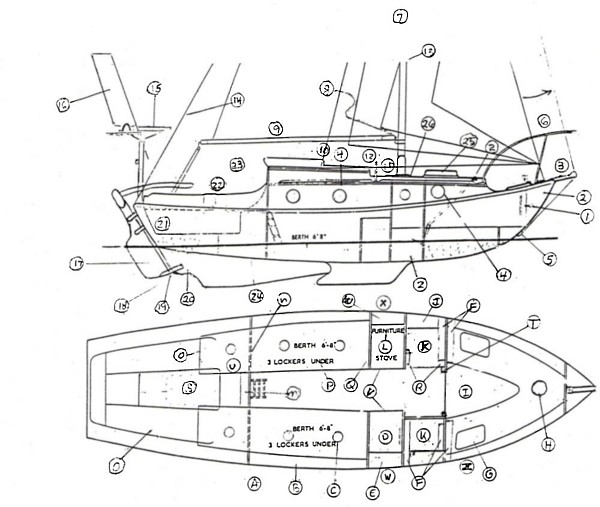
EXTERIOR UPGRADES
1. Samson post bonded solidly to new bulkheads (as in w-22).
Chain locker moved aft
2. Chain pipe that dropped chain into forward bin removed. Chain length increased to
200 ftd. of � � and a removable PVC pipe installed to put the chain over the keel.
3. Custom, heavy duty bowsprit/anchor holder with roller. The forestay was brought
forward 16�. Both medium sized anchors housed beautifully here, held tightly in place
with just a quick release pin.
4. All old ports which had automotive type gaskets were tossed. The area was reinforced
with FBG/ ply composite and new round ports of 1/4� Plexiglas were installed. Only the
three opening ports were left intact.
5. The backing plate for the bobstay snugged into a thickened epoxy gusset to spread the stress in all directions.
6. Bow net and several octopi installed for easy headsail change. A real blessing on rough nights.
7. Masthead tri installed. Deck level lights were left intact as back up.
8. New heavy duty gooseneck.
9. New boom with slab reefing gear to replace roller boom arrangement.
10. Vang added (also used to raise dink and with longer line it raised mast or myself to masthead).
11. Substantial dingy choks. Dink (the forward half) acts as seahood when snugged down to ten eyebolts.
12. Propane tank moved out of cockpit locker to under dink. When dink alongside and cockpit tent not up
I used a small tarp to protect the tank from direct sun.
13. Mast coated with Pellucid, a rock hard clear coating that looks like it may live up to the
manufacturers claims.
14. Backstay split and two new chainplates added. Although the Nomad was strongly built I reinforced
this area to absorb the new stresses.
15. Siemans 75 watt pv unit. Provided all light and radio with watts to spare.
16. Windvane from John Letcher and Bill Belcher plans.
17. Mahogany rudder with NACCA 0024 foil that replaced old poorly supported slab
which would stall at about 10 degrees. More lift at wider range of angles.
17b. Tiller replaced with heavier custom job that socketed into rudder head
18. After calculating and recalculating rudder forces I finally had a foundry cast
an oversize set of pintles and gudgeons. They cost more than most boats I built,
but at least the weight was low.
19. Delrin plug to keep lines from sliding into slot ahead of rudder.
20. Skeg-a mahogany blank was glued to the hull, shaped, then FBG in with 9 oz and 4 oz cloth.
The inside of the hull was reinforced to spread stress throughout stern. Note: Spent a lot of
time and thought in the stern area. There were some tradeoffs as the wetted surface increased
by 4% and moved the clp aft some 2.7� while the net movement of rudder c.e. was only 2� aft.
21. Lazarette with water tight lid and take apart hinges. Storage increased and well sized decreased.
Underseat access FBG over.
22. A second hatch cover/ table provides storage for at anchor items and further reduces cockpit volume.
23. Rebuilt companionway with laminated mahogany and added strong hasp on 1� solid drop boards
of African teak. The old 1/2� hardwood ply board were kept as spares
24. Removed all thru hulls. New drains well above wl aft for cockpit.
25. The hatch was reinforced substantially and a baffle was installed around her. A second,
heavier set of tie downs added inside. She never leaked a drop.
INTERIOR UPGRADES
A. Overbunk chart drawer/table that can be left open for quick reference from the cockpit.
B. Shelves of teak, mahogany, and oak added in every available location.
C. Beckson plates replace fingerhole ply locker covers. Adds some 17ftCube watertight volume.
The area over the keel held about 200 cans of food.
D. Old sink an icebox pretty useless for cruising. New cooler with 4� of best foam
(also ads 3.5 cuft flotation).
E. Hanging locker, only furniture retained from the Nomad layout.
F. Hanging lockers wherever they�d fit.
G. Lockers converted to water resistant with wing nuts and gaskets. P&S. Only once did I feel the
need to �batten the hatches� and that was early on.
H. Water tight (Beckson like) hatch. The compartment was heavily reinforced on inside with many
layers of 9oz. cloth, then �� FBG ribs. The chamber was then filled to water line with a
dense foam. The remaining space held some 1300� of �� and 3/8� line.
I. Top loading anchor locker with a place for four anchors, anchor retriever, shackles, swivels, wire,
and tools in pocket.
J. Top loading lockers P&S with optional batten down option.
K. Water resistant locker P&S. Deep storage for food and some 15 gal. Water. Also 200�
of �� chain over keel.
L. Shelf behind stove with fiddle and bungi to hold a few days supply of all often used food items.
M. Water tight barrier between aft area and cabin. Shelves built to utilize old engine space and 4�
opening alongside ladder to operate a whale Gusher bilge pump without removing ladder.
N. Shelves P&S for things needed underway e.g. binoculars, GPS, weather radio, hand bearing compass, etc.
O. Water tight hatch gives access to storage P&S. Generally I used strbrd for seldom used things
and port for things that might be needed fast (read-not packed so tight you�ve got to remove
everything to get what you want).
P. Bunk raised 2� and space below used to store charts and large cruising guides, books, etc.
Q. Small folding table. Funny how some small projects turn out essential and would be missed terribly.
R. Kitchen stuff-knife rack, sharpener, cutting boards, paper towel dispenser, etc.
S. Large water resistant locker under cockpit-deep storage including 35 ga. Water where engine sat.
Also in far stern 10 cuft. Foam
T. Area under mast reinforced with posts and FBG.
U. Canvas bags hang on eyebolts P&S.
V. Pots, pans, galley gear under stove.
W. Bread Box-13 gal plastic bin with tight fitting lid just happened to fit neatly under hanging locker
(E) behind fiddle. Water tight, bug tight, not real pretty but a good use of space, handy and
used daily. Cost less than $5 almost anywhere.
X. Locker port side under (L) accessed from Beckson plate in bulkhead at head of bunk.
Y. Foam to water line thru out bow and stern. Between bow and stern ten water tight,
or top loading water resistant compartments.


Trials
One midsummer day I launched Andunge a stone�s throw from where she had sat for eight years. It was a beautiful day but memories of a 17ft lug rigged boat I�d built some years before were dredged up. Despite careful calculations I would find my creation on that launch day seemed perfectly unbalanced. Fortunately I had left the mast and lee board just clamped in place for those �minor adjustments� and she did sail quite well, eventually, but not until many adjustments had been made.
These thoughts were on my mind as I tuned the rig and organized the lines. Perhaps going over one�s worst experience is helpful in some ways. I checked wire tension at least twice with steel tape and then checked once around by hand. The recommended rake, 5�, was checked and rechecked. I could find some adjustment with the rake but it would not be like that little 17 footer.
The next morning I set off solo, sculling silently through the crowded harbor. I�m happy, perhaps even a little smug, with the speed and control the $25 power plant gives me. Once in the channel I raise sail despite very light and variable conditions as I want to be assured of getting through the narrows before the flood set in.
Finally, mid-morning, a steady wind comes abeam and fills the sails. I notice the topping lift needs adjustment so I tie off the tiller and go ahead to the mast. From here I study the sails, mast, rigging and back to the wake. She�s still tracking straight as an arrow so I take my time and tidy up the lines, then continue forward to the bow.
The wind is slowly building, but the sea is still flat with just the slightest, �swell� on the nose. Standing on the bowsprit, leaning on the pulpit I watch and feel her charge ahead. I look up to the horizon to try and pick out details as a wonderfully warm mid-August breeze caresses and I feel the anxiety melt away. She sails O.K. and I can almost make out palms and white sand ahead.
We wander the sound for six weeks of what I have called a shake down but we did little shaking and a lot of just lazing along. Of course one cannot sail about without becoming acquainted but if I�d wanted a rigorous test I should have gone offshore. The one small craft advisory that comes thru tops out at 25kt and, in the confines of the inlet, 2-3 ft seas. I did provide some entertainment to onlookers as I tried to snag a buoy in gusty, tight conditions however.
Following a six month's sail in Mexico I�ll report on what worked, what didn�t and what I wished I had.