
World History E-Core
Period 5
1 December 2004
French Revolution
Time Line done by Megan Mallory
The Old Regime: Reign of King Louis XVI (1774-1792)
Marie Antoinette � �The stories of Antoinette's excesses are vastly overstated. In fact, rather than ignoring France's growing financial crisis, she reduced the royal household staff, eliminating many unnecessary positions that were based solely on privilege. In truth, Antoinette and Louis were placed in harms' way not only by elements of their personalities, but by the changing face of political and social ideology in the 18th and 19th centuries.� - http://www2.lucidcafe.com/lucidcafe/library/95nov/antoinette.html
Cardinal Fleury (1653-1743) � �Andr�-Hercule de Fleury (1653 - 1743) was tutor to the young King Louis XV. He was made a cardinal in 1726 and became in effect Prime Minister of France. Louis left government in the hands of his ministers, the Duke of Bourbon and Cardinal Fleury.� - http://www.nationalgallery.org.uk/cgi-bin/WebObjects.dll/CollectionPublisher.woa/wa/work?workNumber=NG903
Financial and administrative problems � �French citizens rose against their monarch, Louis XVI, eliminated the ancient legal distinctions based on social class, and established a republican government. The French revolutionaries invited all of the peoples of Europe to follow their example. Conservative monarchs throughout Europe were hostile toward the revolution. Within a few years wars broke out between France and a number of European powers.� - http://encarta.msn.com/encyclopedia_761553483_13/United_Kingdom.html
Demands of the Nobility � �His measures to curb the power of the great nobles aroused (1465) the League of the Public Weal, headed by Charles the Bold, son of Philip the Good; Francis II, duke of Brittany; Jean, comte du Dunois; Antoine de Chabannes; and the dukes of Alen�on and Bourbon, under the nominal leadership of the king's brother Charles. The lesser nobility, the bourgeoisie, and the lower classes supported Louis, who also allied with the citizens of Li�ge, a Burgundian protectorate, against Charles the Bold. Louis successfully defended Paris, but in Oct., 1465, he granted the demands of the rebels in the treaties of Conflans and Saint-Maur-des-Foss�s. He soon violated the treaties, taking Normandy from his brother Charles, to whom it had been granted.� - http://www.factmonster.com/ce6/people/A0811490.html
Identify "Jacques Turgot" (1727-1781) � �His most famous work, "Reflections on the Formation and Distribution of Wealth" (1766), comprised only fifty-three pages. Among other works written during Turgot's intendancy were the M�moire sur les mines et carri�res, and the M�moire sur la marque des fers, in which he protested against state regulation and interference and advocated free competition. At the same time he did much to encourage agriculture and local industries, among others establishing the manufacture of porcelain.� - http://en.wikipedia.org/wiki/Anne_Robert_Jacques_Turgot,_Baron_de_Laune
Identify "Jacques Necker" (1732-1804) � �Necker wrote his famous Trait� (1784), one of his better treatises. Necker was appointed minister of finance by the new regime, but went into retirement at his Swiss estate soon afterwards. He returned to Paris in 1792 to make a passionate plea before the National Assembly to spare the life of King Louis XVI. He was the father of the legendary Germanophile writer and salon-mistress, Madame de Sta�l.� - http://cepa.newschool.edu/het/profiles/necker.htm
Explain Louis Reign � �He was 20 years old when he came to the throne. His greatest fault was that he was always ready to listen to others and follow their advice. Immediately after he was crowned, Louis remitted some of the most oppressive taxes and instituted financial and judicial reforms. Calonne was appointed finance minister in 1783. He borrowed money form the court until 1786, when the borrowing limit was reached.� - http://www.angelfire.com/va/frenchrev/LouisXVI.html
The Estates General (1788)
First Estate - �The Clergy from the outset was established as a privileged Estate. The French Catholic Church maintained a wide scope of powers - it literally constituted a state within a state and it had sustained this position for more than 800 years.� - http://www.people.memphis.edu/~kenichls/1302FrenchRevolution.html
Second Estate � �The Nobility like the clergy represented another privileged Estate. The nobility held the highest positions in the Church, the army, and the government. As an order, they were virtually exempt from paying taxes of any kind. They collected rent from the peasant population who lived on their lands.� - http://www.people.memphis.edu/~kenichls/1302FrenchRevolution.html
Bourgeoisie- �This was originally the name for the inhabitants of walled towns in medieval France; as artisans and craftsmen, the bourgeoisie occupied a socioeconomic position between the peasants and the landlords in the countryside.� - http://www.bartleby.com/65/bo/bourgeoi.html
Proletariat � �During what Marx called the "socialist phase" of the revolution, the new proletarian government would confiscate all capitalist private property like factories, mines, farms, and other businesses. The government would then operate these enterprises for the benefit of the workers. When the proletariat finally controlled economic production, Marx declared that all classes would disappear and class struggles would end.� - http://www.crf-usa.org/bria/bria19_2a.htm
Third Estate � �This Estate ostensibly consisted of every one who was not a member of either the First or Second Estates. Totaling approximately 25 million people, the Third Estate was composed of the bourgeoisie, the peasantry and the urban artisans.� - http://www.people.memphis.edu/~kenichls/1302FrenchRevolution.html
Peasant life in France - �The bourgeoisie were influenced by the nobility and tried to imitate them whenever possible. So, they tried to improve their status by becoming land owners themselves. By 1789, the bourgeoisie controlled 20% of all the land. They were upwardly mobile, but they felt frustrated and blocked by the aristocracy, an aristocracy whose only interest was that everyone maintain their place in society.� - http://www.people.memphis.edu/~kenichls/1302FrenchRevolution.html
Gabelle - �This was a form of tax in France before the Revolution of 1789�in particular, from the 15th century onward, the tax on salt.� - http://www.britannica.com/eb/article?tocId=9035747
Corv'ee � �The Corv�ee was a certain type of tax for the peasants. It stated that they had to do public work for the city without pay to make up for the taxes that they cannot pay for. Because the peasants were very poor and could not pay taxes with their money, the government came up an arrangement for that.�
The Middle Class - The middle class was part of the third estate. They were also required to pay taxes. Most of them had fair jobs and received minimum pay for their work.
Urban workers - The urban workers were the ones who had the simple but resourceful jobs. They had to pay heavy taxes and do city work
King Louis XVI summons the Estates General (1788)
Identify "Elections for the Estates General" � �It is not idle comment to note that absolute monarchy in France died the day Louis XVI called for elections to an Estates-General. However, the convening of the Estates-General was not a revolution from below; rather, it was a victory of the nobility over the family Bourbon and the absolute monarchs.� -
Identify "Demands on the Monarchy"- There were several issues with the government and monarchy in France; King Louis XVI was a weak ruler. The people wanted food and the estates needed power and he did not know how to handle these revolts.
Voting By Order - Before voting was allowed, each estate would meet separately and would each give one vote to a subject of discussion. The first two estates would usually end up winning 2 to 1, leaving the third estate losing. A new system changed this; they all met together and vote. In this circumstance, the third estate would win by close number
The Third Estate proclaims itself to be the National Assembly (1789)
Identify "The Tennis Court Oath"- The Tennis Court Oath was the result of the dissatisfaction of the Third Estate in France. King Louis XVI was determined to hold on to the country's history of absolute government
Identify "Louis XVI versus the National Assembly"- the Third Estate declared itself The National Assembly. A few open-minded nobles and several clergy joined the movement of the Third Estate and helped them gain power. The National Assembly proclaimed itself the Constituent National Assembly. They now had the ability and power to declare law; their most important task was to create and adopt a constitution.
A Paris Mob storms the Bastille (1789)
Describe what happened - The people living in France were very angry with King Louis XVI because they felt that they were being taxed unfairly. They got organized into a mob and marched 10 miles to Paris to the Bastille where they thought weapons were being stored. In the effort to steal the weapons, they killed several guards and wounded even more.
Jacques Necker's restoration - Jacques Necker thought the taxation and the government was being unfair. He believed that the government should have a strong taxing system and new financial reforms.
Jean Bailly's promotion (1736-1793) - He was elected in 1789 from Paris to the States-General and was chosen president of the National Assembly. He was the Mayor of Paris from 1789 to 1791, but he lost favor with the popular elements that pushed the French Revolution forward and was beheaded on the 12th of November 1793.
Marquis de Lafayette's promotion (1757-1834) - Lafayette returned to France in 1782 and was a member of the Assembly of Notables in 1787. He became the States-General in 1789 anf was elected vice president of the National Assembly. He was made commander of the militia, later named the National Guard, the day after the fall of the Bastille (July, 1789).
How did the revolt affect most aristocrats?- Because the peasants were causing revolts and destroying cities, the aristocrats and other higher people either joined the third-class revolt, or left the city because they feared that they would be overrun and killed.
The Great Fear Sweeps the French countryside (1789)
Describe- The peasants started to realize that there were food shortages and economic depression and feared of an aristocratic scheme. So the peasants stole from and burned chateaus, destroying records of feudal taxes. This reaction was known as the �grande peur�, which meant �great fear�.
Effects- The nobles and clergy in the Assembly, afraid of what was happening and partly by a sudden occurrence of impracticality, gave up their privileges which destroyed the feudal structure of France in one night.
The National Assembly approves the Declaration of the Rights of Man and the citizen (1789)
Describe the Declaration of the Rights of Man- the Declaration of the Rights of Man and the citizens was accepted by the National Assembly of France August 26, 1789. This helped everyone gain more lawful rights; however, it did not give women any say in government and gave men power over women in many ways.
Declaration of the Rights of Women- Olympe de Gouges took the �Declaration of the Rights of Man and Citizen� and changed into in a way that she believed it should be so that it would represent the interest of women as well as men.
Mob Action (1789) - To make sure that the citizens of France actually received the rights they wanted, people got into mobs and stormed around lords� castles and destroyed them.
Political Clubs - The Jacobins, Cordeliers, and the Feuillants were some of the political parties that were created.
The Jacobins - This club was well-known to be the most drastic. It was formed in 1789 by the Breton deputies to the States-General. Later it was reconstituted as the �Society of Friends of the Constitution� after the National Assembly moved in October of 1789 to Paris.
The Cordeliers - This club was founded in 1790 as the �Society of the Friends of the Rights of Man and of the Citizen�. It offered a political base for Georges Danton and Jean Paul Marat. In 1792-93, after Danton left the club, it was involved in the destruction of the Girondists. After Marat's assassination the club was led by Jacques Ren� H�bert and it fell apart
The Feuillants - This club was founded in July, 1791, when the Jacobins that opposed the petition for the dethronement of the king broke off from that club and began to meet at the former Feuillant convent together. The Feuillants supported a constitutional monarchy and in March of 1792, Girondists helped overthrow the Feuillant ministry, which went against war in Austria.
The Civil Constitution of the Clergy (1789) - This constitution put the French Catholic Church under state control and the bishops and priests became elected as paid officials in France.
The National Assembly enacts the Civil Constitution of the Clergy (1790)
The Constitution of 1791 establishes a constitutional monarchy (1791)
Necker's resignation - In 1776, Necker, who had previously aided the government with loans, was made director of the treasury; in 1777 he was made director-general of finances. When his enemies at court again secured his dismissal in 1789, the populace, on July 14, stormed the Bastille in the first outbreak of violence of the French Revolution; Necker was once more recalled; his final resignation came in 1790.
Mirabeau- The year 1785 found him an exile in England, where he moved in Whig circles, but in 1786 he was sent on a secret mission to Prussia. He betrayed his government's trust by publishing his unedited reports to Paris, containing accounts of scandal and intrigue in the Prussian court. Despite his unsavory personal reputation, he found himself the spokesman of the third estate.
Mirabeau's death (1791) Meanwhile, he was increasingly criticized in the assembly, particularly by the Jacobins, who opposed his moderation; his political position was becoming untenable. He died in Apr., 1791, amid impressive manifestations of public sorrow and respect, for he had never lost his popularity with the masses. He was buried in the Panth�on, but his body was later removed when his dealings with the court were discovered.
Louis XVI and family flee but captured � In June of 1791, Louis XVI disguised himself as a valet, Marie dressed as a governess, the royal children and a loyal friend disguised to be a wealthy Russian employer. When they stopped in a small town, a former soldier recognized Marie Antoinette and they were caught.
Louis accepts New Constitution (Sept. 14, 1791) - Louis was forced to accept the constitution of 1791, which limited his power, but preserved the royal veto and his power to appoint ministers.
Other reforms of the National Assembly (1791)
Abolished titles of nobility - Nobles guilds were abolished. However they repaid the nobles for the land they lost due to the peasant revolts.
Reorganized local government- In order to make it more efficient, old Provinces were replaced. Areas were them split up into 83 equal departments.
Laissez faire principals- The government was structured in a laissez faire way which meant that they cannot get in the way with the work of the other people�s businesses
Legislative Assembly convenes (1791-92)
Conservatives- Conservatives captured nearly 85% of the seats in the national assembly, and �douard Balladur, a Gaullist, became premier. The elections in April, 1791 returned a majority of moderates and conservatives to the Constituent Assembly, and their measures against the radicals led to a new insurrection?the June Days, three days of bloody street fighting in Paris.
Moderates (centrists) - The foreign employment was ended in 1818; and France was again accepted into the convention of the great powers. The years of rule by the moderates gave way, however, after the assassination of the heir to the throne in 1820, to rule by the ultra-Royalists, and the succession of Charles X in 1824 brought an ultra-Royalist to the throne.
Girondists- Girondins, reasonable Republican faction active in the French Revolution from 1791 to 1793. They were called Girondins because many of their prominent members represented the department of Gironde, they were also named Brissotins, after Jacques Pierre Brissot, one of their leaders. The group first became known in the Legislative Assembly elected in October 1791.
Mountain - They were an assembly of people that included the Jacobins and the Cordeliers the ruled France during the Reign of Terror.
Intervention of Foreign Powers (1791-92) - In 1789 the French Revolution erupted. French citizens rose against their monarch, Louis XVI, eliminated the ancient legal distinctions based on social class, and established a republican government. The French revolutionaries invited all of the peoples of Europe to follow their example. Conservative monarchs throughout Europe were hostile toward the revolution. Within a few years wars broke out between France and a number of European powers.
Austria-Prussia Alliance - Austria and Prussia were Germans that came to an agreement to form an alliance for spreading the revolution and strengthening power.
France's Legislative Assembly declares war (April 20, 1792)- The constitutional monarchy that had developed by 1791 was as unacceptable to the king as it was to the increasingly powerful and vocal party called Jacobins. In the Legislative Assembly in 1791-1792 they and the Girondins, another party, restless for a republic at the same time as they, engineered a declaration of war against Austria (April 1792). When French forces suffered initial reversals, revolutionary temperatures rose even higher, and in September the newly formed National Convention that promptly proclaimed France a republic.
The Legislative Assembly deposes King Louis XVI and calls for the election of the National Convention (1792)
Liberty, Equality, Fraternity- This was a very famous quote that everyone used as a sort of �slogan� during the French Revolution. It represented how the people wanted to live and so it became their own personal slogan. It helped many realize what they really wanted in life.
Radical Takeover- When the execution of King Louis XVI was followed through with, the cities became a little disorderly. To solve these problems, the National Convention decided that the Jacobins and the Cordeliers should carry out the laws.
Robespierre- Maximilien Robespierre lived from 1758 to 1794. He studied law and was known for his honesty. He resigned as a judge so as not to give a death penalty. In May of 1793, Robespierre forced the Girondists out of the National Convention. This was because he opposed them and was an activist of democratic reforms. In July, he was elected a member of the Committee of Public Safety.
Danton-
Marat- Marat was a well-known physician who had been an essential revolutionary from the very start; because of his radicalism, he was soon exploited and hunted down and spent part of the Revolution hiding in sewers. From the sewers he contracted an incurable skin disease which required that he bathe constantly to ease the pain; it was while he was bathing, that a Girondists extremist named Charlotte Corday stabbed him to death in the early months of the Terror.
sans-culottes- There is a significant range of collective evidence of this kind, it is quite possible to differentiate between the politically orthodox, the parfaits sans-culottes revolutionaries as they would no doubt have preferred to define themselves, and the authentic rebels, a minority within a minority, most of whom were to suffer the fate set aside for ultra-revolutionaries who, according to official revolutionary logic, were but the other face of the Janus-figure of counter-revolution
King Louis XVI is executed (1793)
The Reign of Terror begins (1793)
Committee of public safety- The Committee of Public Safety was formed by Robespierre. From July 1793, to July 1794, he governed France through a dictatorship.
Jacobins- The Jacobins was a political club that was created in 1789 by Breton deputies and the State Generals. They met at the monastery of Jacobins and their purpose was to secure support for the elements outside of the Assembly.
Republic of virtue - Robespierre, the strong leader, believed that France could only become a republic of virtue if all of the criminals lose their heads. That is when he came up with the idea of using the guillotine as a way to execute criminals
Justification of extreme violence- Robespierre believed that every criminal should be sentenced to death, which changed the way of how people thought. People now believed that bad people should be killed, so they executed anyone they though were �bad�.
Revolutionary tribunal- The Revolutionary tribunal was when the new idea came up where they believed in quick court trials, in which they would quickly sentence the victim to death.
How many dead?- It is estimated that around 40,000 people were killed, included Marie Antoinette the queen. They were executed during the reign of terror. The Reign of Terror effectively ended when the National Assembly, whose members began to fear for there own lives, condemned its leader Maximilien.
The National Convention abolishes the monarchy (1792)
The War of the First Coalition is fought (1792-1797) - The war between most of Europe against France began; this was the first alliance among all of the other countries.
Lev'ee en masse- This was the idea that no single power could come to dominate the continent until the French lev�ee en masse provided the manpower that could overrun any alliance.
Coalition - Coalition is an alliance, especially a temporary one, of people, factions, parties, or nations. All of the countries in Europe except France were against France.
French military victories- the French military was very successful on their victories. They were strong and ready to attack so they became stronger and stronger so they won more of their battles.
Treaty of Basel- The Treaty of Basel forced Prussia and Spain out of the revolutionary wars.
The Thermidorean Reaction ends the Reign of Terror (1794)
9 Thermidor- The conspirators of 9 Thermidor, became known as Thermidoreans. This is the Year II, in the revolutionary calendar.
Guillotine- This was a machine used to execute people or otherwise known as �beheading�. Dr. Joseph Ignace Guillotine invented it because he believed that "axes were unreliable."
The National Convention drafts the Constitution of 1795 (1795)
Who controlled it? - The people who controlled the National Convention constitution was a group of people that consisted of a directory, or executive of 5 directors, and a 2 house legislature.
How was it controlled? - The directors would alternate their power from one director to the next after a matter of time. It was fairly reasonable.
Council of Elders - The Council of Elders was made up of older, wiser people. Their place in the government was below the 2 houses of legislature
Dissolving of the National Convention - Like another group, the National Convention became frail. It is believed that it fell apart because the National Convention was trying to rid themselves of all of the Christians in France and also believing that women are not as good as men.
The Directory begins to rule France (1795-1799)
Financial crisis- There was a major financial crisis during 1795-1799 because leaders were using the money that was suppose to be used toward the people for themselves; therefore, causing a financial downfall because no one is aware of where the money is actually going.
Corruption- The Directory became corrupt and chose not help the citizens when they needed the help; therefore, the citizens chose Napoleon to fix the mess they were in.
Exhaustion- The Directory was gaining a lot of power; however, it wasn�t really working out so the people were frustrated with how the directory was doing their job.
Army - While Napoleon was in power, the strength of the Army was stronger than ever. They would be able to defeat many countries and expend the empire. Napoleon was a very strong leader and pushed the army to be stronger.
Time Line done by Courtney McAffee
Napoleon Bonaparte is born in Corsica (1769-1821)
birth and childhood- Hated France because he was born when Corsica was perishing and after a lot of revolutionizing. Napoleon thought his father betrayed his Corsican heritage because his father submitted. Napoleons mother, Litesia, he was fascinated by her and he says she gave him good training in life and punished her children to keep them disciplined. Had two houses but stuggled to make money just to get by. Napoleon had a scholarship to a school in France. At fifteen he went to the Royal Acadamy of Paris and was in a military-type area. He became a soldier at sixteen.
physical stature (Napoleonic complex)- Napoleon was quite small in before his prime (5�11��). He had a rigid pose and would usually walk with one arm tucked in his coat.
marriage and political significance- He wrote a brief history of Corsica and even tried making novels. Was 23 and a fantastic revolutionary. He was a lieutenant in the Corsican national guard.In three months he rose from captian to general by proving himself against the British.
Early military successes (1796)-
Napoleon's army defeats the Austrians in Northern Italy (1797)- Napoleon Bonaparte went to battle with the Austrians and was given command to fight against the Austrians in Italy until he defeated them at Lodi, Arcola, and Rivoli.
Treaty of Campo Formio- On October 17 1797, Napoleon tried to make peace with the Austrians. In so doing, he drew up a Treaty of Campo Formio to end war with Austria in Italy.
1798-1799 French extend their control- Napoleon made many advances with the French. He expanded their borders and invaded Egypt, captured Malto and Alexandria and moved into Cairo. He also won at the Battle of Pyrimids as well as the
Battle of the Nile. He captured and defeated other cities and then moved on to Paris and the Proclomation of the Constitution was established.
Napoleon Fights his Egyptian campaign (1798-1799)
Napoleon's invasion of Egypt/ why?- Napoleon may have invaded Egypt for many reasons but Historians are not sure why. Napoleon Bonarparte�s main goal was to obtain more �glory.� He also may have wanted to conquer Egypt to be able to take control of the Indian Empire away from the British.
Rosetta Stone Discovery- Soldiers of Napoleon's army discovered the Rosetta Stone in Egypt in 1799. As part of the spoils of war, the French army turned the stone over to the British forces. The Rosetta Stone eventually made its way to the British Museum, where it resides today.
Battle of the Pyramids- The Battle of the Pyramids was a giant conquering by the French. They went into battle against two native tribes of Egypt and came out victorious.
Lord Horatio Nelson's role (1758-1805)- Nelson was against Napoleon Bonaparte and fought against him in the Battle of the Nile. He also called for a trade agreement between Napoleon and himself over Great Britain and Europe.
Battle of the Nile- Napoleon used his fleets of naval forces to force an attack on areas in Egypt. Due to lack of food and supplies Napoleon was obligated to either fight and die because of starvation or surrender and leave. This battle denied Napoleon his Eastern Empire and was considered one of his downfalls.
War of the Second Coalition is fought (1798-1801)
Describe the war and its participants- The war came with people from many countries. The odds were a lot to France and the Swiss. The Swiss became under French rule so they were on his side, The Spanish allied with France as well when they later fought Portugal.
Alliance against France- Many countries wanted to put an end to Napoleon spread across Europe and they did not want to lose anymore power or land during the Second Coalition so there formed a strong alliance of several countries against France. This alliance consisted of Britain, Austria, Russian Portugal, Naples, and Turkey which all gathered together and fought with their armies against Revolutionary France.
Napoleon's defeat of the Second Coalition- Napoleon came out victorious at the Second Coalition as he usually does. The war ended with two treaties that helped to bring about some peace.
Treaty of Luneville- In February of 1801, the Treaty of Luneville was written and made to make peace and put an end to the battling with the Austrians. On France�s end of the deal they had to pay for compensation of some things they�d done such as the Rhine princes as well as bring the King of Naples back to his ruling seat.
Treaty of Amiens(1802)- The Treaty of Amiens was a form of peace that Britain wanted with France and Napoleon allowed it. In this treaty, France had to give the Papal States and the Two Sicillies but also got to keep some lands of Piedmont and important places on the French side of the Rhine while Britain would surrender most of the islands in the West Indies.
Napoleon Bonaparte seizes power and becomes first consul (1799)-
How does he come to power?- A new type of government was formed and it was called the Consulate, Napoleon, of course, wanted more glory and he wanted to guarantee himself as first consul. He himself as well as some help worked to overrule the Consulate to insure power. Later the constitution was changed somewhat and Napoleon went from consul for life to emperor.
The Constitution of 1799- Napoleon and his helper, Sieyes, created a constitution that would allow them to manipulate it in such a way that they could gain more power. The constitution made it so that the nation would have an unselected Senate and legislatures who in turn would choose a few consuls.
Consulate- The consulate was the new way of government that was formed. It was not a well structured government and allowed leeway so that Napoleon could gain more power, the Consulate basically did not allow the people to choose their leaders but rather Sieyes stated �authority must come from above and confidence from below.�
The Concordat of 1801 establishes a reconciliation between France and the Papacy (1801)
What did it do?- The Concordat of 1801 was made the Pope at the time and the Papacy, Pope Pius VII, and Napoleon Bonaparte with France. The Concordat of 1801 was made to reestablished the Roman Catholic Church in France.
Pope Pius VII (1800-1823)- Pope Pius the VII was part of the papacy when the Concordat was brought up. It took three phases for Napoleon and the Pope to come to an agreement on reestablishing the Roman Catholic Church as the basis of religion in France.
Civil Constitution of Clergy- Because of the financial crisis that was going on, the national assembly seized some church lands and made the State in charge of church affairs. Many Clergymen were against this new form of government but were forced to sign it or be put under arrest.
Napoleon becomes first consul for life (1802)
The Napoleonic Empire / Map (1804)
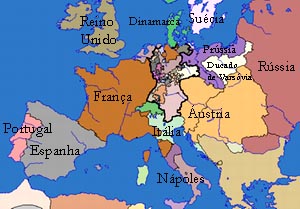
hereditary emperor- Napoleon Bonaparte was supposed to be emperor and the Pope was going to crown him but instead he placed the crown on his own head and declared himself king over France because he thought he was "higher" than the pope.
Eugene de Beauharnais (1781-1824)- Eugene de Beauharnais was the stepson of Napoleon Bonaparte. In 1804, Napoleon made him a general in his army, as well as prince and emperor of the Viceroy of Italy.
Napoleon's divorce 1809)- Due to political opportunities and social awareness in the fact that he needed a son to follow in his footsteps, Napoleon divorced. Napoleon�s divorce of Josephine led to marriage between himself and Mari Louise of Austria.
Archduchess Marie Louise (1791-1847)- Hoping for a son, and as well as political and romantic reasons, Napoleon married another wife, the Archduchess Marie Louise who was from Austria. Marie Louise did have a son named Napoleon Francis Joseph Charles Bonaparte who later became known as the King of Rome.
Napoleonic Administration- Napoleon created an Administration in benefit of the country and the administration was under the national government�s ruling power and authority. This Napoleonic Administration made equality be a major factor to the French government. One of these new laws was to tax citizens based on equality with no exceptions pertaining to wealth or social/economic status.
Financial Reforms- The financial arrangement shifted under Napoleon�s leadership and was improved through a series of reforms. He collected the taxes of the people and formed an unbendable economy, one way this was possible was through the Bank of France which was made available in 1800.
Centralized Government- Napoleon centralized the government of France and the local governments were made lesser to the central government. Each town had a Prefect and sub-prefect to rule under Napoleon.
Napoleonic Code 1807 (into effect 1804)- The Napoleonic Code was one of the greatest things produced during Napoleon�s time. This code required to make French law completely uniform. It was based on two ideas: that all men are equal under the law, women were considered exceptions, and all people have a right to property. In the earlier code it eliminated all privileges from the laws, including tax laws. The following code expounded on various laws to ensure the posterity of private property.
Educational Reform/ University of France (1806)- Aside from political and financial reforms, Napoleon Bonaparte made educational changes as well. He recognized the need for more schools and he placed them in areas in need of educational opportunities. The government was in charge of the schools being run and the University of France was made in 1806.
Napoleonic Wars (1805-1815)-
War of the Third Coalition (1805-1807)- The Third War Coalition was the emperor of France�s goal to unite the French fleets of ships that were scattered throughout Toulon and Brest. This was considered one of the greatest naval battles in Napoleonic time.
British Naval Victory at Trafalgar- The British Naval Victory at Trafalgar was one of the most decisive naval battles in history. This victory all began when Napoleon considered battling the British.
French Victories on Land- Napoleon was also victorious outside of naval battles. He also made victories and conquered many contributing to the French victories on land against Turkish and British troops.
Napoleon creates the Confederation of the Rhine and abolishes the Holy Roman Empire (1806)
Describe what it did.- The Confederation of the Rhine was made to protect certain nations that decided to ally with the French. These nations decided to be on the French�s side
Treaties of Tilsit- This treaty established France and Russia as allies and divided Europe between the two. This made a decline in friction between other countries yet also caused some discontent.
Tsar Alexander I (1801-1825)- Alexander I was the emperor of Russia during Napoleon�s time. He thought that Bonaparte was a �shifty Byzantine�, and called him the Talma of the north.
King Frederick William III (1797-1840)- William the III was also involved in the Third Coalition and he was actually against napoleon. Although he was against him, he thought of him as �the only man in Prussia.�
Napoleon's brothers Kings � Jerome was declared King of Westphalia, Louis was King of Holland, Lucien became prominent as president of the Council of Five Hundred and became King of Canino, and finally Joseph was King of Spain. All of his brothers wanted to become kings because they thought it was their right.
Joseph (1768-1844)- Joseph was in the Directery and the Council of Five Hundred, he was later declared King of Spain because he protested over being left out of the line of succession.
Louis (1778-1846)- Louis was King of Holland and was Napoleon Bonaparte�s second youngest brother and also wanted to be in on the goodness of being in the line of succession.
Jerome(1784-1860)- Jerome is Napoleon�s youngest brother and the last on in the line, he was the King of Westphalia.
Napoleon establishes the continental system (1806)
Describe what it did.- The Continental System was Napoleon's attempt to stop Britain's export and re-export trade with Europe and it was outlined in two Decrees issued by the Emperor.
Berlin Decree of 1806- The Berlin Decree of 1806 was concerning the British blockade of merely commercial ports was opposing to global law, Napoleon retaliated by setting up the British Isles under blockade and forbidding any trade to or from them
Milan Decree 1807- The Milan Decree allowed the French warships to capture neutral vessels that would be sailing from any British port or from countries engaged by British armies.
The Peninsular War- Arthur Wellesley was one of the best soldier of his time, other than Napoleon. He was smart as far as militarian trade and he knew the art of war and the techniques of strategies.
Conflict on Other Fronts(1808-1810)
Austria- Austria was just one of the many nations that Napoleon chose to battle against during the Napoleonic Wars. As a result of these wars Austria greatly suffered and was a lowly European state.
Battle of Wagram (July 1809)- Napoleon learned from his last battle and made it up to his nation at the battle of Wagram. In this battle he defeated Wagram and this battle also influenced Austria.
Treaty of Schonbrunn (Oct. 1809)- The Treaty of Schonbrunn was a treaty of peace that was made between France and Austria, which forced Austria to give up a lot of land and it also made them unite under the Continental System.
Plans to restore the French Empire in America (1803)- France was trying to establish a French Empire in America. They had plans and followed through with them by purchasing land such as Louisiana.
Louisiana territory (1803)- France bought Louisiana around 1800 but Napoleon Bonaparte realized that keeping Louisiana was not worth the cost and so he sold it to the US in 1803.
War of 1812
Describe the happenings of the War � America had a war to fight for their newly found independence in the War of 1812. They fought with France at their aid and had victory against the British.
Napoleon fights his unsuccessful Russian campaign (1812)
Invasion of Russia- Napoleon gathered an army together and entered Russia because they had broken off from the alliance. Napoleon realized that he would not be able to clothe and dress 600,000 men so he left Russia.
Prince Mikhail Barclay de Tollay (1761-1818)- Prince Mikhail Barclay de Tollay was a prime minister. This man was very powerful yet he was against Napoleon through all his dealings.
Marshal Mikhail Kutuzov- Kutuzov was a follower of Prince Mikhail Barvlay de Tollay and he later got to take his place after Tollay died. He also became powerful and was also against Napoleon.
Battle of Borodino- In this battle Bonaparte lost about 30,000 men because he was to ignorant to listen to the signs of war. He went into this battle with less weapons and provisions than the Russians which led to the loss of many men.
Grand Army entered Moscow- When the Grand Army entered into Moscow there was a significant difference of the two sides of the war. The French under Napoleon�s rule did not have enough food or provisions to last them through the battle.
French Retreat (Oct 19, 1812)- Napoleon realized that they were at a disadvantage in this war. He finally decided that they should retreat because they would not be able to make it through the war.
Russia, Prussia, and Austria defeat Napoleon in the Battle of Nations (1813)
Battle of the Nations- After the battle in Moscow, Napoleon�s empire basically went downhill from there. After noticing his loss, Russia, Prussia, and Austria form an alliance together and defeat Napoleon in the Battle of Nations in 1813.
Napoleon abdicates and goes into exile on the island of Elba (1814)
Describe Napoleon's exile.- Due to his downfall and destruction Alexander the I and others decided to exile Napoleon so he could stir up no more trouble. They sent him to Elba to live the rest of his life.
Louis XVIII (1814-1824)- Louis XVIII was the next leader to take the empire of france and he ruled as King. He stayed in power up until Napoleon came back out of exile.
Napoleon returns to power, beginning the Hundred Days (1815)
Describe the 100 Days- The Hundred days is also known as the Waterloo Campaign which started on Maarch 1st which was the day Napoleon arrived in Paris and June 28 which is when Louis XVIII returned as King.
Napoleon is defeated at Waterloo (1815)
Describe the Battle of Waterloo.- The battle of Waterloo was the decisive battle for Napoleon Bonaparte in which he lost and Louis the XVIII was returned to power as the king.
Duke of Wellington- The Duke of Wellington was against Napoleon Bonaparte and he helped to bring Napoleon�s final glorified days to an end.
Gebhard Von Blucher (1742-1819)- Gebhard Von Blucher aided the Duke of Wellington to the destruction and capture of Napoleon Bonaparte and saw to it that Napoleon no longer fought them again.
Napoleon dies on Saint Helena (1821)