Depending on the degree the colonist control their environment they
will be able to:- build habitats out of weaker materials, avoid the need
for emergency measures in the event of a depressurization, be able to walk
around without thermally insulated cloths, be able to walk around without
pressurized suits and breath the Martian atmosphere.
The purpose of this project is to develop engineering tools so if the
residents choose to increase the atmospheric temperature they can do so
in the most economical fashion.
A prerequisite for this understanding is to learn how greenhouse gasses
change the spectra of light that travels through it. A lot of insight can
be gained by studying the fraction of light is transmitted through a region
of gases per wavelength. The resulting graph from this study is called
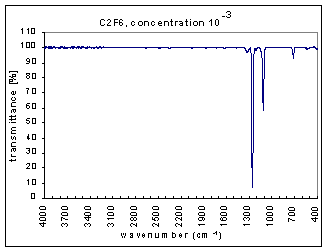
a transmission spectra. The spectra bellow is from the NASA
Student Project on Supper Greenhouse Gasses.
In this project this data was used to construct an application that can extrapolate transmission spectra outside of the domain of the supplied empirical observations. A screen capture from the resulting application is shown bellow.
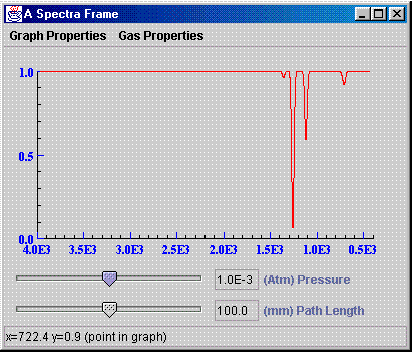
The application is set up generally enough so that various models of light absorption can be used. This is done by making all object wich are drawn implement the Interface FunctionRtoR. All objects that implement this interface are guaranteed to have the methods:
double getY(double x);
float getY(double x);
If the method getY(...) is not defined at any value x it will return NaN. Each of the graphed objects also implement the interface Paint. This allows the objects to be drawn. Another useful interface that the graphed objects implement is OPDistrubtion. This interface has the method:
void update(GasProperties g)
This method allows the function to change the value of y it returns for a given x to reflect a change in the state of the gas.
Ultimately it is hoped that the application will allow the user to select between various models of light absorption. One such model is The Fog-McKay gray opacity model. In this model empirical and theoretical information is used to construct empirical equations that will give the effective amount of light that was absorbed by the planets atmosphere from the Martian thermal emission. In this context effective is taken to mean equivalent planetary warming effects given that all solar radiation which made it to the planets surface.
This McKay-Fog model can be included by adding an additional gas property to say if the light is from a thermal planetary emission or a solar emission. The combined effect of the Mckay model is a multiplier of the form 1-tau where tau is the gray opacity. This multiplier will only be included if the light source is a planetary thermal emission. Alternatively the Mckay-Fog model could be included by adding an equivalent absorption band over the infrared region of the gas. In this alternative the multiplier would only be applied over the infrared region. The value of the tau in both cases will be relatively close.
The complete spectra is a composed of members of the class OPDistrubtion. An object that is a member of the class OPDistrubtion distribution could be:- constructed from the transmission spectra for a region of air on earth, constructed form the McKay-Fog gray opacity model for a planetary emission, or even constructed from a single transmission peak observed from a gas in a lab. The spectra is represented by an object of the class Spectra. An object of the class Spectra is an OPDistribution.
 (1)
(1)
dI- The change in intensity
I- The intensity
Io- The initial intensity
l- length
lo- The initial length
tau- the instantaneous opacity
The concept of instantaneous opacity can be generalized by considering the quantity of gas the light traveled trough, instead of the distance the light traveled in the gas. Under these circumstances we obtain equations of the form:
 (2)
(2)
k- is a constant (may or may not be unitless)
rho_A- is the mas per area the light traveled through. The area is measured perpendicular to the direction the light is travailing. (Note the volume of consideration is the Cartesian product of the perpendicular area and the path the light took)
tau_z is defined so that dI=(Io-Io*tau_z*dz)-Io
This preferred model works when the percentage variation the instantaneous opacity divided by the density remains small. In cases where this is not suitable for a given gas the model is general enough to include other models. However when several data points are available the value of tau_z can be interpolated between different states. This interpolation forces a fit of the preferred model in the rare case a gasses value tau/rho may very significantly in the domain of consideration.
The value of tau varies with the wavelength of the light. The variation
of tau with wavelength is implicitly taken to be gaussian when the wavelength
is sufficiently close to the peak. However, absorption peaks are fit with
guassian curves instead of tau for simplicity. This is an acceptable approximation
because the distribution of the absorption divided by the path length approaches
the distribution of tau as the length approach zero. (Note similar arguments
can be made for tau_z.
In the preferred model the gaussian fit to the peak is used to calculate the distribution of tau with wavelength. The distribution of tau with wavelength is then used to extrapolate changes in the distribution with respect to z.