Assessment of the likelihood of Being in a Dome that is Struck by a Meteorite.
Introduction
As the planers of a community we must evaluate possible sources of danger
so we can prepare against them. A community on mars is closer to the asteroid
belt and has less atmosphere. Consequently the risk of an asteroid puncturing
a surface structure is greater.
The most common meteorites come from the dust in the tail of a comment.
These meteorites are typically the size of a grain of sand. Since mars
has a limited atmosphere it should provide adequate protection against
these shower meteorites.
The other type of meteorites are called sporadic meteorites. These are
the meteorites that arrive randomly. On average these meteorites hit the
earths atmosphere at a rate of 8-10 per hour. One source of these meteorites
is collisions between asteroids. The goal of this paper is to gain incite
into the constraints (if any) that the frequency these meteorites hits
the Martian surface imposes on the design of a Martian community..
Assumptions
To begin our analysis we assume:
-
The probability of where the meteorites hit is independent of the location
on the planet.
-
The probability of a n meteorites striking a piece of land in a time delta
t is independent of the number of meteorites that hit previously in time.
-
There exists a parameter alpha such that for any short time interval of
length delta t, the probability that exactly one meteorite hits the surface
is alpha * delta t + o(dealt t)
(note o (delta t) is the error term and o(delta t)/(delta t) approaches
zero as delta t approaches) zero.
-
The probability of more then one meteorite striking an area of the surface
during delta t is o(delta t)
With the above assumptions the probability of n meteorite hits is given
by a Poisson distribution.
 (1) (1)
n The number of occurrences
lambda The average number of occurrences.
P(x; lambda) The potability of n occurrences for a given lambda. |
And Lambda is given by:
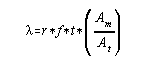 (2) (2)
r The average rate meteorites hit the atmosphere of mars.
f The fraction of the meteorites that hit the atmosphere of mars
that make it to the surface
Am The surface area of mars
At The area of the place on the surface we wish to know
the probability of a given number of meteorite hits.
t The time interval of interest |
Evaluating The Risk
For some incite we may choose the following values.
| t 80 years |
(The average age of a human)
24*365.2422= 701265 hours |
| At 31416 m2 |
(The area of a dome with a radius of 100 m. People will
not likely be in domes much bigger) |
| r 10 per hour |
(This is the average rate at which meteorites hit the
atmosphere of earth). |
| f 0.01 |
A wild guess but I wouldn't expect more then 1% of the
meteorites to make it through the Martian atmosphere. |
| Am 1.447*1014 m2 |
pi*d^2=pi*(6787000) m2 |
For these numbers we obtain lambda=1.218*10-5
With this lambda the probability of a meteorite hitting a dome with
a 100 meter radius in an 80 year period is 0.001%. Table 1 gives the probability
of n occurrences for a given value of lambda. The reader is free to choose
his own numbers to calculate what he/she feels is a more reasonable number.
Table. 1 The probability (%) of n Occurrences for a given value
of Lambda.
| Number of Occurrences |
Lambda |
| 10-03 |
10-04 |
10-05 |
10-06 |
10-07 |
| 0 |
99.9 |
99.99 |
99.999 |
99.9999 |
99.99999 |
| 1 |
9.99*10-02 |
9.999*10-03 |
1*10-03 |
1*10-04 |
1*10-05 |
| 2 |
4.995*10-05 |
5*10-07 |
5*10-19 |
5*10-13 |
5*10-15 |
| 3 |
1.665*10-8 |
1.667*10-11 |
1.667*10-14 |
1.667*10-17 |
1.667*10-20 |
Conclusion
Assuming:- the rate meteorites hit the Martian Surface is comparable to
that of earth, a person spends 80 years in a 100m dome and 1% of the Meteorites
that hit the Martian atmosphere make it to the surface: the likelihood
that person will be in a dome that is struck by a meteorite is0.001%.Most
people will not:- live for 80 years. They will also not spend most of their
time in large unprotected structures. As a consequence they are unlikely
to be in a structure that is breached by a meteorite. Even if we were to
assume that all of the meteorites made it through to the Martian surface
a 100 m in radius dome still only have likely hood of 0.1% of being struck
in an 80 year period. The likelihood of multiple strikes in an 80 year
period approaches zero. We should expect that domes will be practical to
build and on average should last some time without rupture from a meteorite.
The safety of people can be addressed by ensuring if a rupture occurs that
suitable time will be given for people to evacuate.