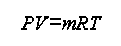
 (1)
(1)
There are three types of domes to consider. The first type of dome contracts well the dome deflates. The second type of Dome maintains its shape during deflation. The third type of dome maintains its shape until the air pressure can no long support its weight. We will consider in our analysis the second type of dome.
For any of the domes to give settlers a hope of escaping during depressurization it is necessary for the fabric to be rip stop. It is also necessary for the hole to be of a similar size as the puncturing projectile. Each of these tasks are easily within our current abilities of material science.
At Martian atmospheric pressure and temperatures the major component of gasses people live in follow the ideal gas relationship.
(1)
P=The pressure of the gas.
V=The volume of the control volume.
m=The mass of the gas in the control volume.
T=the temperature of the gas in the control volume
R=The ideal gas constant (note this depends on the gas)
Rearranging (1) and differentiating with respect to mass we find:
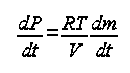 (2)
(2)
The rate gas is discharged out the hole (kg/s) is given by:
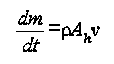 (3)
(3)
Ah=the area of the hole
v=the velocity of the gas
In the worst case there is no friction impeding the flow of gas out
the whole. In this case the energy per mass of gas following a streamline
remains constant. This is expressed in Bernoulli's equation.
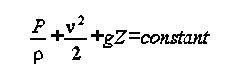 (4)
(4)
P pressure
v velocity
g acceleration due to gravity
Z height.
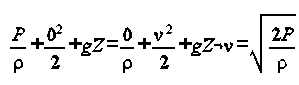
If we follow the streamline from a place where the velocity is low to a place where the pressure is low and we get:
 (5)
(5)
Where v is the average velocity of the gas just after it left the dome, P is the Pressure inside the dome and rho is the density of air in the dome. (2), (3) and (5) give after some algebra:
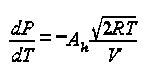 (6)
(6)
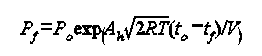
Solving the differential Equation we get:
 (7)
(7)
to, tf the initial and final time respectively
Po, Pf the initial and final pressure respectively
or equivalently:
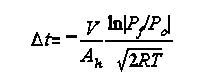 (8)
(8)
In the case of a dome we can replace V by (2/3)Ad*r giving:
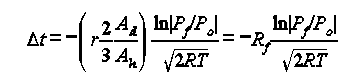 (9)
(9)
Results
Figure 1. Contains the percent depressurerization vs time for various rip factors. Table 1. Puts the rip factors in perspective. Table 2. Gives some conversion factors. It is assumed the gas in the dome is of similar composition to air (R=0.287). Any breathable air mixture will give similar results. Figure 3. Shows the effect of temperature. The code to graph figure 1. And figure 2 is shown in appendixes one and two respectively. Appendix 3. Gives some properties of various ideal gasses.
Table 1.
| Condition | Rf | Discharge time order |
| hole radius 10 cm
dome radius 4m |
4.2e3 | ~1 minute |
| hole radius 1 cm
dome radius 4m |
1.1e5 | ~ 1 hour |
| hole radius 1m
Dome radius 1km |
6.6e8 | ~1 month |
| hole radius 100m
dome radius 100km |
6.6e10 | ~1 decade |
| hole radius 10m
dome radius 100km |
6.6e12 | ~1 millennium |
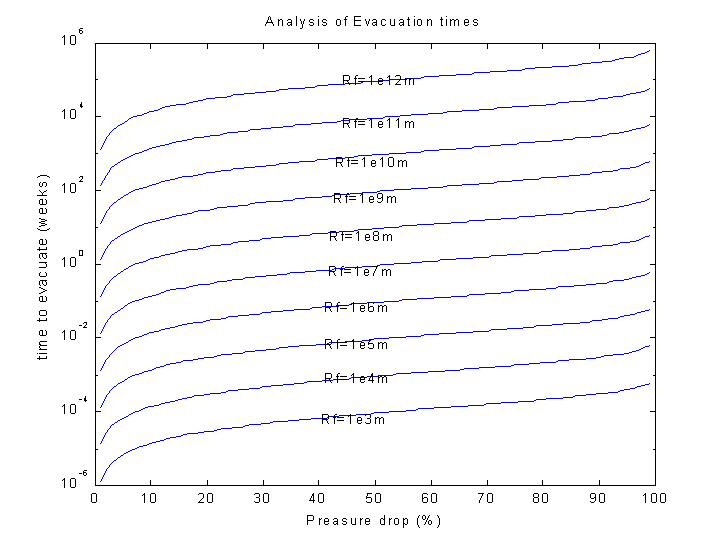
Table 2. Conversion Factors:
| 6.048e5 seconds/week
1.008e4 minutes/week 1.68e2 hours/week 7 days per week 1 week per week 1.917e-2 years per week |
Discussion
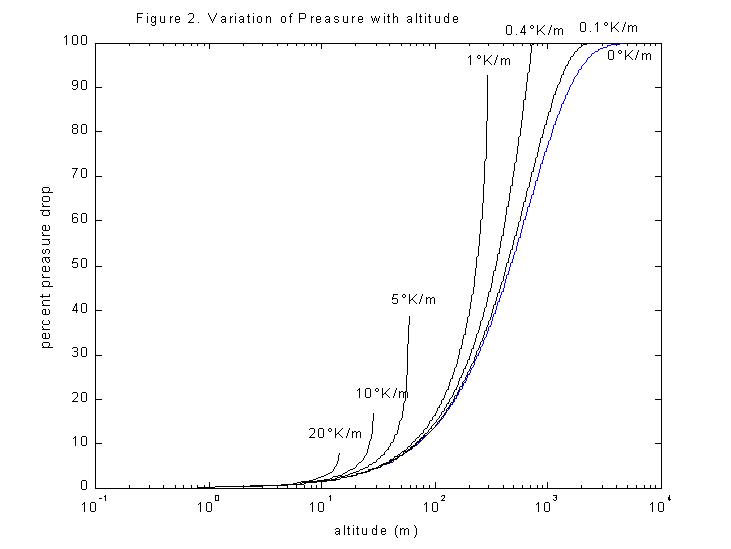
The model is very good for domes less then 100 m in radius and reasonable for domes less then 1km in radius. For larger domes the model considerably overestimates the amount of gas in the dome. Figure 2. shows that the amount temperature varies with altitude is insignificant for any reasonable size dome. On earth temperature varies with altitude on the order of 1e-3 degrees kelvin per m. Even if we assume that temperature can very by as much as 0.1 degrees per m the constant temperature approximation still yields values accurate within 5 percent.
R=0.287 %kJ/Kg-K
PfPo=linspace(1,0.01);
T=273;
Rf=logspace(3,12,10)
for k=Rf
deltaT=-k*(log(PfPo)/sqrt(2*R*T));
semilogy((1-PfPo)*100,deltaT/(60^2*360));
hold on
end
ylabel('time
to evacuate (years)')
xlabel('Preasure
drop (%)')
title('Analysis
of Evacuation times')
for i=1:10
gtext(['Rf=1e' num2str(2+i) 'm'])
end
hold off
Appendix 3. Properties of Various Ideal Gasses at 300K
| Gas | Molecular Mass (g/mol) | R (KJ/Kg K) |
| Air | 28.97 | 0.287 |
| Carbon Dioxide | 44.01 | 0.18892 |
| Carbon Monoxide | 28.01 | 0.29683 |
| Nitrogen | 28.013 | 0.2968 |
| Argon | 39.948 | 0.20813 |