The Tree of Liberty
By Tom J. Wheat
"Our greatest primary task is to put people to work. (...) Hand in hand with this we must frankly recognize the overbalance of population in our industrial centers and(...) endeavor to provide a better use for of the land for those best fitted for the land.(...) Finally, (...) there must be a strict supervision of all banking and (...) an end to specu-lation (...) In the field of world policy I would dedicate this Nation to the policy of the good neighbor - the neighbor who (...) respects the rights of others." -- FDR First Inaugural Address--
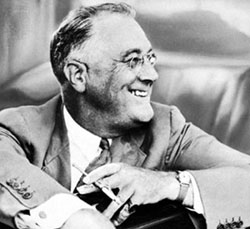 America
owes a debt to the legacy of FDR. It was from him that America's commitment
to international peace and stability and freedom from tyranny were established
as the foundational basis for Americanism as that ideology exists as definitional
to American perceptions of patriotism under the flag. Rhetorical assumptions
aside, as President Roosevelt established a precedent that unfettered
capitalism had to be contained as it would later evolve into Fascist tyrannically
ruled enterprise. The New
Deal sought to establish a social safety net, strengthen the power
of the Federal government, at a time when international speculators, the
'global plebiscite' as Soros refers to them as such, nearly succeeded
in bankrupting the republic.
America
owes a debt to the legacy of FDR. It was from him that America's commitment
to international peace and stability and freedom from tyranny were established
as the foundational basis for Americanism as that ideology exists as definitional
to American perceptions of patriotism under the flag. Rhetorical assumptions
aside, as President Roosevelt established a precedent that unfettered
capitalism had to be contained as it would later evolve into Fascist tyrannically
ruled enterprise. The New
Deal sought to establish a social safety net, strengthen the power
of the Federal government, at a time when international speculators, the
'global plebiscite' as Soros refers to them as such, nearly succeeded
in bankrupting the republic.
American overseas investment projects during and after the war were financed through the Export Import Bank, and monitored by the Federal Reserve Board both a Roosevelt invention. The Year 1944 first began the US's commitment to regulation of international banking and economic development, bonds underwriting European economic development. US European capital investment projects were turned into export credits in European banks, stability maintained by keeping par with the dollar and the pound. As European state economies began to recover from the effects of German occupation and Allied bombing European economic recovery financed infrastructural capital development in the third world during the Cold War. The realities do not always belly the substantive application of rational policy rather post World War II demobilization, ended when Europe began to turn a profit this precipitated the rise of the military industrial complex.
The new deal despite claims by conservative reactionary historians was not an ideological appeal to Stalinist enterprise, American style, nor a system of unnecessary entitlements in comparison to the real politic of the government oligarch war mobilization subsidiary premise as private manufacturing capital stood as rouge benefactor evolving into its present status as reactionary feudal vassals, corporate America.
In reality New Deal Legislation enacted by FDR provided a means in which the federal government was the only willing and capable bureaucratic force invested with the capable means of providing outreach to the impoverished masses in the midst of the great depression. The effects of the Gilded Age betrayed the motivations of elite capitalism, Hoover's indifference and laisseiv faire'isim cost him the election. Hoovervilles would later haunt Macarthur in Korea. FDR though somewhat of a blue blood recognized that regulation of the global and domestic economies meant advancing an ideal that capitalism had to be regulated or mitigated via centralized economic planning requiring government subsidizing of social safety nets to compensate for the excesses of unfettered capitalism.
The New Deal Involved three phases. The first New deal started from Roosevelt's election to the end of his first hundred days in office.
The 1st New Deal's effect on the American domestic economy involved first and foremost a regulation of the Banking industry and guaranteeing all deposits of 5000 dollars or less should other banks fold. The Federal Reserve Board provided for the regulation of currency supply and fixed/float[?] interest rates to maintain the purchasing power of the US dollar overseas. The SEC another newly created federal agency under Roosevelt, was fundamental in insuring and establishing the regulatory mechanisms for: "the trading of stocks and bonds and to discourage the manipulation of values or overspeculation."(818) The Creation of the FDIC, due to the Glass Stiegal Banking Act along with the SEC provided the seeds for the eventual emergence of US capital and productive power capable enough to defeat German continental industrialization under the Nazi's and for a time thereafter America ran a balanced budget.
Other Federal Programs such as the CCC and FERA aimed at revitalizing the local workforces of America with a promise of a job to quell the tales of poverty and exploitation evoked in Steinbeck's Grapes of Wrath and Cannery Row. The Federal government also provided subsidies to agriculture via the Farm Credit act of 1933 which offered loans at minimal rates of interest with flexible terms of financing future debt. It also provided low cost loans to middle class families seeking to refinance their homes for needed repairs commensurate with the costs incurred for building another. This program known as the Federal Housing Administration, (later to become HUD under Johnson), also founded in 1933 helped to lessen the load of American debt accumulated under the great Depression , by providing the equitable means in which to attain the American dream, owning a home.
The economic intent of the New Deal required deficit spending to stimulate capital flows and national economic recovery. Chief among these programs was the Tennessee Valley Authority, one of Roosevelt's most successful programs revitalized the economies of six states all within its jurisdiction. The TVA aimed towards revitalizing agricultural commercial development and increased rural electrification relying on hydroelectric power to fuel American Midwestern economic development. The TVA a nonprofit and public corporation was granted the authority to:" build dams and power plants, to produce and sell electric power and nitrogen fertilizers and to sell explosives to the federal government."(817)
Roosevelt also strengthened the power of the AFL and later through indirect means the CIO as well, allowing for labor's right to freedom for collective bargaining between union officials and employees along with corporations giving all the right to mobilize and protect their interests. "...through Representatives of their own choosing." (817) This National Industry Recovery Act assured miners among others in unskilled occupations the rights to form unions to protect their wages and their jobs.
Roosevelt's second new deal began in the second 100 days to focus directly on the issue of unemployment and its increase after 1933 despite improvements in some areas others began to become insolvent. Roosevelt's response was the Works in Progress Administration to create federally funded subsidies for national, local, urban and rural renewal projects to subsidize the decrease in labor demand. The WPA was one of the most expensive programs ever undertook nonetheless aimed to mobilize artisans laborers and providing assistance at the local level in the construction of, "roads, bridges, parks and public buildings."(820)
Perhaps the most innovative program of Roosevelt's New Deal was the Social Security Act of 1935. This provided a social safety net for Americans during times of economic trouble such as: "unemployment, dependency, and old age."(820) Social Security provided the means in which employees had a portion of their wages withheld and placed either in a retirement account or as a safety net to be used as unemployment insurance. Once a person reached 65 years of age he was set to retire and the wages accumulated throughout the course of one's lifetime having procured interest would directly subsidize that person's cost of living minus inflation.
The final greatest attribute of the New Deal pre war mobilization effort was the Fair Labor Standards Act of 1938 which mandated a uniform minimum wage at that time, 25 cents an hour as well as a set work week of 44 hours. This act also outlawed interstate trafficking in goods produced by child labor.(828)
In sum America's version of the New Deal focused primarily on strengthening unions, providing innovative means of employment as well as providing safety nets for the unemployed and infirmed. Opponents of the New Deal attack its effectiveness by citing statistics indicating a rapid increase in unemployment from 1933 and onwards until the outbreak of WWII. However, this is just a biased interpretation of statistical data to suit a policy outlook that increasingly blunders by unknowingly and historically favoring Hoover's deregulatory 'interest rate hikes' approach, after the crash in 1929, and later with 80's interest rate hikes marked the preeminence of the deregulation equals profitability hypothesis the sum of these precipitating onerous further rapid economic collapse of US currency prestige during key moments in its history.
The 20th century Malthusian specter of exponential population growth inevitably led to shortages of capital. Hence scarcity without the means to acquire freedom, became the antithesis to the rallying cry for every war in America's history thereafter-- in a time in what Keynes might have described as the 20th century crisis and challenge of capitalism, exchange rate stability to forestall currency shortage, the alternative scarcity was a solution that had inevitably led to the second World War. Keynes sought to avert a third world wide war which he knew to be disastrous given that America had nuclear weapons at the time of the signing of the Bretton woods agreements in 1944 when the post world war II political and economic balance of power had been decided. International peace and security hinged on free though somewhat regulated international system of global economic trade based upon a system of fixed exchange rates, free convertibility of exchange and international currencies pegged to the sale of US dollars financing European economic development and success in the post world war II global economy. US sponsored European investment would later blend Keynes New Deal theories with a synthesis of George C. Marshall's American Gaullist view that after 1947 Europe required centralized capitalism, as well as a legitimate alternative to Russian Bolshevism.
Unfortunately American Capitalism became enmeshed with the ideological myth of the Free West, that represented a policy of engagement and confrontation with the Soviet's in a bipolar balance of power System and a policy of intervention that melded such ideology divergent more often in practicality as the defender of the economic status quo more so than the defender of true freedom according to the spirit of the Atlantic Charter. These contradictions became also emblazoned upon Kennan's geostrategic theory of containment of Soviet expansionism. The Vietnam war would later succeed in bankrupting the fiscal solvency of the New Deal and under Nixon the US dollar was de-linked from the gold standard and allowed to float amongst other currencies. Proxy intervention in Vietnam proved to be a strategic blunder in terms of overall clear security directives and a divided chain of command that would escalate and capitulate according to the divided reins of American partisanship. European Currency Speculation legitimately threatened American sovereignty, necessitating Vietnam troop withdrawal when European creditors threatened to cash in their export credits for US dollars.
While the second New Deal did not bring America completely out of the great Depression the Second New Deal and World war II mobilization inherently required deficit spending, a cornerstone to victory abroad and later culmination of the Marshall Plan financed for a time America's jubilant return to economic prosperity post world war II.
Socially conservative historians argue that the New Deal was not affective, and only created more bureaucracy and that WWII was what truly brought America out of the Great Depression. They fail to see the stable real politic forged by Roosevelt to one of later presidential administrations that enunciated fully that Liberty has always bequeathed the legacy of the existence of tyranny to substantiate its existence? Fortunes of politics and idealism aside, the New Deal and all of its federally funded programs provided centralized government and centralized regulatory mechanisms on a previously existing laisseve faire economy particularly those institutions involved in the sectorial enclaves of commercial and investment banking.
With success in WWII achieved, military and economic strategists saw the benefits of Keynes deficit spending as providing the means and mobilization of US national resources under a strong centralized governmental apparatus of New Deal Legislation to combat the twin threats of Fascism and Stalinism via the Marshall plan. Procurement of supply and labor power during WWII was financed entirely by New Deal Legislation. Without Roosevelt's modernization platform and reaffirmation of America's Monroe Doctrine and formulation of the Good Neighbor policy articulated the Apex of American empire and though somewhat unknowingly officiated the passing of the torch to the imperial presidency of Eisenhower and later to other wartime president's. Without the New Deal-WWII the US military would have ranked behind Greece in military power and its Depression economy would have been the centripetal bane of the republic and television would have perhaps than caught and portrayed the plagued Zeitgeist of blind mobs and Jacobins during the French Revolution. Without Federal oversight and management of the US national economy would have rendered the US to the vulnerable to the powers of absolutism, those American and German Industrialists that had supported Adolph Hitler in the pre war Nazi controlled German government. The New Deal required war though it was not its ultimate intention. "Democracy and War" require that the "tree of liberty," to quote Jefferson must be refreshed by the "blood of patriots."
The Tree of Liberty, an expository of the New Deal was Submitted to Professor Alice Yang-Murray 5/19/98 UCSC
Revised 11/1/02
Of related interest: Atlantic Charter
Recommended Reading: Looking Forward (FDR and the Era of the New Deal Series) by Franklin D. Roosevelt
Free Essay @ this site--->http://www.freeessays.cc/db/2/aky134.shtml
Are you still curious now why FDR may have provoked the Japanese to Bomb Pearl Harbor---Also I recommend a book also discussed with eerily pale and compelling tones to 911 by Tom Clancy in his book, "The Bear and The Dragon," in which the publication of the book occurred in 2000, and the book describes a plot by a Japanese hijacker to crash a plane into the World Trade Center.
Also see this Book: America Firsthand by Robert D. Marcus (Author), David Burner (Author)
Selections from, "Why England Slept," by JFK
Comment on the historical evolution of the US Export Import Bank from Roosevelt to the present-- from the CATO Institute.
1934 March 7 The Carnegie Institute compiles the family tree of President Roosevelt, claiming that his ancestors came to America about 1682. Supposedly they were Claes Martenszen Van Rosenvelt and Janette Samuel, both originally of Spanish Sephardic (Jewish) descent. Once again, conservatives and antisemites used this information to stir up anti-Jewish tensions and create distrust of the President, his cabinet (many of whom were Jewish) and the government. (See March 14, 1935)
1934 March 19 An article in the New York Times reports that the Polish government is fighting back against American and German stockholders who control "Poland's largest industrial unit, the Upper Silesian Coal and Steel Company... Two-thirds of the company's stock is owned by Friedrich Flick, a leading German steel industrialist, and the remainder is owned by interests in the United States." (Those interests were Averell Harriman, George Herbert Walker and Prescott Bush among others.)
1934 Hitler in a conversation with Hermann Rauschning asks: "How can we arrest racial decay? Shall we form a select company of the really initiated? An Order, the brotherhood of Templars around the holy grail of pure blood?" (Rauschning)