20th Century China and Russia: A century
of revolution and reconciliation with the West
By Tom Wheat
What makes a revolution? This is inherently a political contention that involves an amalgamation of processes without clearly defined functional modes of analyzing revolutionary activity, its escalation and ultimately articulation of revolutionary change. According to Goldstone there are three historical theories for revolution, the first involving resistance in response to too much state oppression, the second involves a crisis of state management involving either its ability to respond to civil emergencies, fiscal crisis’s or its collective impotence rendered such by the presence of abundant factionalism in its bureaucratic ranks. The third factor, which posits the structural conditions necessary for revolution to take root, is the growth of radical ideas fueled by technological advancement, and acculturation. Revolutions also require the politicization of different class groups as well. All revolutions stem from sort of societal modernization process that effects or creates either new modes of production effecting market consumption interest or pressures exerted by increased population. Often states respond to late to revolutions rather assisting blindly in them.
Revolutions, are typically elite centered and this requires
an elite group of partisans, reformers, (moderates, radicals) and status
quo hardliners (pro-regime) or some sort of fractious divide among the
elite classes so compelling as to threaten the social order of stability
will permit these individuals to mobilize other classes in opposition
to the current regime. Essentially all revolutions have required elites,
and those that have been attempted without them, i.e., solely peasant
populist regimes, have rarely ever been successful.
Revolutions begin when the state is no longer capable
of dispensing effectiveness of justice, when in essence the political
organs of the state cease to be able to conceal the system of patronage
and corruption of government. This causes the alienation of elite support
for the current regime, in that a crisis of authority undermines the
macro economic rotational structure of the class regime when social
mobility is unreasonably excluded. Alienation is typically caused by
declines in wages, employment, food access, land, rent, etc., and propels
the elite to mobilize the masses to overthrow the regime. The other
key important factor is the effect of foreign hegemony in inciting local
nationalistic revolutionary aspirations, either by rite of direct imperialist
practices of occupation, or through regional economic manipulation which
tends to involve the willing acquiescence of counter-revolutionaries
and ruling hardliners, polarizing the populace to view the government
as an internal graft of an external foe, further capitulating the demise
of the pre-revolutionary state.
My thesis is that revolutions are made possible by the degree to which there exists a social ventricle that sustains the intellectual and philosophical elements of a civil society and to the degree to which the state has a legitimate hold on authority is ultimately defined by that polity, as that polity exists to act as the intermediaries of regional authority and the state as a central authority built on the principles of core civil values.
The state itself relies on 4 types of power to reasonably monopolize the process of social accumulation. These 4 methods are 1.) By its ability to regulate use of economic resources and modes of production, 2.) Its ideological affiliation and platform toward progress, 3.) Through the use of military force to quell opposition, and 4.) The fourth form of functioning state power is the necessary reliance on the elite view that the state legitimately exercises political power for the benefit of the collective state. This type of state structure existed in the USSR until 1970 when the Soviet state itself declined in economic power, due to US trade and détente policies and increasing reliance on foreign loans and grain imports to supplement an economy where industrialization was high and spare parts and quality goods were scarce.
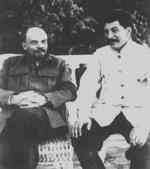 Russia’s
civil society stepped in to fill the void left by the antiquarian revolutionaries
of the early 20th century, the Bolsheviks
and paved the way for economic integration with the west. Russia proved
to be somewhat more accommodating to liberal change then china and the
reason stemmed again from the nature of power relations and the degree
in which the same civil society had had the tactical freedom to mobilize
along multi-class lines rather than peripherally motivated by individual
class and status interests, demonstrates that China’s civil society
was in decline or eclipsed by a more conservative revolution of Chinese
global market integration, by party leaders, and an opposition force
of proletarians and intellectuals and occasional peasants bound to the
system of progress by which the party has set the standard for revolution
and not the people. Deng’s consumerist socialism wins out over
Gorbachevs accommodation, in terms of the maintenance of state power,
and the smooth regime changes China has encountered after Mao
posit that revolutions from China come usually from above due to the
nature of the peasantry, and that Russian leaders had to contend with
a much more developed and organized urban civil society then china signaling
its success and possibly china’s long-term failure.
Russia’s
civil society stepped in to fill the void left by the antiquarian revolutionaries
of the early 20th century, the Bolsheviks
and paved the way for economic integration with the west. Russia proved
to be somewhat more accommodating to liberal change then china and the
reason stemmed again from the nature of power relations and the degree
in which the same civil society had had the tactical freedom to mobilize
along multi-class lines rather than peripherally motivated by individual
class and status interests, demonstrates that China’s civil society
was in decline or eclipsed by a more conservative revolution of Chinese
global market integration, by party leaders, and an opposition force
of proletarians and intellectuals and occasional peasants bound to the
system of progress by which the party has set the standard for revolution
and not the people. Deng’s consumerist socialism wins out over
Gorbachevs accommodation, in terms of the maintenance of state power,
and the smooth regime changes China has encountered after Mao
posit that revolutions from China come usually from above due to the
nature of the peasantry, and that Russian leaders had to contend with
a much more developed and organized urban civil society then china signaling
its success and possibly china’s long-term failure.
Pursuant to the scope of this assignment this paper will
analyze the Chinese communist revolution of 1949, and the tianamien
1989 uprising and the East German soviet revolutions of 1989-1991.
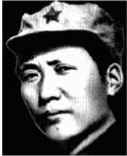 The
20th century marked an epochal shift in China’s legacy as
one of the enduring traditional dynastic cores of Asia and a civilization
endowed with historical continuity of imperial rule from antiquity.
That century saw the rise of revolution first beginning in 1911,
with the republican Tongmeng
hui republican movement, that managed to overthrow the Qing
dynasty with the help of the counter revolutionary, Yuan Shikai
who later installed himself as emperor. Yuan Shikai’s reign was
brief ending with his death in 1915. The imperial troops subsequently
revolted and the Nationalist party was installed in power with its top
general Chiang Kai Shek as Generalissimo. Mao Tse Tung
a middle peasant from Hunan and former librarian at Beijing University
was a leading member of the Kuomintang Executive Bureau and one of the
key founders of the Chinese Communist party. China’s tradition
of nationalist protest centered on the method of remonstrance, centered
on the principle of the Confucian bureaucratic duty to state as involving
the right of reminding the sovereign of his sage duty to emulate heavenly
order according to the various Confucian analects.
The
20th century marked an epochal shift in China’s legacy as
one of the enduring traditional dynastic cores of Asia and a civilization
endowed with historical continuity of imperial rule from antiquity.
That century saw the rise of revolution first beginning in 1911,
with the republican Tongmeng
hui republican movement, that managed to overthrow the Qing
dynasty with the help of the counter revolutionary, Yuan Shikai
who later installed himself as emperor. Yuan Shikai’s reign was
brief ending with his death in 1915. The imperial troops subsequently
revolted and the Nationalist party was installed in power with its top
general Chiang Kai Shek as Generalissimo. Mao Tse Tung
a middle peasant from Hunan and former librarian at Beijing University
was a leading member of the Kuomintang Executive Bureau and one of the
key founders of the Chinese Communist party. China’s tradition
of nationalist protest centered on the method of remonstrance, centered
on the principle of the Confucian bureaucratic duty to state as involving
the right of reminding the sovereign of his sage duty to emulate heavenly
order according to the various Confucian analects.
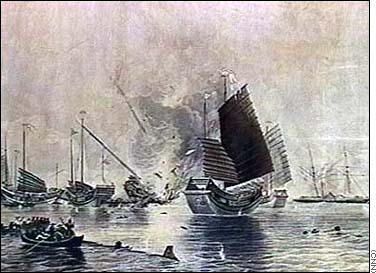 China's
experience with modernity has been a mixed blessing. After the 19th
century legacy of rapprochement from the west via, the opium wars,
ensuing establishment of western treaty ports, cantons and enforcement
of western spheres of influence in china by gunboat diplomacy, and extra-territoriality,
dramatically changed the modality that sustained the intellectual process
of protest and nationalist remonstrance into outright revolution. The
students of china’s 1920’s may 4th movement, sought
to radically define nationalism as the process of loyalty to the state
based upon its ability to function more so than the divine mandate of
the Chinese sovereign. Accordingly they came to view themselves as a
great civilization made backward by western imperialism and china’s
lack of knowledge in the sciences. Extraterritoriality gave china’s
emerging civil society the tactical freedom necessary to mobilize and
culminated in the overthrow of the imperial regime.
China's
experience with modernity has been a mixed blessing. After the 19th
century legacy of rapprochement from the west via, the opium wars,
ensuing establishment of western treaty ports, cantons and enforcement
of western spheres of influence in china by gunboat diplomacy, and extra-territoriality,
dramatically changed the modality that sustained the intellectual process
of protest and nationalist remonstrance into outright revolution. The
students of china’s 1920’s may 4th movement, sought
to radically define nationalism as the process of loyalty to the state
based upon its ability to function more so than the divine mandate of
the Chinese sovereign. Accordingly they came to view themselves as a
great civilization made backward by western imperialism and china’s
lack of knowledge in the sciences. Extraterritoriality gave china’s
emerging civil society the tactical freedom necessary to mobilize and
culminated in the overthrow of the imperial regime.
 China
during The 1920’s saw the rise of warlords, due to the earlier methods
of militarization of the countryside as a method to quell rural unrest.
Gradually Chiang completed his consolidation of provincial chiefs under
his authority. This period was also characterized by Nationalist counter
insurgencies against Mao’s emerging bands of communist peasant guerrillas.
The 1930’s marked the beginning of the Japanese imperialist phase when
in 1933 Japan seized Manchuria, and installed the deposed emperor Pu
Yi as the puppet ruler of a Japanese protectorate, state newly named,
Manchukuo. Further Japanese expansion occurred throughout the southern
and coastal portions of china throughout the 1930’s prior to the intervention
of the US in WWII.
China
during The 1920’s saw the rise of warlords, due to the earlier methods
of militarization of the countryside as a method to quell rural unrest.
Gradually Chiang completed his consolidation of provincial chiefs under
his authority. This period was also characterized by Nationalist counter
insurgencies against Mao’s emerging bands of communist peasant guerrillas.
The 1930’s marked the beginning of the Japanese imperialist phase when
in 1933 Japan seized Manchuria, and installed the deposed emperor Pu
Yi as the puppet ruler of a Japanese protectorate, state newly named,
Manchukuo. Further Japanese expansion occurred throughout the southern
and coastal portions of china throughout the 1930’s prior to the intervention
of the US in WWII.
In 1937 the Japanese sacked and razed the capital city Nanjing provoking international condemnation. The British and FDR respond by imposing a steel embargo cross-cutting vital Japanese steel imports from Manchuria which ultimately led them to decide to bomb Pearl Harbor, as a strategically defensive sucker punch. During 1937 a brief nationalist communist alliance was established, with Mao installed as the commander of the communist 8th route army. American intervention in the war led to the expulsion of the Japanese from China, and the development of a strategic alliance between the US and Chiang’s KMT party. This alliance proved to be costly failure in terms of US diplomatic and foreign assistance objectives being compromised by Nationalist bureaucratic corruption and misappropriation of funds for their own personal aggrandizement. Mao’s communists defeated The Nationalists, in 1949 and established the PRC. The initial communist offensive was made possible by their seizure of Japanese-Manchurian armaments after the war and the subsequent brief Soviet occupation of Manchuria tipped the military edge in favor the communists.
Despite millions of dollars of US aid the nationalists
were unable to defeat the communists. The reasons for the fall of the
KMT, stemmed from the fact that the Communist's could claim numerical
superiority, via mobilization of the rural peasantry, into brigades
of cadre led communes, and militias, and in its ability to dispense
regionally the maintenance or the appearance of national government
in the face of a crisis, corruption and disorder in Chiang’s regime.
This was marked by a military elite exodus and disassociation from the
KMT regime.
According to Charles Tilly revolutions require
a multiplication of polities and power status groups competing for authority,
in which a single polity or party assumes a majority and control over
the coalitional process. Secondly, revolutions require the commitment
of the subject population and when this is not possible due to coalitional
breakdown at the elite level haphazarding the state’s institutional
role as the resource allocator of public works projects, then the opposing
force that fills the vacuum becomes the instrument of the revolution,
and becomes viewed as the legitimate dominant contender as an alternative
polity to the current regime, by the merging of elite and peasant consensus
centered upon nationalist survival. “This analysis veers from Huntington’s
especially in denying the significance of a discrepancy between the
overall rates of mobilization and institutionalization, in attaching
greater importance to conflicts over claims, duties, privileges and
conceptions of justice embedded in particular contenders for power and
in drawing attention to the important possibility that the crucial contenders
will be disaffected members of a polity rather than newcomers to power.’(Goldstone,
Revolutions, 50)
Mark Seldon argues that the communists were successful
due to tactical and logistical superiority in dealing with the Japanese
while Chiang’s military command structure divided its authority between
extermination of the communists and gradual escalation of resistance
to Japanese expansion. Secondly by the communists’ defeat of the KMT
saw the end of the foreign treaty ports, a historically ascribed cause
for the institutional decay of imperial civilization. For the masses
in China It seemed that the communists had history on their side. Furthermore
after the victory, in 1949, the PRC legitimized its revolutionary and
ideological claim to power by instituting a policy of rural land reforms.
Furthermore Seldon argues that China during 1949 was undergoing a period
of economic hyperinflation brought on ostensibly by the corruption
of the KMT regime. Furthermore it was faced with a population crisis,
a process that had first began to develop late in the 18th
century and assumed pre-imminent influence in the breakdown of the earlier
Qing state, in that the population had come to evolve beyond its current
social institutional structures of support. The end result was revolution,
which finally culminated after a long tortuous process of 100 years
of petty revolts resulting in a communist victory.
Theda
Skocpol argues that in imperial china the landed classes were
able to resist the state bureaucrats and their efforts towards modernization.
The Qing state was a bureaucratic monarchy that existed outside of colonialism
and then later became incorporated and struggled under the experience
of colonialism. This struggle between nationalism and national unity
has made possible by china’s experience of western rapprochement, and
according to
Skocpol, “China’s vulnerable international situation has
always encouraged centralization and bureaucracy.”(68) This radically
redefined the traditional Chinese view of legitimate sovereignty, as
involving the authority of the state in redistributing the wealth however
it was not a matter of question of whether authority should be centralized
or decentralized the alternative was considered to be irrational and
evoked memories of china’s feudal warlord past.
The reasons for the Chinese communist success at revolution
involved their ability to mobilize the peasantry. Eric Wolf argues
that peasant rebellions are defensive attempts to maintain traditional
lifestyle from the pressures of population growth, commercialization
and growth of market activity and finally the breakdown in local government
handling of farm and disaster granaries. In order for peasants to be
able to revolt requires that they have tactical freedom, enough autonomy
on lands outside of the central authority of the state or local landlord.
Generally it is the middle and rich peasants that have enough of a surplus
to legitimately possess tactical freedom, i.e., freedom from compulsory
labor and also it may include independent peasant communes. However,
Wolf argues that in order for a peasant revolt to be successful it requires
elite support. So the peasant revolution in china is a stark contrast
with Marx’s view of an urban proletarian socialist revolution.
Wolf further argues that peasants are difficult to organize and this stems from the competitive nature of each peasant’s relations to the factors and forces of production. Peasant economic and political outlooks become acutely aware and sensitive to tyranny of landlords and production schedules in eroding the power for a peasant to own a piece of land. The system is further complicated by a system of extensive kinship lineages in which the wealthy rich peasant landlord can be related to the poorest of poor peasants. Peasant interests then can cross cut class alignments.
Essentially mass population increases along with the
ensuing commodification of wage labor (stemming from the monetization
of the Chinese economy beginning in the late 18th century British traders
flooded the Chinese market with a steady influx of silver, with the
ensuing result culminating in inflation and rising food prices. This
trend would continue throughout the 19th and 1st
half the 20th century) essentially created an international
agenda to local market relations thereby disrupting the sanctity of
the peasant village universe. Hence the displacement of the rural peasantry
and increased population and urban growth rendered whole peasant villages as tributaries and subsidiaries of the
market. This loss of traditional autonomy involved the confiscation
of traditional peasant rates of surplus by raised rents or by coercive
seizure and or increased tax rates. “This is perhaps best seen in Russia,
where successive land reforms threatened peasant access to pastures,
forests and plowland…equally evident in cases where commercialization
threatened peasant access to communal lands (Mexico, Algeria, Vietnam),
to unclaimed land, (Mexico, Cuba), to public granaries, (Algeria, china)…commercialization
disrupted rural life it also created new and ecological niches in industry…Increased
instability in the rural areas was thus accompanied by a still unstable
commitment to industrial work”(57) Generally peasants are conservative
andtheir rebellions are generally an anachronistic response to industrialization.
China's economic mode of production relied mostly on
traditional methods of agriculture and land tenancy, in which the modern
industrial sector only accounted for 7% of national income, whereas
19% of national income was derived from rural property owners. Equally
important was China’s transportation infrastructure, which lay in shambles
after the Japanese attempts at occupation. Ultimately, with the victory
of the PRC in 1949 culminated in a Naval blockade of China by the US,
a boiling point only resolved after China’s intervention into the Korean
War. “The party’s leadership of the peasant based anti Japanese resistance
demonstrated the capacity of the peasantry to organize, to mobilize,
and to grow in the context of a movement which respected its subsistence
needs and which attempted to locate the foundations for change on such
common practices as rural mutual aid and the cohesiveness of village
structures.”(194) The land reform program of the 1950’s centered
on uniting of the party interest with the middle and poor peasants against
the wealthy landlords, which often involved the expropriation of the
latter’s assets and redistributing the assets locally on the basis of
need. The outcomes in themselves where not always ideal and many villagers
used the PRC’s land reform program to showcase their own internal feuds
between neighbors or local officials.
China’s leadership came to now increasingly rely on soviet assistance for economic planning and development of industrial infrastructure. Between the periods of 1953-1958 saw the creation of heavy industrial production plants and consolidation of peasant communes into centralized districts of state directed enterprise. The Great Leap Forward however was a disastrous failure of the state’s attempt to turn mobilized labor into industrial capital in that production was heavily geared towards manufacturing when the primary focus had been agriculture, ostensibly resulting in mass starvation and the deaths of 30 million people. “In short, the central promise and central contradiction within societies engaged in the transition to socialism center on the role of the state which can serve at once as a vehicle for advancing and concentrating the interests of the direct producers in a socialist society and as a roadblock for preventing the expression of those interests.”(196) According to Seldon, China would not recover from the effects of the land reform movement until 1978. Despite the modest gains in personal income gained by the peasants during the early years of land reform resulted in an overall decrease in peasant incomes. (198)
However, China continued a steady process of industrialization
from 1952-1978 in which industrial output grew by 11.2%
whereas agricultural output remained steady at 3.2% rate of growth.
Also China’s rates of investment into industrialization, from 24.2%
(1953-57) to 39.6% at the height of the great leap forward, 1958, and
from 1970-78 it devoted 33% of material output into research and development.
(199) Since 1980-2000, China’s economy has grown at a rate of 8-10%
annually. After the failure of the Great Leap Forward, China disbanded
its soviet economic advisors, in 1960 and the growing Sino-Soviet divide
later provided the leveraged basis of America’s détente diplomatic tactics
in the 1970’s.
In 1966 Mao launched the Cultural Revolution as
a bid to reclaim party power for himself from Liao Saochi and Deng Xiaopeng,
the so called, ‘capitalist roaders,’ whom he purged later resuscitating
Deng as his heir apparent. Mao encouraged students and workers and peasants
to organize as Red Guard Brigades where they would expose intellectuals,
bureaucrats, and production managers with supposed rightist tendencies.
Seldon argues that the ideology of the Cultural Revolution did manage
to radically redefine Chinese expressions towards age and authority,
bureacratisim and statisim. “Proponents of uninterrupted revolution
and continued class struggle did in fact develop a cutting critique
of the dangers of bureacratisim, of statist tendencies to monopolize
and abuse power.”(200) The Cultural Revolution ended in chaos and
in the deaths of some 60,000 people when the PLA finally stepped
in restored local order. Indeed after Mao’s death in 1976 many began
to refer to the Cultural Revolution as the age of the cult of Mao.
Deng Xiaopeng emerged as the new leader of China and embarked on a radical departure from Maoist collectivism, to state directed economic liberalization and development of a private sector. Essentially Deng planned to merge capitalism, with Chinese socialism, a major departure from previous polices of isolation from the west to one of direct economic engagement. In 1980 Deng begun the partial privatization of enterprise, resulting in the rise of the southern and eastern coastal cities as commercially powerful sectors leading china to eventually dominate the global export trade and freight business due to its cheap commodity labor supply. The CCP still had a monopoly on political power that increasingly called into question its own ideological affiliation to socialist cradle to grave policies of maximum full employment, replaced by what the western liberal capitalists designated as economic liberalization, resulting in the CCP’s bid to extend privatization and export led development policies resulting in the laying off of 10’s of millions of workers from formerly state owned factories. These contradictions according to Seldon constituted the volatile ‘combustible material’ that embodied China’s economic transition from state directed market socialism to gradual integration into a global economic market structure. “The Market then appears as a necessary but dangerously volatile instrument in the socialist transition. Its dual nature constitutes one of the many contradictions that socialist countries face in the transition process.”(201)
Many would argue that while china experienced vast economic
growth in the 80’s as a result of foreign and state directed private
sector investment, the widening disparities between wealth, income,
status, rural and urban classes, as well as corruption in the CCP undermined
this whole transition process, and culminated in the 1989 tianamien
uprising. Revolution comes to china gradually in waves of uprisings
culminating from decades of struggle amongst the competing entities
of the Chinese cultural universe, the forces of traditionalism, capitalism,
and Socialism. Rather revolution represents a transfer of power from
one regime to the next, and arguably China searches to employ her past
legacy of dynastic continuity as an image of constancy to mold the process
of its social evolution and social change and also it is an attractive
sell to western multinational capital seeking to do business with a
'stable autocratic regime' such as China has proven itself in
its successes in quelling the 1989 uprising, but not necessarily the
issues that movement sought to address.
Whereas China’s 1949 revolution involved a long complex
transfer of power from regime to regime the Russian revolution happened
rather rapidly and the socialist state soon consolidated its hold over
all of Russia quickly. Tsar Nicholas II the last Romanov ruler
of Russia governed that nation according to the dictates of royal precedents
extending back to Ivan Grozny the first autocratic Muscovite ruler.
In the late 19th and early 20th century Russia
as a nation under tsarist
autocratic rule underwent a process of industrialization, reorganization
of peasant land communes, and also the formation of the Duma, the people’s
assembly. In each case these measures where direct responses to popular
revolts and an attempt by the state to wield greater authority, and
eventually resulted in the overthrow of the regime itself.
The Tsarist government
consisted of ministries with the two most powerful ministries, Finance
and the Interior vying for control amid the tsar’s own autocratic authority.
These Bureaucratic organizations were effectively undercut by the system
of autocracy in that rule by authority of personality superseded the
authority of an institution. Russia between 1890-1914 initially
embarked upon a path of industrialization and agrarian reform because
it wanted to compete with the west. The modernizers led by Sergei
Witte, the minister of Finance, financed their industrialization
programs by increasing the rates of taxation on the peasantry. The Russian
Government also subsidized or exempted entrepreneurs from taxes and
also encouraged foreign capital investment.
Despite the efforts of Witte, Russia still trailed Italy
and Spain in terms of industrial development. However, there was a major
increase in the proletarian class, beginning in 1867 after the liberation
of the serfs, at 35,000 workers and increasing to 200,000 proletarians
by 1913. The Population's Literacy rate doubled in this period
as well to 40% of the total population. Despite the rises in industrial
wage earners, Russia remained predominately a peasant nation with a
total of 1/2 of European Russia organized under peasant communes.
On these communes all taxes were paid in kind and land redistributed
according to family size and productive capacity. Tim McDaniel
argues that the system of collective ownership created a low incentive
on the part of the peasants to agriculturally innovate. However, a system
of demographic upheavals would result in 1916 with fully one half of
the Russian peasants being displaced from communes or otherwise landless
vagabonds.
Tsarist Russia's earlier
attempt at agrarian land reform, in 1906 began the process of privatization
of peasant communes. Led by the Prime minister Peter Stolypin
these reforms did little to quell the growing revolutionary sentiment
in the minds of the Russian people. During 1905-1906 Japan fought and
won a war with Russia setting the precedent of the first Asian power
to defeat a European power in the modern age. Against this backdrop
was the growing exploitation of the Russian proletarian worker, and
on January 9th 1905, 60000 workers petitioned the tsar for better working
conditions. The Tsar refused to the see the workers and instead sent
Cossack troops to gun down the insurrectionists. As mentioned
before the Stolypin reforms were a failure and the end result
was the government's withdrawal of a land reform plan, which
in turn led to an increasing development of village solidarity on the
communes. McDaniel describes the bureaucratic structure of the
Russian government and why the twin towers of the tsar's domestic policy,
privatization and modernization indicated that his royal authority and
the monocratic bureaucracy associated with it had become outdated. "..The
regime staked its success of its modernization program on private initiative,
but its authoritarian nature stifled it. In the case of some groups
the regime smothered their initiative quite consciously out of fear
of overt opposition. For example the tsar had no intention of permitting
an independent trade union movement even if its suppression entailed
worker disaffection both in the factory and in the society at large."(187)
In fact this disaffection would be felt in the urban centers and with
the rise of Marxist ideology a unified national class-consciousness
began to be established, linking peasants with proletarians. During
WWI Russia suffered a number of disastrous defeats until the Americans
entered the war. This demonstrated that the modernization reforms had
been null, and that the security of apparatus of the state was more
bent on repressing the populace then actually protecting it from foreign
invasion. In October, 1917 a national revolt was launched in Moscow
and St. Petersburg and the tsar was forced to abdicate by members of
the Russian Duma of whom the Bolsheviks had sizable majority after defeating
the moderate mescheniks.
Lenin's thesis proposed
a rural revolution of the countryside. The agriculture was predominately
based on the medieval three-field system. Only in the frontiers and
in Siberia could villagers claim mixed success as opposed to the whole
of the Russian masses mired in economic stagnation and rising currency
devaluation. essentially poverty stemmed from corruption and overpopulation
and in Russia's case this had created a declining class of rural elites
and overall poverty in the countryside. The new Provisional government
composed of moderates, liberals and socialists essentially had no social
base of support in the countryside their primary focus being increased
industrialization. Bolshevik ideology was willing to accommodate both
the proletarian and the peasants endowing them with a politicized view
of class consciousness that had never before been articulated
as a mass whole by the Russian people and that ideology
of revolution defined class struggle and nation building as the
transhistorical mission of the Russian people. However, McDaniel argues
that the system of autocracy was passed to the soviets, in that the
land reform was revolutionary, however, essentially there was a recapitulation
of the Tsarist bureaucracy under Lenin and later Stalin's rule.
"In Russia, autocratic control of society meant that critical knowledge
vital to rational decision making on the part of individuals and social
groups was masked. Workers had no real sense of what support for the
Bolshevik party implied."(190) Hence socialist revolution created
a Soviet privileged class of the intelligentsia.
Revolutions against Soviet
communism would first occur in the soviet client states of East Germany,
Hungary and Poland. Goodwin argues that the reasons for these
revolutions against socialism were due to the closed autonomous economic
sphere maintained by the Soviet Union and her client states and republics,
and that ensuing fiscal problems in the late 1970's and 1980's were
due to commerce being dependent upon foreign capital investment. The
polish steel workers strike sounded off the demise of communism, and
soviet regional economic state directed planning. However, none of the
more so dramatic events occurred when Gorbachev was elected President
and he proved to be liberal moderate accommodating the forces of change
and revolution again, by passing the torch of soviet collectivism to
free market Russian capitalism. Gorbachev's rejection of the Breznev
doctrine--direct soviet intervention into rebellious client states
to enforce the soviet line, was met by his later acknowledgement that
through the years of government party statist control, Russia had an
underdeveloped 'civil society.' Essentially an elite exodus had occurred
because of breznev's hardline or what Goodwin calls an elite reaction
to the decline of an 'overextended imperialist power.'(257) Gorbachev’s
reform years, 1985-1989 paved the way for the dissolution of the Soviet
Union and spurred on a smoldering national movement to create independent
states out of the former soviet republics. In 1991 while Gorbachev was
vacationing in the Black Sea the communists attempted a coup, however,
they were defeated by Gorbachev’s ally, Boris Yeltsin. Since Yeltsin
had effectively control of the soviet army, he assumed the Presidency
of a new Russia no longer communist.
The unique feature of the East German revolution of 1989
was that it was rather a peaceful revolution compared to other revolutions
of the past. Goldstone compares the E. German revolutions
(Poland Czechoslovakia, and east Germany) with the third world revolutions
of (Mexico, Vietnam, Cuba, Iran and Nicaragua). Essentially he views
these revolutions as a response to 2nd world totalitarianism, evolving
into 3rd world authoritarianism. Goldstone argues that the regime similarities
are pronounced in their connections to neopatrimonial, personalist
dictatorships and former tactics of colonialist rule were all embodied
in the soviet tributary regional state security structure. Also
in the post Stalin years there were also a lack of quality consumer
goods, and this problem became especially acute in the (1970's-1980's)
when innovation came to be increasingly undermined by the politicized
nature of state socialist economies. During this period of economic
stagnation the Soviet Union also began to borrow heavily from the west and
had undergone limited attempts at political and economic liberalization.
However, the reforms were undercut or otherwise impeded by state socialist
bureaucracies. (259) Furthermore political and economic liberalization
threatened the elite power of the enterprise manager, who had essentially
made a cult of no work and opportune access to government graft as their
carrot and the stake in maintaining the decaying soviet state.
The opposition movements of Eastern Europe involved five
features. First it was a multi-class movement, and secondly this movement
featured widespread discontent with government. Thirdly this phenomenon
erupted into nationalism, with the growing opposition of soviet client
states to Moscow’s attempt to exercise centralized control. Fourth these
movements all featured radical forms of leadership, and finally they
all featured quasi utopianist ideologies. These opposition movements
were comprised of peasants, workers, intellectuals, professionals, and
disaffected members of the state enterprise boards. Essentially since
the state owned everything and was in charge of distribution, the communist
party came to be called into question since there were shortages and
lack of quality in production.
A similar logic of opposition existed in the third world
in response to neocolonialist regime reform measures, and in each case
when elite regional power was threatened even if their office was the
adoptive measure of reform proved ultimately incapable of reform. The
potential loss of authority for the nomenklature like 3rd
world neopatrimonial dictatorships made reform an insurmountable barrier
to development in that political and economic favoritism, corruption
and cronyism were the natural politics of developing nations. Revolutions
only came to the third world when colonial empires found the costs of
empire to great to bear after long years of counterinsurgency campaigns
against opposition native guerilla forces. Goodwin argues that the
Soviets themselves ultimately were bankrupted by the attempts to maintain
a neocolonialist empire. A series of policies focusing on ‘progressive
attrition’ and negotiated revolutions in (Poland, Hungary, Czechoslovakia,
E. Germany) resulted in a series of mass popular protests that brought
about the collapse of authoritarian socialism in E. Europe in 1989-1991.
Accordingly with the thesis of this paper Gold Stone
argues that revolutions involve a series of conjunctions involving an
amalgamation of trends. Revolutions involve a decline in state effectiveness
and fiscal solvency, increased alienation and conflict among elites
due to impeded social mobility and an ensuing increase in mass mobilization
of the populace by declining living standards and increased urbanization.
(262) In the 1970’s this problem was not as acute, Communism was on
the rise and indeed it was the West and the US that looked ineffectual
after Vietnam. The communist party institutionalized its control over
society replacing gulags with cronies of the party.
In terms of the standard of living, the period between 1958-1971
saw soviet infant mortality rates halved from 40.6 to 22.9 deaths per
1000 infants. Indeed after WWII The Soviet Union economy grew at
an average rate of 6% a year. However, after 1970 economic development
began to stagnate and while the Soviet Union was committed to heavy
industry while it could not begin the transition to an emerging 'high
tech' economy that had begun to evolve in the west. While the USSR
attempted to increase production yet it lacked spare parts and came
to be increasingly dependant upon foreign trade in raw materials. USSR
economic growth fell to 5.5% between 1971-1975, and then fell to 2.7%
between 1976-1980, and then 1.9% from 1981-1985. Soviet manufacturing
began to lose its foreign market demand and hence exports declined as
well. “Perestrokia simply disrupted production and led to severe shortages
of goods.”(264)
While Gorbachev was seen as a liberal reformer his policies
almost bankrupted the USSR. The Budget deficit climbed from 15billion
to 18 billion, 1980-1985 and rose to 80 billion dollars 1988-1989. The
USSR also lost a number of its Middle East regional client states, in
which in 1975, Egypt shook off its soviet alliance for an
American foreign aid and development leaving only Syria as the USSR’s
principle ally in the Middle East. Also in 1979 the Soviets undertook
what would be a long disastrous decade long counterinsurgency campaign
against Afghanistan mujahadin guerillas. This war further exacerbated
soviet deficit fiascoes. Perhaps the single-handed most ideological
blow to Leninist soviet communism came during 1986 during the Chernobyl
nuclear power plant disaster. The radiation fallout around the Ukraine
was 80times the fallout at Hiroshima and Nagasaki. The Soviet leadership
failed to warn the populace about the disaster. Kiev the nearest major
city, 75 miles away saw mortality rates climb back to world war levels.
Inherently these factors brought about the alienation of elites
in opposition to the soviet state. During the 1960’s-1980’s there
was an explosion of Soviet engineers and scientists however, they were
more or less indentured to enterprise managers who disliked innovation
when it conflicted with their graft ethic. These intellectuals came
to reject the communist party and were later instruemental in securing
Yeltsin’s ascent to power.(267)
The Soviet unions last gasp toward mass mobilization
came with glasnost and this inevitably brought about the collapse
of the communist regime. “While Gorbachev apparently envisaged popular
action by soviet citizens, he failed to realize that local organizations
would follow preexisting lines of local organizations created by the
USSR which emphasized the national identity of the constituent republics.”(269)
Inherently the Soviet Union believed class mobilization could overcome
nationalism and ethnicity as primary measures of concern; rather they
unified all three measures together unknowingly. In 1989 Russia had
an urban population of 188 million double what it had been in 1959.
This urbanization consolidated tensions and became the focus for popular
mobilization. Between 1989-1991, 400,000 coal miners went on strike
along with steel workers. The revolution represented the conflicting
lines of control, authority and legitimacy in the modalities of Soviet
elite authority in a period of increased economic stagnation prompting
the state to attempt reforms, perestroika, glasnost, that essentially
while intended as reform measures opened up the view that the communist
party was no longer fallible.
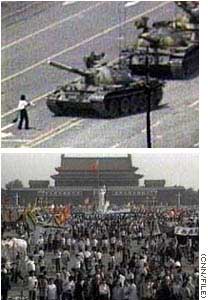 Martin
King Whyte argues in his essay, “The Social Sources of the Student
Demonstrations in China, 1989,” that Deng’s economic reforms, the push
for private limited property ownership made inequality in escapable
part of life for modern Chinese socialism. Initially a group of Chinese
students from prestigious universities and some workers from the major
cities met in Beijing at Tiananamien Square to push for greater reform
in the CCP, and party accountability to the principles of socialist
democracy. However, in 1989 China was in a better economic position
then Eastern Europe. Deng’s ‘open’ policy allowed western style goods
to flood Chinese markets, and some temples destroyed during the Cultural
Revolution were restored. Also there was a revival of Confucianism
and an effort to retrieve cultural practices repressed under the Mao
years. The roots of popular discontent can be traced to three groups,
the ‘not far enoughs,’ ‘the too fars,’ and ‘the satisfied.’ In reality
Deng’s reforms had stalled since the mid 80’s and there was a growing
surplus of entrepreneurial, and intellectual talent along with skilled
labor rendered irrelevant by the newfound prosperity. The Chinese
demonstrations of 1989 were a repeat of demonstrations held in 1987,
1981, and 1979.
Martin
King Whyte argues in his essay, “The Social Sources of the Student
Demonstrations in China, 1989,” that Deng’s economic reforms, the push
for private limited property ownership made inequality in escapable
part of life for modern Chinese socialism. Initially a group of Chinese
students from prestigious universities and some workers from the major
cities met in Beijing at Tiananamien Square to push for greater reform
in the CCP, and party accountability to the principles of socialist
democracy. However, in 1989 China was in a better economic position
then Eastern Europe. Deng’s ‘open’ policy allowed western style goods
to flood Chinese markets, and some temples destroyed during the Cultural
Revolution were restored. Also there was a revival of Confucianism
and an effort to retrieve cultural practices repressed under the Mao
years. The roots of popular discontent can be traced to three groups,
the ‘not far enoughs,’ ‘the too fars,’ and ‘the satisfied.’ In reality
Deng’s reforms had stalled since the mid 80’s and there was a growing
surplus of entrepreneurial, and intellectual talent along with skilled
labor rendered irrelevant by the newfound prosperity. The Chinese
demonstrations of 1989 were a repeat of demonstrations held in 1987,
1981, and 1979.
Essentially the demonstrations in the spring of 1989
involved these aforementioned groups reminding the party leadership
of its promise that this form of elite would have a voice in shaping
china. In reality the state
was investing little in into its educational institutions and so students
had little market demand for their skills, since their individual expertise
and talent had to contend with the social norms of career limited opportunities
due to cronyism and corruption. “All though the specific ways in which
the ‘not far enough’ sentiment was felt by these groups varied, they
were united in their anger at the hypocrisy involved in the meritocratic
vision of the reforms. A few individuals were benefiting disproportionately
even though they had done relatively little to merit such benefits.”(275)
The argument for true reform centered upon the debate between equity versus equality. The ‘not far enoughs’ looked to china’s may 4th revolution for a time when they saw that intellectual opinion was valued. These marginalized elites attempted to provide a critique of china’s traditional legacy (imperial feudalism) and the modern evolving nature of Chinese bureaucratic socialism. Generally, it was only the progeny of high-ranking communist officials who received first access to new markets and positions of newfound economic autonomous power. The group who comprised the ‘too fars,’ of the majority were predominately industrial workers, low-level bureaucrats, party officials, PLA and the police. For the workers, the loss of job income security was a return to capitalistic exploitation and a sellout of socialism. Equally important was that during 1988-1989, failing Chinese state firms began to be turned over to private contractors, not only did layoffs increase dramatically afterward, enterprise managers began laying off women as well.
Among the low level bureaucrats, party officials, soldiers
and police the argument centered on their small fixed salaries and the
threat of increased economic engagement with the west as construing
a threat to their power. “The ‘too far,’ groups vision of the good society
was decidedly not one which party bureaucrats would be replaced at the
top of the social pyramid by meritocratic experts…They saw precious
little of such benevolence in the policies and pronouncements of the
reform era leadership and many feared the elitism and arrogance of China’s
intellectuals.” (277) The ‘too fars’ thought that the ‘not far enoughs’
program of westernization was a fatally flawed solution in that greater
economic contact with the west inevitably grafted western economic ideas
into the traditional Chinese economic landscape once sanctified by socialism.
On the flipside the peasants, or ‘the satisfied were content with the
reforms. There were increases in rural income despite the imposition
of the ‘one child policy’ in 1979, and the peasantry traditionally sanctified
bribery. Hence though there was some spillover unrest in the peasant
population during the uprising, the lack of a coalitional consensus
provided a situation unlike what befell East Berlin roughly at the same
time.
 There
was also a generational transition in China with the Red Guard coming
of age with many beginning to advocate multiparty rule. (280) Zhao
Ziyang was a high-ranking bureaucrat who favored increased reforms,
and sought to compromise with the protestors on how to deal with corruption
and inflation. Hunger Strikes were launched in Mid May as means to step
up the moral pressure on the party leadership to accept a legitimate
form of intellectual remonstrance cognizant with china’s historical
past. To some extent this tactic was successful and slowly it seemed
the protesters had begun to galvanize popular support, and with Party
Secretary Zhao’s position a party leadership split was created in the
upper echelon of the CCP. Many provincial towns and cities would unknowingly
host similar demonstrations. The imminent consequence was the ouster of
Zhao Ziyang and the installation of Jiang Zemin, the former mayor
of Shanghai, as Party Secretary. He quickly began a program to reduce
enrollment in china’s national universities, and saw to it that all
expressions of dissent were totally suppressed.
In June 1989, with the order of Première Li peng, PLA
military troops were called into the square resulting in the approximate
deaths of 1500 Chinese. The 1989 Chinese student democracy movement
was effectively repressed.
There
was also a generational transition in China with the Red Guard coming
of age with many beginning to advocate multiparty rule. (280) Zhao
Ziyang was a high-ranking bureaucrat who favored increased reforms,
and sought to compromise with the protestors on how to deal with corruption
and inflation. Hunger Strikes were launched in Mid May as means to step
up the moral pressure on the party leadership to accept a legitimate
form of intellectual remonstrance cognizant with china’s historical
past. To some extent this tactic was successful and slowly it seemed
the protesters had begun to galvanize popular support, and with Party
Secretary Zhao’s position a party leadership split was created in the
upper echelon of the CCP. Many provincial towns and cities would unknowingly
host similar demonstrations. The imminent consequence was the ouster of
Zhao Ziyang and the installation of Jiang Zemin, the former mayor
of Shanghai, as Party Secretary. He quickly began a program to reduce
enrollment in china’s national universities, and saw to it that all
expressions of dissent were totally suppressed.
In June 1989, with the order of Première Li peng, PLA
military troops were called into the square resulting in the approximate
deaths of 1500 Chinese. The 1989 Chinese student democracy movement
was effectively repressed.
Daniel Chirot
argues in his essay, “The
Crisis of Leninism and the decline of the Left,” that there
are connections between the revolutions of 1989 to the French revolution
of 1789, and the Bolshevik, 1917 revolution along with the Chinese 1949
revolution. He argues that social revolutions constitute large-scale
social experiments conducted during the collapse of formerly stable
state structure. The collapse stemmed from economic decision-making
being subject to political ideology along with artificially fixed prices
for goods producing inefficient production. “The aim of curtailing the
power of market forces was achieved but an inevitable side effect was
that under these conditions it became impossible to measure what firms
were profitable and what production processes were more or less efficent..there
were no real prices.”(4)
Chirot argues that there have been five industrial ages
to capitalism. The first involved the cotton-textile age dominated by
England from 1780-1830. The second age was the rail and Iron Age also
dominated by England during the 1840’s-1870’s. The third age was the
steel and organic chemistry, electrical mechanization age dominated
by Germany and the US during the 1870’s to 1914. The Fourth Age, the
automobile and petrochemical age began in 1910- and continued to 1970.
The final age of capitalism was the electronic age, 1970-present, dominated
by the US, Japan, Korea, and China. Essentially Chirot argues that during
the 1970’s the Soviet Union was stuck in the 3rd age of capitalism.
“By the 1970’s the USSR had the worlds most advanced late 19th
century economy, the worlds largest and best, most inflexible rust belt.
It is as if Andrew Carnegie had taken over the entire United States,
forced it to become a giant copy of US Steel, and the executives of
the same US Steel had continued to run the country into the 1970’s and
1980’s.”(6) Each transition phase between one capitalist age to
the next one is marked by economic depressions and political turmoil.
After WWI colonial acquisitions precipitated a massive European arms
race between Germany and England. WWII was the result of an inconclusive
peace reached at Versailles in WWI and the second war was also triggered
by global economic depression. The Leninist Stalinist model did
work somewhat in Manchuria for the Chinese and in backward areas of
Eastern Europe. However, the growing policy of détente, trade with the
west and foreign loans led to the raising of prices in Poland and Hungary.
The reasons for the CCP’s success in quelling this global revolutionary
wave stemmed from the Chinese initially decollectivizing agriculture
in 1976, and then promising not to resocialize existing land relations.
“This remains of course the advantage of the Chinese communists. They
can still entirely rely on a vast reservoir of peasant indifference
and respect for authority along as agriculture is not resocialized.”(11)
For the USSR the revolutionary precedent came in 1968 with the Breznev policy of reform through blackmail. “In any case arbitrary, ‘petty tyranny’ becomes the only model of proper authoritative behavior.”(11) Chirot’s essay argues that this may explain Stalin’s purges of the 1930’s and the Chinese sentiment during the Cultural Revolution. These changes and crisis’s in government authority had more of an effect on the urban population because of the politicized nature of their social relations. Timothy Garton Ash argues that Poland’s response was to create alternative social structures during the 1970’ s-1980 due to the growing perception of the erosion of Soviet legitimacy. The Soviets had appeared strong in the mid 1980’s during their Afghan war and subsequent crushing of the Polish solidarity movement. However, the common theory for the Soviet’s fall was that NATO had developed a tactical edge in the automated delivery of conventional missiles and the promise of A Star Wars like missile defense program that if proved real would render soviet first strike capabilities dead in the water.
Furthermore the industrial ineptitude of the Chernobyl
disaster further added to the growing malaise of popular discontent.
For Poland things changed with the election by the Vatican of a Polish
pope that essentially created the solidarity movement. Initial Soviet
difficulties at repressing these movements stemmed from the unreliability
of local client state armies and an increasing reliance on secret police
and soviet military to enforce order in the republics. Gorbachev fearing the worst arranged for talks
with polish workers in November 1988, he also pulled Russian troops
out of Afghanistan the following year. Soon Afterwards Hungarian officials
opened up their border with Austria creating a massive exodus of eastern
Europeans into Western Europe. “East Germany was no China, despite Honecker’s
claim that it would be. It had no reserve of ignorant, barely literate
peasant boys to bring into the breach; and its economy was far to dependant
on the West German connection to risk a break.”(15) November 9th
the Berlin wall came down.
There was a growing feeling in Eastern Europe that hegemony
under the USSR had created deprivation of the masses in relationship
to the west. It was as if the moral basis of communism had vanished
and elites began to lose confidence in government. Essentially the urban
public was educated enough to read between the lines of elite-intellectual
dissent and ineffective government structure. Overall, the swift transition
was only made possible by Gorbachev’s willing acquiescence to compromise.
Chirot concludes his essay by noting that the Soviet Union was to formalistically
dependant on Marxist inspired social science models and its imitation
of an outdated mode of industrialization was the essential reasons for
the Soviet collapse. However, the most important factor was that eastern
Europe had a better mobilized, professional urban class then China and
it is essentially this group, the ‘civil society,’ that Chirot argues
sets the tone for all revolutions that have come and gone.
In conclusion this essay has sought to explore the contrasts and parallels between the Chinese and Russian revolutions. Dominant features of both revolutions have involved breakdown in legitimate state authority, in response to foreign encroachments, resulting in alienation of the elite from the regime, and their mobilization of the populace through existing village structures to bring about a regime change. Successful revolutions have required a developed civil society and a connection between rural and urban elites and commoners to achieve legitimacy, and this explains the Russian success in 1989 and the Chinese student demonstration’s failure lack of cohesive connection to the peasantry. The Chinese succeeded in their 1949 revolution because the Japanese invasion forced the gradual centralization of power into the CCP’s hands due to the corruption and lack of connection to rural sentiment evinced by the corrupt KMT regime.
The question that remains is whether modern western modes of communication and warfare can prevent the outbreak of further revolution in the second and third world since it has effectively prevented the outbreak of major social transformative revolution in the west since the 1960's? The West has monopolized the revolutionary ideal through conquest and through the maxim of Kipling. This maxim of the West has framed the modalities of modernity, development as economic industrial progress whereupon it now faces globalization a theory that subsumes a rational crest for revolution and diversion of state power into the sphere of market control. The sentiment of national state authority has replaced sovereignty with multinational market managerialisim in the face of a decapitated 'invisible hand' of atomistic competition vanquished before oligopoly.
Texts:
Jack A. Goldstone, ed., Revolutions: Theoretical, Comparative, and Historical
Studies,
(Fort Worth, TX: Harcourt Brace, 2003).
William G. Rosenberg and Marilyn B. Young, Transforming Russia and China:
Revolutionary
Struggle in the Twentieth Century (New York: Oxford University Press,
1982).
Eric R. Wolf, Peasant Wars of the Twentieth Century (New York: Harper
and Row, 1969).
Marifeli Perez-Stable, The Cuban Revolution: Origins, Course and Legacy
(New York: Oxford
University Press, 1993).
Timothy Garton Ash, The Magic Lantern: The Revolution of '89 Witnessed
in Warsaw, Budapest,
Berlin and Prague (New York: Random House, 1990).
Robert V. Daniels, The End of the Communist Revolution (London: Routledge,
1990).