Civilization And Its Discontents
Notes on Introduction, and Preface
by Tom Wheat
Freud's Psychoanalysis Excerpts Comments
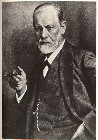 "The fateful question for the human species seems to me to be whether and to what extent their cultural development will succeed in mastering the disturbance in their communal life by the human instinct of aggression and self-destruction. It may be that in this respect precisely the present time deserves a special interest. Men have gained control over the forces of nature to such an extent that with their help they would have no difficulty in exterminating one another to the last man."
--Sigmund Freud, 1930--
Freud b(1856) in Moravia and then moved to Vienna in 1860 when he was four.
Age of the Liberal Hasburgian Empire:
Tax burdens were lifted on Jews and they were now allowed to own property
In 1873 Freud enrolled at the University of Vienna at age 17 where he studied medicine. He had originally planned to study law but as Freud described it, it was his, "greed for knowledge," that drove him to pursue the field of medicine. At Vienna, Freud studied neurology and physiology and began the quest for a scientific and physiological explanation for the innate workings of the human mind. In 1881 Freud graduated from the University of Vienna. Between 1885-86 Freud studied hypnosis and theory of hysteria under Jean Martin Charcot. During this time also Freud married Martha Barnays in 1886. Martha bore Freud, six children the youngest of which, Anna Freud become notable in the historical tradition of Freudian Psychology in its descent from Freudian thought.
Freud's medical professors, notabally Ernst Brucke indoctrinated the young Freud with "tough minded positivisim," i.e., a disdain for the metaphysical and pious minded delvings into naturalism.
Freud was a self proposed pious aethist who believed that science in theEpicurean sense of reality, i.e., the phsyician psychoanalytical method; could scapel the mental contructs of irrational nerousises brought upon the human experience with history of one in which the rational misappropiated instincts and drives imposed by the demands of the narcissistic and natural libido were impaled or sustained upon the crux of order and civilizational egoism. The demands brought upon by civilized material existence propelled man to seek comfort in life according to the pleasure principle.
Freud specialized in treatment of Victorian women suffering from Nervous disorders and hysteria. In 1895 he published, "Studies In Hysteria."
Freud believed that a woman's hysteria originated in her unconscious mind in response to her ego's cognitive defense mechanisms to rationalize or expropriate the experience of early childhood trauma, abuse and or neglect. During that trauma the unconscious imprint of the Ego upon the Id, was severed from its natural link between the ego as defender, to the ego that was repressed during that period of crisis effected the construction of a psychologically dysfunctional woman's egoist outlook in a way in which her sexual identity and vicariously her social and psychical identity were restrained, or repressed by that memory of early childhood trauma creating a dysfunctionalized identity complex effecting and encompassing her entire array of interpersonal relations. Freud termed his psychoanalytical study on the originate causes of hysteria, as sedation theory.
In 1899 he published, "Interpretation of Dreams," during that time his father also died. The essence of his theory on dreams is that all dreams represent a sordid and varied set of wishfulfillments.
In 1901 Freud published, "Psychopathology of Everyday Life,"to the tune of being percieved as a radical of modern philosophy. In 1902 he overcome anti-semitist prejudice and was elected Associate Professor at the University of Vienna. In 1905 He published ,"3 essays on the theory of Sexuality," in which he outlined his theory of the Oedipus complex as sustaining the drives and passions of men in day to day affairs. In 1908 he founded the famous, "Vienna Psychoanalytic Society,".
Freud's contempoary peers were the socialist Alfred Adler, and the Swiss Psychiatrist Carl Jung, (1875-1961). Freud began active correspondence with Jung in 1906.
Other Works by Freud
- Totem and the Taboo, 1913
- Ego and the Id, 1923
- Future of an Illusion, 1927 --An aethist dissection of the proofs of religion
- Civilization and Its Discontents, 1930
- Moses and Monotheisim, 1938
For further reading: Madness: A Brief History by Roy Porter