
|


|
Historical Site in Chinchilla 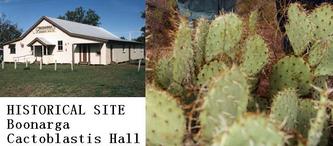 I travel through two main roads to get to work everyday. First, I'd be on the Warrego Highway (which is something like the Old Masai Road parallel to PaGu Highway) and then I'll have to connect to Kogan Creek via Banana Bridge Road. Along the way, I see trees which turn out to be cacti when you get closer. The cacti are so huge. But they aren't the main vegetation. There's not much farming these days, since there's been a drought here for two years. The fields are all laden with fresh soil, farmers waiting, hoping for the next rainfall so that they may sow again. I also noticed a lot of old flood warning signs as it had flooded horrendously in the past. In fact, the whole Brisbane is experiencing drought. On my first day, we were singing "Rain down" in Brisbane City Church, but we were not calling on the Holy Spirit, we were literally praying for rain. Now, a really interesting sign which caught my eye was "Historical Site" and when you take a second look, the building it refers to is the "Boonargo Cactoblastis Hall" ... So I did a google on that one... Guess what? The whole site is dedicated to an insect which saved Chinchilla's farmlands from the terrible cacti (or prickly pear). The cacti were imported from the Americas to be used as natural fences for the cattle but disaster struck when the cacti spread over acres and acres of farmland. You can see a colorful website on this. Click here. Excerpt of Article from Sydney Morning Herald website: In both the 1890s and the early part of the twentieth century the Queensland Government developed the area around Chinchilla with programs of closer settlement. While the first program failed the second one in 1906 was far more successful. The next decade saw the population of the area increase dramatically. The new settlers became successful dairy farmers and the economy of the area was driven by dairying for the next fifty years. It was during this time that Chinchilla wrote itself into the history books as the town at the heart of the eradication of the dreaded prickly pear. It is hard to imagine today but by the 1920s there were 24 250 000 hectares of Australia covered with prickly pear. The cactus had been introduced into Australia in 1839 and by 1862 it had reached the Chinchilla area. By the turn of the century it was increasing at a rate of 400 000 hectares a year. Farmers tried to fight it by cutting and burning but their labours met with little success. In 1925 the Commonwealth Prickly Pear Board, realising the scale of the problem, introduced the cactoblastis moth and larva from South America. Initially 3000 eggs arrived from Argentina and from a population of 527 females a total of 100 605 eggs were hatched. Half these eggs were sent to the Chinchilla Prickly Pear Experimental Station and half were kept in Brisbane. The moth was spectacularly productive. The second generation yielded 2 539 506 eggs. At the height of the operation Chinchilla was sending out as many as 14 million cactoblastis eggs a day. No wonder the locals decided to dedicate a hall to this small insect. Located 10 km east of Chinchilla on the Warrego Highway is the Boonargo Cactoblastis Hall which was built by the local farmers and dedicated to the redoubtable insect which had managed to eat its way through the jungles of prickly pear. It was seen as the true saviour of rural Australia and thus it is entirely reasonable that a hall should have been dedicated to its memory. 2007-03-27 12:45:44 GMT
|


