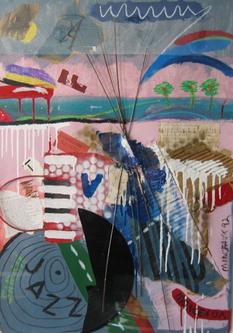
The Art of Jazz mixed media on paper with found objects
Morgan Monceaux

kid Ory's Original Creole Jazz Band
40x30 mixed media on paper with found objects
by William turner
los angele's arts and entertainment
Venice
11 /94
There is something open, innocent, even childlike, in Morgan Monceaux's paintings of the early founders of jazz that feels perfectly suited to his subjects. The musicians are painter with dark intensity but sit against a background of flowing, rhythmic, barley contained movement and color. At the recent reception for the artist at the House of Blues, (prior to their display at Barney's of New York in Beverly Hills), I had an opportunity to speak with the artist and to discover that he is a rare individual. As warm and proud and unaffected as his work.
VENICE: When did u start painting?
MONCEAUX: Three years ago. I'd been living in Manhattan, actually I'd been living in the Bronx and I'd lost my apartment and my job and was homeless for about a year. then I left New York and moved to Long Island.
Why Long Island?
I needed to get out of the city, where I was living was very dangerous. There were a number of crack addicts and I felt like if I wanted to survive, I needed to leave the city. I got a job in a nightclub named Lil's as the janitor and I started painting 3=4 months later and basically used things people threw away for materials.
Where did the inspiration for your first painting come from?
I live in a world of sound. I keep music on twenty four hours a day, whether I'm home or not. And these sounds that I hear in my head are what I try to put down on paper.
What were the subjects of your first paintings? Buddy Bolden
40x30 mixed media on paper with found objects
The first series was of American Presidents, which are now on their way to the Ford library in Michigan. Then I started working on Jazz.
What inspired the idea for the series of paintings of the presidents?
Originally my great grandmother told me that there were presidents that had African American ancestry, and I started researching when i was in New York at the Public Library, Just history. I wanted to know the truth and to find out for myself. SO i JUST STARTED DOING RESEARCH, READING BIOGRAPHIES, CONTACTING PEOPLE WHO HAD ACCESS TO What was not available to me through the library.What came out of this was that, yes, maybe there were one or two with African ancestry but the information was not really visibly available. But it led me to a different look at the White House and to view each persident more as a man.
You grew up in Louisiana. What was it like growing up there as an African American, as a black man?
As a Negro.
That's what you prefer?
No. But I grew up as a Negro. I went to an all Negro school. That's is what it was called "Peabody Negro School". THAT'S WHAT IT WAS CALLED "pEABODY nEGRO sCHOOL". However, where I lived-Alexandria, Louisiana-was in the center of the state. It's Catholic and Jewish and Italian and Black so its somewhat more liberal than the southeren half of the state. There is a Klan there and ppeople who carry racial prejudice, but I didn't really feel that until I got into Juniro high or high school. My grandparents, my mother, were very protective. I came from a large family so I wasn,t really exposed to it. I very seldom got to see what the world looked like outside my family.
How did segregation affect you  Duke Ellington 40x30 mixed media on paper with found objectsWell, because of that I had an oppotunity to become immersed in African and Negro history, which was unusual for that time. A lot of my teachers were graduates from Howard and had a strong orientation to teaching that. When I talk with kids and they ask me about growing up during segregation. I tell them that I didn't see very much of it. Where I grew up the major department stores would call my mother to let her know when the fashion line was in, and these were white stores, so what 's that? I mean you have the illusion that when you live in the south you're under a great deal of oppression. Yes there was oppression, but there were enlightened people who lived in the soouth too, they weren't all crackers.
My great great grandparents and great grandparents who had been brought up in slavery taught us to be proud. To be proud of yourself, that you have value that no one can ever take that away from you. That you should live in it-love it. And I do. each day of my life
When you left Louisiana did you have an idea of what you wanted to do with your life?
Yes. I wanted to be an opera singer. I studied opera and theology at Bishop College. There were very few black opera singers, or blacks who studied classical music. But in studying I discovered that i REALLY DIDN'T HAVE WHAT IT TOOK TO BE A OPERATIC TENOR, SO I WENT BACK TO SINGING JAZZ, AND THEN I WENT TO THE nAVY AND DID MY TIME IN VETNAM. wHEN I GOT OUT I KIND OF JUST HUNG OUT FOR A WHILE.
Was the adjustment difficult?
No,because once again I had my family. They were there to surround me and protect me and allow me to adjust. they gave me the things i needed to get back into society again.
You seem to have a great reverance for your heritage.
My family still has the records of it arrival in this country. I am a mixture of african, native american and french. so I'm Creole. And being creole you're not white, not negro, but in between. So there is a whole culture within a culture. It's one that has always preserved its heritage. So I was given both the written and oral information about these different sides of my family
 They would sit us down and talk to us. What happened, where we came from and who we are. We were taught to remember the family name and always be proud of it. To be proud of yourself, be proud of who you are. That you are part of the american fabric.
That sense of pride in African American history comes across very strongly in your recent jazz series. There is an obvious reverence for the musicians you've depicted. There seems to be something of the teacher in you. The works seem to say "this is who this person is and this is what they've done." There seems to be a strong desire to educate and enlighten.
Thank you, Yes i do, They wanted me to be a teacher but i never wanted too but i guess i am now,