
 |
|||||
 |
|||||
| The Life and Times of a Black Leatherman | |||||
A glimpse of the ultimate outsider 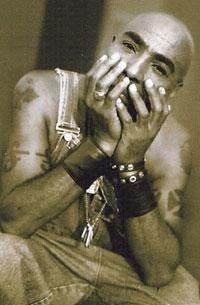
"If Elected I Promise-From George to George," was Monceaux's first project, completed in 191. It depicts U.S. presidents from George Washington to George H.W. Bush and was followed by three series on jazz greats and on black cowboys and Indians of the Old West. "I can't explain how I do it," Monceaux saya, "I work in series, there's a story line, and I try to start at the beginning and work my way as close to the end as I canget. Wheb I'm finished, the work starts." Monceaux's lively cast of charaters, draw in pastels and paint, and embellished with bits of fabric, bead, buttons and other found objects, instantly command viewer's attention. There's whimsy in his work, and a deep empathy with his subjects that often is spelled out in layers of idiosyncratic, hand written text that surround the figures. These anecdotes and bigraphical notes, which seem almost casually strewn across the surface of his paintings, are in fact the result of painstaking research. In many ways, Monceaux, who was born in 1945 in Alexandria, La., exemplifies what it is to be an "outsider" artist. He has no formal training in aart, and, as a homeless person, lived much of his adult life outside conventional society. His work does not belong to a folk tradition but is inspired by a private vision that exists apart from traditional notions of art and artmaking. However, in recent years, sucess has brought Monceaux rewards to which many formally trained artists also aspire. ART WORK OUT OF HIDING He was discovered in the early 1990s byan East Hampton gallery owner. While still working as a janitor and painting in his spare time, Monceaux passed a gallery in East Hampton thaat specialized in primitive American art. "I saw the works in his window. The images were raw just like mine," he recalls. "So I walked in and said "I know someone who can do this.' and the owner said 'No one out here can paint like this.' That's when I told him that's what I did." The gallery owner, Morgan Rank, asked for sileds but Monceaix didn't have any, So he asked to see the paintings, but Monceaux didn't have a way to transport them. Finally, Rank drove Monceaux home and looked at the paintings there. He was so impressed that a few weeks later he gave Monceaux a one-man show. Within a few years, Monceaux had been written up in the New York Times and interviewed on Good Moring Ameriica. He publisherd two children's books,Jazz:My Music, My People and My Heroes, My People: African American and Native Americans in the West, both based on his paintings. These days his works sell for between $4,000 and $7,000 and he earns enough to make it as an artist, something he never dreamed could happen. Last year, Monceaux moved from Providence, R.I., where he had been living since 1995, to Baltimore. THE CITY SEEMS A NATURAL FIT FOR THE ARTIST, ESPECIALLY SINCE THE aMERICAN vISIONARY aRT mUSEUM HERE SPECIALIZES IN JUST THE KIND OF ART HE MAKES. hE HAD RENTED STUDIO SPACE IN THE abell BUILDING ON EAST BALTIMORE STREET, BUT AFTER A WATER MAIN THERE BROKE, THE STRUCTURE was condemned. So Monceaux is looking to move yet again. Maybe he won't he won't go far.
2007-07-28 17:50:16 GMT
|
|||||


