
 |
|||||
 |
|||||
| The Life and Times of a Black Leatherman | |||||
DIVA SERIES: ( And So I Sing ) 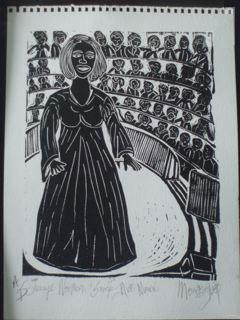 AFRICAN-AMERICAN OPERA SINGER (LINO-CUTS) FORWARD BY BOB DILWORTH We all know the music of black people. Music that comes from the deep bowels of the black soul. Music that began in a distant land, its syncopation and rhythm redefined in the fields of southern delta in times almost forgotten. music played in the juke joints and crowed shacks along narrow winding Mississippi roads. Music re-tempo-ed and re-issued to fill the dance halls and night clubs of nor then cities. Music, modified and echoed by almost every known popular musician. Some called it Boogie Woogie, some called it Bebop, some called it Jazz, some called it Blues, some call it Hip Hop, and some call it House. It all comes from the same place. It all resonates with the same cultural and emotional urgency. The souls of black folk remain deeply embedded in this music. The soul of America is irrefutably shaped by it. But Little is known about those black women in history who sang classical music. Those women who beat all odds to appear in recital halls and on operatic stages of the world. Who, through sheer talent and tenacity,out -maneuvered America's social and racial schizophrenia to be counted among the most gifted of classical singers. By all accounts they were perceptional. From Marian Anderson, who was proclaimed by Toscanini as having a voice that is heard only in a hundered years, to Jessey Norman whose Olympian voice catapulted her to international fame in the early 80s. And there were others. In the nineteenth century- Sissieretta Jones, Elizabeth Taylor-Greenfield, Marie Selika, and the Hyers Sisters, to those who came later such as Anne Brown, Camilla Williams, Dorothy Manor, Abbie Mitchell, Leontyne Price, Martina Arroyo, and Kathleen Battle, to name a few. Thus, the wave of black operatic and recital stars was relentless. In Morgan Monceaux's latest exhibition of lino-cuts entitled, " And So I Sing," he pays homage to the women who were triumphant in this music. "divas," he calls them, and divas they are. But what is a diva, a black diva in particular? What separates her from all other singers, many of whom sing the same songs but do not reach "diva" status? In other words, what are the primary ingredients in becoming and remaining a diva? The textbook definition is taken from the Latin word meaning "goddess, or divine one." However, these question led me to think of ten points that all the women above and many other share. To me, in every case they 1) Made themselves from scratch, 2) In their own way, formed and defined the black female stage presence, 3) Sacrificed all for their music, 4) Confessed to no crimes of the heart, 5)Instilled remembrance, 6) Had no fear, 7) committed to love, 8) Were real, 9) Undressed and then re-outfitted the soul, and 10) Created a safe harbor in us all. They each are not just a mere object de luxe, as many would have them, but a particular embodiment of black cultural heritage. In short, they are a necessary part to defining the black cultural whole. Through out twenieth-century American artist have turned to musical forms such as jazz, blues, and classical music to inspire specific artworks or to be the models from which a work is shaped. Monceaux often uses music to provide a ground for his paintings, drawings and prints. This group of twenty lino-cuts testifies to his ever expanding range of images based on the continuing theme of Black Music America. Like Romare Bearden, William H. Johnson, Archibald Motley, and a host of other black artist before him, Monceaux explores and reconstructs the psychological Underpinnings that has given rise to black music and makes it so enduring. Using the elements of visual design and printmaking he sifts through the interior spaces of black musical culture to form the corpus of Diva. Collectively, they constitute a world within itself. `The works are appropriately titled, given, in most cases, only the name of the songtress. As linocuts their power and presence are carried through the black heavy lines. they are dense and straight-forward, giving an expressionistic like narrative to each. For instance, in his representation of Grace Bumbry, " A Morden Diva," Monceaux centers the principal figure in the frame then focuses obsessive attention to the background evoking a spontaneity that is also surrealistic. The figure in the linocut of Kathleen Battle, kneeling and costumed in an ever expanding gown, has an air of rising out of the curvature of the floor into a space that is occupied by a series of tense, certical lines. The piece of Gwendolyn Bradley is electrfied with open spaces, animated flowers, and vision of totemic spirits disolving into the background. These works are achievements equal only to thoses of the women they represent. Clearly, Monceaux has given us an alternate vision of the "Diva." These are not just depictions of singers who made musical history but women who lives confronted and exemplified the conflicts of a world constantly changing. perhaps the diva can be bestsummed up in a poem by Langston Hughes. in DOWN AND OUT Hughes writes: If you love me Help me when I'm down an' out if you love me help me when i 'm down an' out. Cause I'm a po' gal that Nobody gives a dam about.
Robert Dilworth is Associate Professor of Art at the Universityof Rhode Island where he teaches African American Art History, Painting, Drawing, Design, and Intro to Art History. 2007-07-28 00:07:44 GMT
|
|||||