
 |
|||||
 |
|||||
| The Life and Times of a Black Leatherman | |||||
Jazz is the Muse 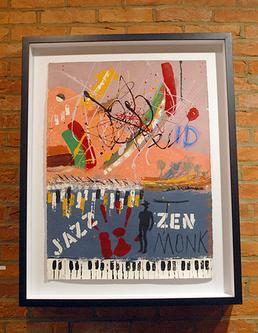 Slave to The Rhythm
By Morgan Monceaux The International Review of African American Art Volume 13 Number 4 Part 1 I paint because there is nothing else for me to do. At one time I wanted to be an Opera singer. My mother had been a singer, a bluse singer. She once told me," When you sing, remember the pain,struggle and love of your people and make the audience feel it." Mother's grandfather was a minister and we all sang for him in church: my mother,my grandmother, my great-grandmother, my sister and me. We sang for ourselves, too and played the piano. Living in Louisiana, my Creole great-grandparents liked blues and jazz but not as a way of life for their own children. My mother was a rebel. When I was younger I thought I was crazy because I heard music in my head. (i still do. Often, it's music that i've heard before or a comibination of unfamiliar and known music: full sounds, not impressions. And each day the sound track changes. I dream to a sound track and when I wake up, the sounds are flowing out of the dreaming.) There were a lot of juke joints around Alexandria, Louisiana when I was growing up. Jones' place was near my house. A wooden building with a tin roof, it had been a sactified church, so the rhythms ran deep there. Sometimes my sister and I would be allowed in the place when my mother performed. Other times we would stand on barrels and peek in. My mother sang songs that she composed about her life and loves. " Stonewall Has gone Away" was about the divorce from my father. One of the most memorable moments of my life occurred when I was 10. My grandfather and his brother, both musicians who lived outside of Baton Rouge, were friends with Louis Armstrong and Mahalia Jackson. As friends of my uncle , both were part of the family. When my uncle died, he was given the traditional jazz funeral where musicians come to play forr the departedfriend. In the cemetery chapel on the family property, Uncle Louis and Aunt Mahalia joined us in saying good-bye. The funeral procession started with a slow dirge, " Lord, I'm on my way home." It sounded like the world had come to an end. As we approached the cemetery, Aunt Mahalia burst into song. The feeling was powerful. It was like God was there waiting for my uncle. I had never seen anything like that. It was sad but electrifying. In 1967 I left college to serve in Viet Nam. I belived that my country called. When I came back in 1969, I was on the verge of being shell-shocked." Being young and naive, I had not realized that I would be responsible for death. My family---sister, Mom and cousins from all over the country---came together and stayed with me for nine months, Living in houses on the family compound. Because of them, I was able to heal. Entrenched in Viet Nam, America was also embroiled in a social revolution at home. I now needed to find out where I stood as a black man in america and as an American citizen. I left Alexandria and travelled around the country: Arizona, California,Michigan,Texas,Mississippi, back to Louisiana, then on to San Francisco and Seattle. I worked as an offshore driller,short order cook,janitor,treated telephone poles with creosote-anything to survive, including a gig at Mc Donald's. Like the early, itinerant jazz muicians, I needed the newness that moving brought to my life. I slowed down only long enough to care for my mother when she became ill and to get married. Mom died. I got divorced and left for Seattle, again. In 1990 I was drawn to New York by the jazz vespers at the Cathedral of St. John the Divine. In the City, I met one of my buddies from the Navy who had a business cleaning basements. I worked with Cass until he was murdered one night as he was returning to his apartment. I only had a little money at the time and faced eviction when I couldn't make the rent. I became homeless. If i had called my aunt, she would have said, "Come home." But I could not make that call. I could Not go home. I said to my self, in effect: " I 'm a man. I have to take responsibility for myself. I got myself in this: Ill have to get myself out. I can live through this. It is not going to kill me." The people who were most helpful to me were the pimps,prostitutes and transvestites on 42nd Street, and the city's immigrants: Hispanics,Asians and Africans_particularly the Ghanaians. If you need a hand,these people are there for you. They would let me come to their homes to shower aand clean up. I didn't find that kind that kind of concern from most Americans. People who appeared to be stable, Christian types to humiliate me. Initially I was totally dumbfounded but eventually I understood: these people shirked from me as a way of protecting themselves. Being homeless shatters your reality---your conception of the world and who you think you are. surviving as a homeless man was the most difficult thing I ever had to do .To find myself eating out of trash cans and dumpsters was like having a ladder knocked from under me. I learned to be very humble. The experience put me more in touch with myself:I had to get a grip on myself. And it made me more aware of how people treated each other and judged others based on how they looked. Most of my energy was concentrated on survival. I didn't want to die a statistic in a city where nobody knew me. 2007-06-21 18:14:05 GMT
|
|||||