| | ADVERTISEMENT  Portrait of the Portrait Artist
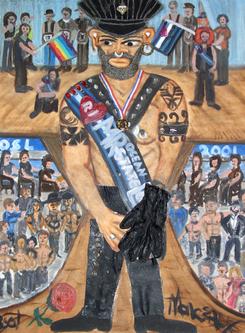
 | | Painter Morgan Monceaux. Photo by Sally Neeld | In the world of fine art, Morgan Monceaux widely is known as an important contemporary American portrait artist. He will be in Minneapolis for the 11th annual Leather Leadership Conference (April 20-22), where he will be among the artists whose work is on display in the art gallery. Although he currently is undergoing treatment for lung cancer, when I interviewed him recently, he sounded cheerful, strong, and in good spirits.
Monceaux’s art credentials are impressive. Three of his paintings hang in the Smithsonian Institution’s National Portrait Gallery. His art has been exhibited at the Carter, Ford, Nixon, and Hayes presidential libraries, as well as at galleries and universities.
And Monceaux has illustrated and authored two books: Jazz: My Music, My People; and My Heroes, My People: African Americans and Native Americans in the West.
The artist grew up in Central Louisiana. His mother was a jazz singer.
In Monceaux’s words, “Mahalia Jackson and Louis Armstrong were my surrogate uncle and aunt.” Monceaux aspired to be an opera singer. He attended Bishop College in Dallas, Texas, studying music and theology. In addition to everything else, he is a licensed and ordained minister.
After entering the Navy and serving in Vietnam, Monceaux says he “came back a different man.” He decided to travel—“to experience the world, to see what America was about. For my own sanity, I needed to do that.”
Monceaux’s travels took him to San Francisco, Seattle, New York City, and Long Island, where he taught himself to paint. He now lives in Baltimore in a row house that is also his studio. It formerly was Cab Calloway’s boyhood home.
The painter’s nontraditional style of portraiture makes use of pastels, paint, and markers, along with found objects such as fabric, ribbons, jewelry, plastic toys, and even Popsicle sticks. Text describing the subject of the portrait swirls around the canvas.
Every so often, Monceaux chooses a theme, then creates a series of pieces around it after researching the theme extensively.
Monceaux’s first creation was a series of portraits of every American president: “George to George.” Other series include “The Royals”; “Shall We Dance” (African-American professional dancers); and “Divas” (African-American concert and opera singers). His next series, “Pages from a Black Leatherman’s Journal,” will be photographs of African-American men and women who are part of the leather community.
Known in the leather community as Nagrom or Sir Nagrom, Monceaux has been a leatherman for almost 40 years. He holds the title of Mr. Ocean State Leather 2001, and competed at the 2001 American Brotherhood Weekend.
The artist explains that his legal name is Nagrom Morgan Monceaux: “I’m Nagrom all the time, and I’m Morgan when my paintings come out.”
Monceaux is Old Guard, and proud of it: “People keep saying the Old Guard is dead. We’re far from dead. We’re just standing nearby watching you make fools out of yourselves—because you think it’s all about the sex, about how many people you can sleep with, how much pain you can take, how many times you can be wrapped up, stuck, cut, what have you.
“It isn’t about all of that. There’s a spiritual aspect to being a leatherman that so many people miss. I want my boys to know that you can go and stand before the throne of God, and this is how you do it, and let me take you there, so you can see for yourself.”
Regarding his cancer, Monceaux relates, “It’s been a 10-year fight. It went into remission, and it came back again two years ago. At one point, I had decided not to go through the chemo and radiation, because I knew what it did to me the first time, and I was afraid of having to do it alone. I had a boy with me, but unfortunately, he booked—he left. I was here by myself—not a very pleasant place to be. I thought, ‘If this is it, then this is it, and I want to go out like a fucking comet. I’m going to paint the greatest body of work I’ve ever done.’”
The artist was working on the “Diva” series at the time.
Monceaux goes on, “But I changed my mind. My paintings talked to me, and they said, ‘You can’t give up. Why are you giving up? Look at what you’re creating. Look at the story you’re telling.’ And I looked at my paintings, and it was, like, you’re right. What in the hell was I thinking?”
According to Monceaux, the treatments this time have been easier: “I’m a guinea pig for Johns Hopkins, and they’re using a new form of treatment for my specific type of lung cancer.”
And Monceaux is no longer alone. He currently has two slaves—as he remarks, “one full-time 24/7, and one part-time.”
Throughout the treatment process, Monceaux has continued to paint: “That’s the one thing that helped me make it through the sick times—the times when I was puking my guts out. It allowed me to surround myself with 30 beautiful women, each one of them singing at the top of their lungs, singing their hearts out. It let me hear them tell their stories. So, when you said I sound cheerful and chipper, I am cheerful and chipper. Damn right. I am a man who’s very happy to be alive today—to be able to have this conversation with you.”
|  |