


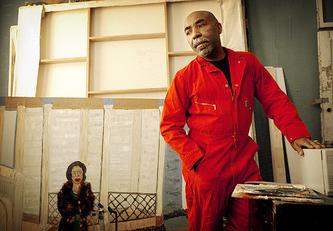
This scene marks the climax of Puccini's operatic masterpiece Madama Butterfly, and, on a hot summer day as Baltimore artist Morgan Monceaux struggled to translate his vision of it into paint, the opera's sonorous harmonies and plangent melodies resounded through the rooms of his sweltering West Baltimore rowhouse.
 = dcminversion  |
Monceaux's evocation of Butterfly's grief is a scene of transcendent pathos and beauty. The flat, painted figures -- Butterfly clad in a sky-blue kimono with oak-leaf stencils and gold braiding, her small son in a green silk jacket with velvet embroidery -- are embellished with bits of paper, foil, fabric and silk orchids, along with sequins, American flags and even Popsicle sticks.
Entering the seventh decade of his life, Monceaux has been hailed by those who know his work as one of America's most important living visionary artists -- a self-taught genius whose works have hung in major museums.
In 2003, the National Portrait Gallery in Washington purchased three drawings by Monceaux -- of jazz greats Ray Charles, B.B. King and Dinah Washington -- the first portraits the museum had ever accepted into its permanent collection that weren't made in the presence of the subjects.
"You see in his work a very personal rethinking of the individuals he portrays, so that what we feel above all is that he cares about them, that he is fascinated by them, that the details he brings out in their manner or costume give them a kind of grandeur," says National Portrait Gallery director Marc Pachter.
"Very often what people see in some other visionary artists is a very basic view of life, life stripped to essentials," Pachter adds. "But Morgan's on the other side: He's highly civilized in his vision, highly elaborate, a visionary through complexity. All visionary art is personal and deeply felt, but his feelings operate at the level of the grand and the theatrical."
But as Monceaux raced to complete his mural-scale image of the doomed Butterfly last summer, the specter of premature death also hung over his own life. For years he has battled lung cancer; the disease, formerly in remission, had returned recently to waste his body and spirit. He has long suffered from fragile health, compounded by high blood pressure, HIV and other ailments.
Though the doctors urged immediate chemotherapy to save his life, Monceaux hesitated. His grand vision has been a series of 40 monumental scenes from the world's great operas in which African-American performers played starring roles. He feared the side effects of therapy would render him too weak to paint. And if the treatments proved unsuccessful, he might die leaving his magnum opus unfinished.
"I thought this might be the last part of my journey, so I just said, 'OK, then I'm going out with a bang,'" says Monceaux, a compact, wiry man whose trim figure belies his 61 years.
"I said, 'I'm going to paint until I drop dead, because I'm willing to die for my muse. And if they say anything about me, it's going to be that the brother believed in his work enough to die for it. If you don't believe in it enough to die for it, you shouldn't be doing it."
But Monceaux's friends were torn by his decision. None of them felt entitled to tell him how to live his life, but at the same time they were fearful for the artist's health. They wanted to respect his dedication as an artist but feared losing a beloved friend who might be saved by the therapy.
"When you make a decision like that, it divides people," says Monceaux's friend Dudley Clendinen, a former New York Times writer now living in Baltimore who has written about visionary art.
"Morgan had been through [treatment] before and knew what it did to his energy and ability to concentrate, so he thought he could either do the divas or treat his cancer," says Clendinen, who also worked for The Sun briefly in the '90s. "But I think everyone close to him was hoping he would have the chemo."
Friends intervened
Ever so tactfully, the artist's friends nudged him to reconsider."They told me to be realistic," Monceaux recalls, "that I was putting myself in harm's way in order to create when I was going to create anyway, so why not take care of myself? In other words: Take the therapy, but whatever decision you make, we're going to stand by you."
Eventually, Monceaux was persuaded to take his doctors' advice.
"Part of what people love about Morgan is that he dares to live completely as the person he is," says Janelle Farris, a New York ceramicist who regards Monceaux as a kind of father figure. "That's the beauty of him, the way he's willing to stand on his own choices. I have to respect that."