
 |
|||||
 |
|||||
| The Life and Times of a Black Leatherman | |||||
Race, Class, Gender donot=Character 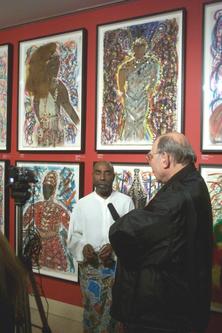 By Claude L. Elliott Curator with the Rhode Island Foundation Comments By Claude L. Elliott Curator with the Rhode Island Foundation On exhibition for the first time were twenty-two paintings from The Royals, at the American Visionary Art Museum. A series of fifty mixed-media works, which Morgan Monceaux began creating in 1993-94. These works on paper are comprised of oil and acrylic paint, magic marker, and recycled objects. Buttons, string, sequins, fabric, costume jewelry, also fragments of plastic, wood and leather are reclaimed from obsolesce and fashioned for artistic purposes. The creative process begins with a pencil sketch outline, by details of the figure developed with oil and acrylic paint, dependent on the colors required and which materials are accessible. The goal is to quickly capture the essence of the personality, then design a visually compelling background, and lastly the placement of text. Text written diagonally, upside down, right to left, left to right activates each portrait. The viewer is challenged to follow the text as it evolves around the figure of the subject outlining historical facts. The combination of text and painting are reminiscent of early illuminated manuscripts. They also resemble the engraved text and illustration of the 19th century poet-painter William Blake. The use of recycled materials is a conscious and thoughtful prosess. Each subject demands unique embellishments to make the portrait lively and personal. Therefore, additions have been made several of the portraits, at a later date. Closely observe King Solomon's gold ornaments which were added after a prolonged search by the artist for the appropriate golden materials and found only recently in Baltimore. In The Bible, Kings 10:2 states that the Queen of Sheba "came to Jerusalem with a very great train, with camels that bear spices and very much gold, and precious stones." The gold ornaments and precious stones sewn into Solomon's clothing reflect his wealth and wisdom. Solomon's vestments subtlety suggest his relationship with the Queen of Sheba. The portraits of the royals are informed by historical references and source material including engravings, photographs, drawings, or artistic license. Makeda, The Queen of Sheba is the first in the series created is conjured out of the artist's imagination. Most likely it's a composite of women with Ethiopian features Monceaux witnessed on the streets of New York City. An opportunity to comment on the Diaspora and cultural lineage is not missed by Monceaux. The artist questions the fascination of Americans with European nobility. Children are taught about ideal beauty, class differances, and gender roles through fairy tales about Prince Charming, Snow White, and Sleeping Beauty. The 20th century weddings of the Norwegian Prince Harald V and Sonja Haraldsen in 1968 and the British Prince Charles and Diana Spencer in 1981 are clear examples of this fascination about nationality, class, wealth and power. The idea that a ruler is chosen by divine providence and imbued with the divine right to sit on the throne is the focus of these paintings. While Americans turn towards Europe for the majestic, pageantry, and pomp and circumstance, Monceaux looks beyoun the West and includes the continents of South America, Asia and Africa with its powerful dynasties dating back 10 1375 B.C. Monceaux is interested in historical dress, offical poses, and symbols of power. The artist symbolizes power through metaphors-the use of scale, the royal stool, tiara, crozier, crown and other royal accoutrements. In the art historical canon size denotes importance. Emperor Hirohito of Japan is presented larger than life, in frontal view; his larger figure occupy the sheet of paper much as a massive Olmec sculpture utilize its block of stone. Hirohito is dressed in clothing for the temple, in his hand are prayer sticks, glasses frame his face and are attached over his left ear. His hat is made from paint, metal, and fabric, and his clothing, neckline, shoulder and the front of his jacket is outlined with green velour. While the portrait of King Prempeh suggests that the seat of power is activated by the golden stool, the portrait of Supreme Pontiff John Paul II is more elaborate and ceremonial. The Pope wears the triple crown tiara, symbolic of the three spheres of papal power-the church, earth, and hell. He holds a gold pastoral staff with a crucifix attached symbolic of the office of the bishop of Rome. The Pope presents his fisherman's ring cherished as a symbol of the allegiance of the faithful to the Papacy. A gold cross suspended from his neck. In contrast, Holiness Dalai Lama Gyatso is presented as a simple Buddhist monk. According to Tibetan tradition, the Dalai Lama is the Head of State and spiritual leader of Tibet, guided by Buddhist principles. He was awarded the 1989 Nobel Peace prize for his writings on Buddhist philosophy and for his leadership in human rights and envirinmental issues. He advocates peaceful solutions to international challenges. Although The Royals is conceived as a series, each portrait is a single entity each story is independent. In this series monceaux the artist fulfills the role of historian and storyteller. The Royals is a work in progress and continues to be fueled by the artist ongoing investigation of history, an interest in portraiture, and the universal experience. Sunday November 19, 2006 - 05:18pm (PST) Perman2006-11-20 01:18:42 GMT
|
|||||