dcsu04.zip
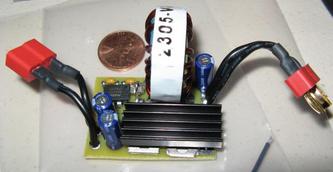
Finally this is the most powerful voltage step-up circuit I have built to this day. This circuit can provide upwards of 100W at 12V from a 6-cell NIMH. It uses all throughhole parts so it can be easily built, but as you can see, the size and weight is considerable. This circuit has gone through a few builds to make it work up to the wattage it does. The heaviest part is the inductor, so if you don't need all this power, you can go with several smaller ones, I've provided several holes in the circuit board for this purpose.
The voltage is not fixed at 12V, you can set it using two feedback resistors. Follow the directions in the included text file.
This circuit has a built-in protective current-limit which can also be set. I have found that the amount of heat is rather negligeable (as long as you don't saturate the inductor) so a heatsink may not be necessary. Even with the current limit, don't short it out, you can still kill the circuit this way.
There are many uses of this circuit -- for instance you can create 6V from the 5V BEC in many ESCs to power your servos + receiver, you could use it to power 12V fans, you could use it in stock racing / turn-limited racing to give a higher voltage to your ESC and motor (higher max speed), you can use it to level the voltage in a longer run so you get semi-constant speed even as your batteries discharge, etc. This is the first real high-power circuit I've made that gives enough power to power a RC motor -- a small one like a mamba 1/18th scale. Nowhere near enough power for a mamba max, the inductor is rated at ~16A, so this is going to limit the maximum power out. Operating off 6 NIMH cells (6-7V), you can expect to get 90-100W of power tops, after which the voltage will start to taper off until it drops to a little bit below the entry voltage. If you're going to use this on a high-power system, consider installing a schottky diode to bypass the inductor when the current limit kicks in, otherwise you could end up saturating the inductor and further limiting your current.
For more info on the max1771 IC used in this circuit, go to the maxim website and search the part "max1771".