Bio 101
Introduction
Biology - Bio· (life) & ·logy (study of)
The Scientific Method
“Rules” of scientific investigation
1. Observation - define the problem you wish to explain
- Hypothesis - one or more falsifiable explanations for the observation
- Experimentation - controlled attempts to test one or more hypotheses
- Conclusion - was the hypothesis supported or not; accept or reject hypothesis
Scientific theory - A hypothesis tested several times.
Scientific law – A fundamental underlying of the universe’s workings
3 Theory’s of
Modern Biology
1) Cell theory –
A) All organisms are composed of one or more cells
B) All cells have arisen from pre-existing cells.
2) Gene theory –
A) DNA is the physical carrier of inheritance
B) The hereditary info in the DNA is translated (via RNA) to build proteins
3) Theory of Evolution –
A) Adaptation – all organisms adapt to their environment
B) Variation – all organisms are variable in their traits
C) Over reproduction – all organisms tend to reproduce beyond their environment’s capacity to support them
D) Natural selection – since organisms are not equally adapted, some will survive and reproduce better than others
Characteristics of
Life
|
Adaptation Growth / Development Organization Reproduction Response to stimuli |
Homeostasis – maintenance of a constant internal environment Metabolism – acquisition & release of energy Interactions (w/ each other & the environment) |
I Principles of Cellular Life
Chemical Foundations for
Cells
Element – a pure substance that cannot be decomposed by chemical change
Atom – the smallest unit of matter containing the properties of a particular element
Sub-atomic Particles
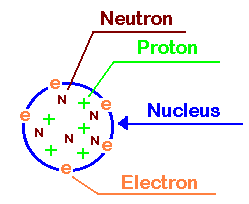
Atomic # – the number of protons in the nucleus
Atomic mass – the number of protons & neutrons
A neutral atom contains the same number of protons, neutrons, and electrons.
Isotope – A variant form of an
atom; specifically, having the same number of protons but
a varying number of neutrons.