Democratic
People's Republic of Korea
Annoy hasemnika!

Why not visit North Korea before it is too late?

Updated Juche 90 (2001) January 21 GMT 02:10

Wishing all visitors a Happy New Juche decade!

This country is open to nearly everyone who wants to explore the most interesting place in the world.

Welcome


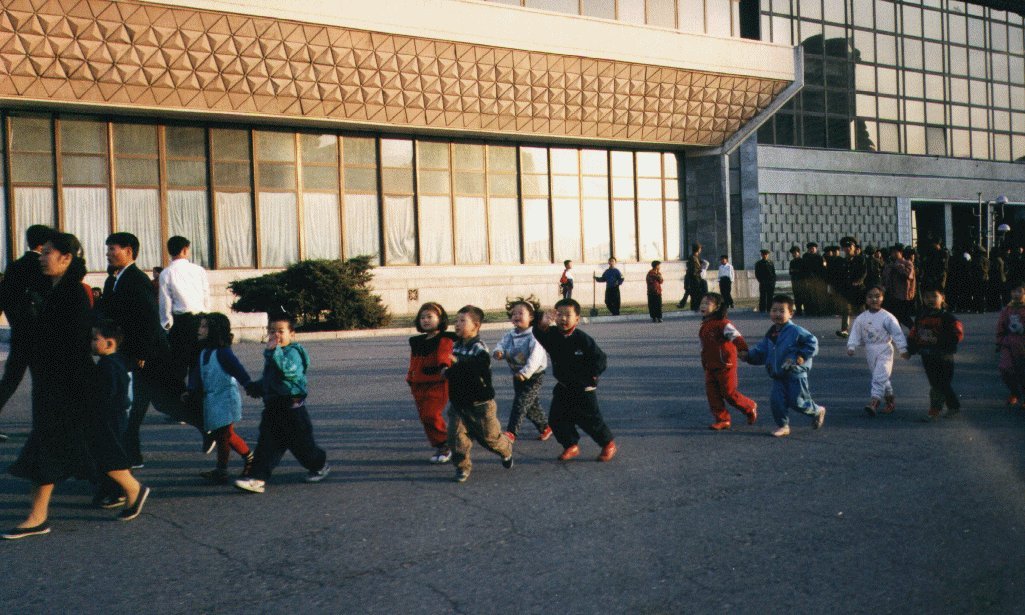
The official North Korea is not that welcoming - no advertisement, not even official web page what I am aware off, visas from Beijing etc. But after you booked (and paid) your holiday, you can feel that you are taken care of and you can feel generally very welcomed, especially by children who express their greeting - hello, hello! You are not ripped off in Korea, not even encouraged to shop much.

What is North Korea?

In a nutshell it is a country which wants to be "normal", but it is not for you - as my guide pointed out shortly after our arrival. Sometimes you will get the feeling that it is a country which is in a war - but no bombs. This applies to prevalence of uniforms and infrastructure.

Travel arrangement

Travel arrangements include all meals, accommodation, transport, two guides and a driver, entrance tickets (except Juche Tower, which is 10 won). You will pay for your own shopping. The train ticket is included in the price and please note that when most travel guides mention 6-day tours, they start when the train sets off and returns to Beijing so you will practically spend about 4 days in North Korea. Please note that the host set the terms in the travel, this means that it is more than likely there will be changes on arrival or during travel of itinerary. Our guide wanted us to stay in Pyongyang for four days, because of lack electricity in Kaesong, but he said we can try candles if we wanted and we said it is not a problem.

All visit to North Korea has to be prepared well in advance

 
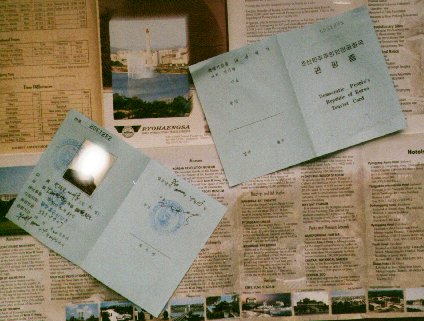
You have to remember that normally you have to collect your visa by prior appointment (which has been arranged by your travel provider) from Beijing embassy which is issued on the spot - you have to arrive on the time given to you, because the embassy is not normally open. It is best to read as much as possible about North Korea prior to arrival. We lent our train tickets to an embassy employee for a day, because he wanted to send some stuff to Pyongyang. He returned them next day as agreed at Beijing railway station.

Travel restrictions

Visitors get where the guides brings them. Journalist are not allowed to visit using tourist visa. This rule has been more forcefully enforced in the last years. You will be told what you can not do.

Travel in and out North Korea

Air

Pyongyang airport at Sunan, 22 km west of the city, is the only airport use for international passenger traffic (or at the moment at all). The airport has two runways and following flights (as per August 2000): Pyongyang-Beijing (2 flights per week), Pyongyang- Moscow-Berlin (1 flight per week), Pyongyang-Bangkok (1 flight per week), Pyongyang-Macau (1 flight per week), Pyongyang-Vladivostok (1 flight per week), Pyongyang-Shenyang (1 flight per week), but I am aware that Beijing is usually only alternative for tourism. There is no much hassle, but there is a shop for visitor. The transfer to Pyongyang will be by car or coach.

Train

The train takes about 25 hours from Beijing. The speed of the train is slow, so you can get a view of Korean countryside. Although, the line is electrified (as most of the rail network in North Korea), the train is a diesel one. There is a possibility that you will be sharing your compartment with Korean people, so you can probably find the first chat in your life with a North Korean national, this, of course, depends that you can find a common language. Beware that some Koreans smoke like chimneys everywhere, so there is a big probability that you will be a passive smoker during the trip. The border check takes a while, not too long both in the Chinese and North Korean side. Please note that we did not have any problems of bringing old camcorder, Lonely Planet's North Korean pages (the info on the 1998 edition is out of date i.e. there are bicycles, the stamps have glue on the other side, there are some street stalls with bread in Pyongyang and Kaesong) and remember all pictures even in newspapers respected leader Kim il-Sung and great leader Kim Jong-il have to treated well - no folding. I have sometimes been checked more troughly in Finland than in North Korea. There is a restaurant car were you can share your meal with People's Army soldiers.

Travel company

All tourism is handled by Ryohaengsa (Korea International Travel Company). This company is state-run and has about 300 employees both men and women. You can contact them directly by fax (or telephone), but you are probably then given a contact outside Korea.

Guides (Minders)

You will be accompanied by two guides who hopefully answers your questions and asks questions from you as well. These guides have many times been studying a foreign language abroad. One of our guide had studied English in Tanzania. The other one had travelled around Europe. These guides have been trained to carry out the work in professional manner. They also meet many visitors, so do not be surprised of their knowledge. You can get guides in English, Spanish, Chinese, German, Japanese, Arabic and Russian. There is a shortage of Chinese speaking guides, so some of the guides attend Chinese speaking courses. If you feel you want to tip or give a present, you can after your visit. After the trip our guides wanted us to tell friends to visit North Korea and even hoping to see us again. I send some letters and pictures, but have not received any response - yet.

These are the answers to some of my questions from our guides

Can a local marry a foreigner?
There is no law against it.. but it is not encouraged.

What is the average salary of a North Korean?
150 wons.

Where does the great leader Kim Jong-il live?
He lives in his office where is working.

How did you meet your wife?
Through parents and their friends.

Guide: Is he homosexual?
Visitor: It does not means that every man who have long hair is gay in Europe. Are there any homosexuals in Korea?
Guide: Silence

What is your religion?
Most Koreans believe in Juche idea.

Visitor: Great leader Kim Jong-il has a son and his half brother is (or was) ambassador in Finland. {The family relatives are not public figures or even known in North Korea}
Guide: Where did you get the information?
Visitor: From internet.
Guide: INTERNET!!!

I have a heard that defectors live well in North Korea. Is it true?
Silence

Does the great leader Kim Jong-il drive himself?
Yes, he is more brave than father.

What type of rocket did North Korea launch 1998?
It was used for collecting information such as weather.

Calendar

Since 1997 North Korea follows Juche Calendar. Respected leader Kim il-Sung was born on year 1. The dates are the same as in Gregorian calendar.

Pyongyang

Pyongyang is completely re-built after Korean war and it has impressive architecture. The main street is 13-lane and you can find that the centre of North Korea has the cleanest air of any million cities in the world. It is claimed by North Korea that is has one of the highest proportion of greenery per person of any big cities.

Highlights

The trip is going to be educative and your are in the host terms. Forget about 'meeting a man or woman in the street', fortunately, you can have a good chat with your guides. If you do not know much about (North) Korean history after your trip you will. Infrastructure: water supply, electricity supply is not probably what your used to (except in Pyongyang hotels). Apart from speaking to your guides, you can possibly speak to waiter/waitress if you find the common language and to soldier. Please note that in most cases you rely on the translation of your guides. You do not find any street cafes to go in the evening - your guide probably suggest bowling.

Circus
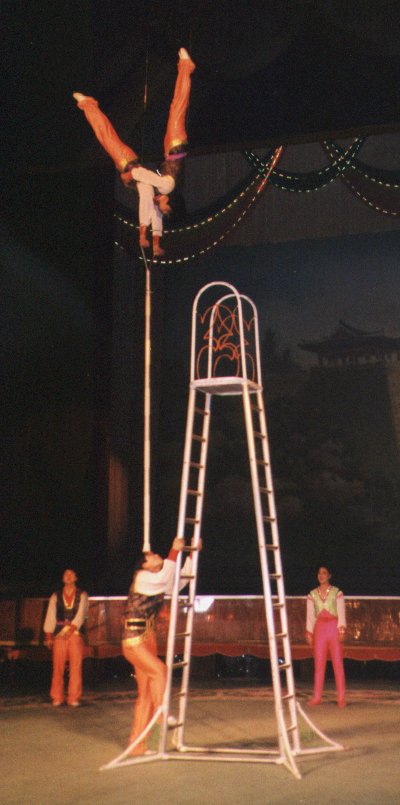
Pyongyang circus is one of the top circus in the world. Pyongyang circus is very interesting for someone who thinks circus' are on decline. There is athletics performances, clowns and sketches. And be aware that they are picking a volunteer during a performance - so if want to get a bit more famous in North Korea...

Children's palaces and Kindergarten
You will probably visit at least one of the following children's palaces or kindergarten
- Mangyongdae Students' and Children's Palace, located in Mangyongdae District. This palace houses group activity rooms, a swimming pool, a gymnasium, a library (a hundred thousand volumes), a theatre.
- Changkwang Kindergarten is located on Changkwang St., Jung District. Kindergarten has a Kim il-Sung Revolutionary Ideology study room as well as playrooms, study rooms, bedrooms, and bathrooms on each floor. It possesses 260 stuffed animals and 255 musical instruments.
- Pyongyang Students' and Children's Palace is located at Chongno-dong, Jung District. This Palace is an education and cultural facility for students' extra curricula activities. The Palace possesses 500 plus rooms including 200 activity rooms and small group rooms for politics and ideology, science and technology, arts and athletics. There is also a 1,100 seat theatre, 500 seat gymnasium and an observatory on the 10th floor rooftop.

International Friendship Exhibition Hall 

The International Friendship Exhibition Hall, located at the valley of Mt. Myohyang in North Pyongan Province, was built in 1978 to exhibit gifts to Kim il-Sung and Kim Jong-il.
There are two halls, one for Kin il-Sung and Kim Jong-il, which was opened 1989.

May Day Stadium

May Day Stadium, built for the 13th International Youth Festival 1989, has an interesting roof construction of titanium and can accommodate 150 000 people. This stadium is one of the most impressive stadiums in the world.

Kim il-Sung birth place

The birth place of Kim il-Sung is located about 12 km from Pyongyang centre. This place can be very crowded with school children during daytime.

Martyrs' cemetery

This is full of graves of North Korean heroes and heroines.

Juche Tower

Juche Tower, built in 1982, gives a nice view of Pyongyang in a clear weather. Admission charge.

The is also an approx. 200 m tall TV tower, but I do not know if it is open at the moment. 

Panmunjom

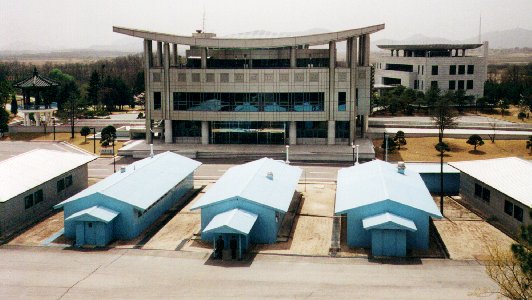
Panmunjom is still on the agenda, although broadcasts have stopped. If you expect dramatic you will be disappointed. You can look the border and think that during the years there has been two way traffic from south to north and vice versa. Remember the yellow line - I nearly missed it and my guide told that terrible things happen if I had crossed it. 

Travelling by visitors

Depending if you choose an individual tour or group tour, you will either travel by minibus (e.g. Toyota Town Ace) or by coach. There are four line highways to south and north. One interesting point is that the metro seem to be free. Little traffic outside Pyongyang and the surface of the roads is not the best one. The roads to Pyongyang and Kaesong (three!) have checkpoints. The motorways are usually built by People's Army. Between Pyongyang and Kaesong there is one rest area - So-hung. It has a lounge and two shops that sell beverages, hand-made goods and paintings. You will most likely share your tea with your guides only.
 

Travelling by locals

Pyongyang has bus, trolley bus, tram and metro. The public transport is crowded in the morning. You are very likely to use the metro only one ride - it seem that the metro is free of charge for everybody - maybe it is more expensive to collect the coins than they are worth. You will be accompanied by your guide. The metro is built in 1970s and with many individually decorated stations. The station names are revolutionary. Taxis (have signs) are usually Volvo 144 -74 (North Korea seems to have bought a bulk of these after Swedish recognition of DPRK in 1973) if you ever need one. Outside Pyongyang you will see hardly any public transport, even the train service to Kaesong has been suspended. Private cars compensate (if available) for the missing public transport, so you can see hitchhiker(s) on the road waving pack(s) of cigarettes (the local money with Kim il-Sung seems to worthless - our guide did not have it even for a souvenir).

Cars

Although there are North Korean truck and light vehicles. There are no North Korean passenger cars - yet. The most popular cars are various Japanese (brought as second-hand because of the steering wheel on the right). Korean (south and north) traffic is on the right side. One thing you will find that although North Korea has very few cars (we travelled 180 km in Pyongyang - Kaesong 4-line motorway and we passed only 5 cars), but one of the highest proportion of Mercedes' and Volvos in the world. Some of the army Mercedes' are presents from great leader himself. Other popular cars are Dacia (Romanian Renault) and Volga. The majority (in my estimate 90 %) are state owned i.e. white number plates (civilian) and black (People's Army). Normally people who have own cars (yellow plates) are people with relatives in Japan according to our guide. The blue number plates are diplomatic cars. Although I could see Samsung TV in hotel - South Korean cars are forbidden according to our guide. The great leader Kim Jong-il is keen driver himself, unlike his father respected leader Kim il-Sung.

Accommodation

Although Pyongyang has many hotels you are likely to stay in the following (except Ryuguong).

Yanggakdo International Hotel - Pyongyang

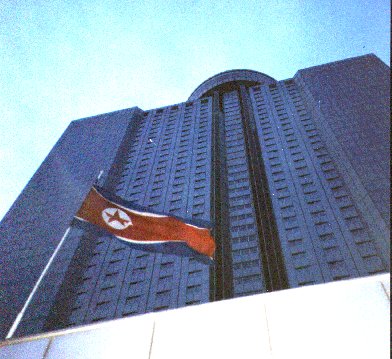
Visitors are most likely to stay in the Yanggakdo International Hotel. This 48-storey hotel is built 1995 has 1001 rooms of different classes. This is a modern, although the final finish everywhere is not to the top class and it is situated at Yanggakd Island. You can get to the top level, but the revolving (not revolving at the moment) restaurant on the top seem to be closed. Drawback - inconveniently located, but this is a minor, because you are not allowed to walk unaccompanied. There is a Korean, Chinese and Japanese restaurant and also a standard one called Restaurant no. 1 (before called western restaurant). This hotel has the only casino in North Korea opened 1999 (Koreans not allowed). Pool, sauna, bookshop, hairdresser, bureau de change are also for your use if you have time.

Koryo Hotel - Pyongyang

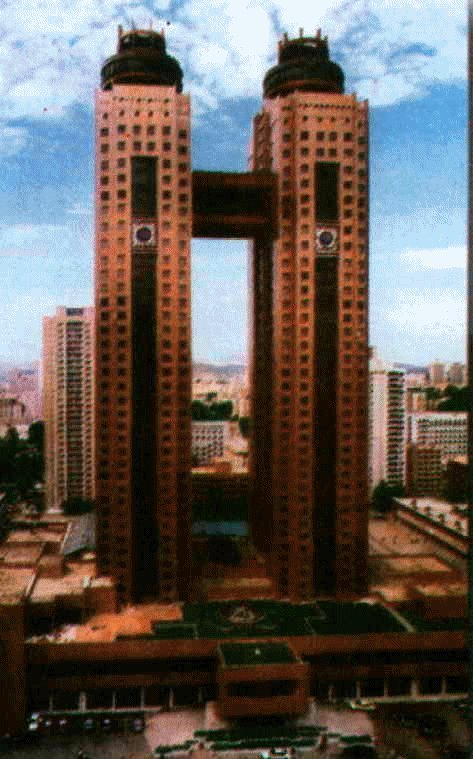
Other hotel is 45-storey twin tower Koryo Hotel is built 1985 has 500 rooms. This hotel has the benefit to be located at the centre. If you ask to go for a drink when staying at Yanggakdo you will possibly be brought here and you can see some locals in the bar. Please note that the both hotels have an own mini brewery so at least the beer is different. In this hotel the foreign visitors seems to be African.

Ryuguong hotel - Pyongyang (not completed)

 
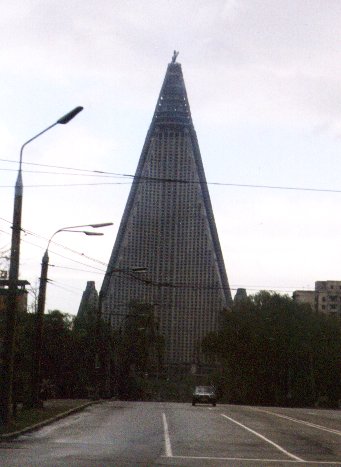
This Ryuguong hotel is 105-storey which construction has been suspended 1991. The estimated no. of rooms are 3000 (when completed). This building has an unique structure. Original plan includes five revolving restaurants on the top. At least you can see this hotel, but no visits allowed and also short distance photographing not encouraged. The construction has been started together with for me unknown western company according to our guide. Any ideas which?

Guest Houses

Pyongyang has couple of guest houses, but these are reserved exclusively to VIP visitors. One is Baekhwawon State Guest House at Daesung District. This Guest House is surrounded by forest and has four buildings and a man-made lake. There is a building for state guest quarters, a main building which houses a meeting hall and guest quarters, an apartment-style building and a performance hall.

Minsok Hotel - Kaesong

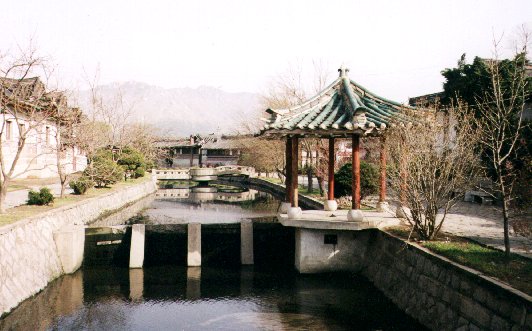
This is a traditional hotel, which has about twenty rooms. You will feel to be a real guest here. When arrive in the evening you will have a dinner in very cosy atmosphere. There is a shop (prices seem to be cheaper than in Pyongyang). You have to be like a Korean here - no shoes inside. You can wander in the garden freely, but there is an iron gate on the entrance, so visits to the town centre are not strongly encouraged. The power for this hotel is from the dam on the picture left..

Food

You will not get hungry (if you do not eat like Romans). There is standard to have a continental breakfast, lunch and dinner. Normally, you will eat without your guides, but if you are in a restaurant outside hotel and at the farewell dinner you guides will be accompanied. Dog meat (tastes like reindeer if it helps to choose) is provided in the farewell dinner by request.

The Pin

Every North Korean  has a pin of Kim il-Sung (we did not see any babies so we do not know if they have as well). However, there are different models. The traditional is Kim-il-Sung (in 1970s) without background. There are then also Kim il-Sung with a red flag background and then also Kim il-Sung together with Kim Jong-il with a red flag background. These are usually worn, always, outside if not doing hard work. Most North Koreans wear these also in these pins abroad.

Money

 
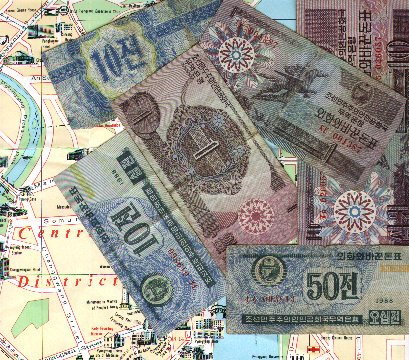
Visitors use special issue won - blue-coloured. This is "fixed" at the moment to the USD, but USD directly are more than welcomed at the rate of 1 USD = 2.13 won. These blue-coloured wons were also used by our guide in a rest place. Your guide are probably more than happy to change money (prefer USD), but any other major currency can be changed in the hotel - if you are not happy to change with your guide. You will not receive receipts when exchanging. Although credit card signs can be seen, it is unlikely that you will be able to use them.

Postal Services

 
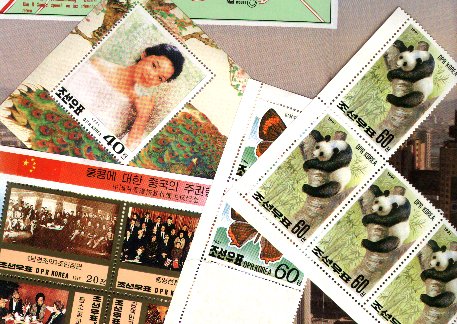
Post services are provided in Koryo and Yanggakdo hotels. Some cards/letters arrive, some do not. Stamps can be very decorative. Stamps can be bought from hotels.

Shopping

 
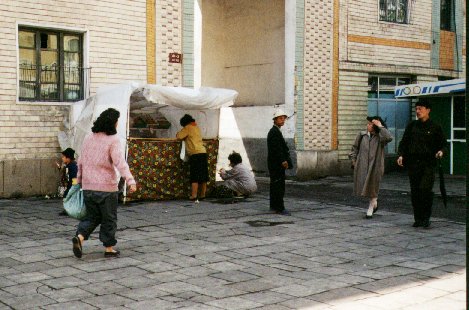
Visitors use special shops catering for them. Department store no. 1, you probably can do only window-shopping. The special shops have generally good stock of souvenir, sweets, drinks of Korean and Chinese products. Shopping is slowly being encouraged, especially if you show signs of liking it. One interesting thing is that although Korea has a state control the prices for books varies considerably. Personally best recommendation is Korean Insam drinks (note that not all alcohol tastes good), anti-imperialist paintings (no.1 sales article according to my guide), films, CDs and cassettes, books (even criminal law of DPRK), stamps,.

Photography

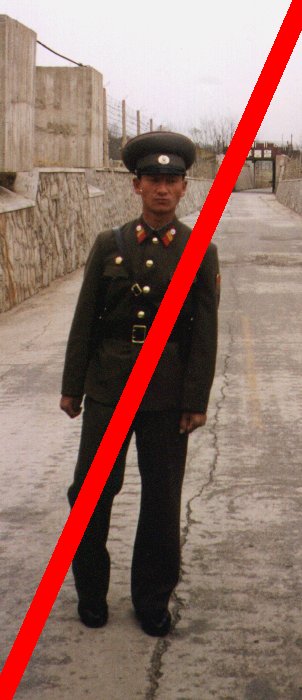
Soldiers, some buildings are not permitted to be taken photos. Some people may object and married women do not like to taken pictures straight away. Best way is to ask and you can find that surprise, surprise some people are very willing to be pictured. A video camera can be very useful for memories and for promoting North Korea at home.

Communications

Internet

Not available yet, although great leader Kim Jong-il asked an e-mail address from US Secretary of State Madeline Albright.

Telephone

IDD code is 850. Although, you can see North Koreans using mobiles in China, there is no network in North Korea. Only people who have phones in cars are ministers and police. From Yanggakdo International hotel you can make calls abroad. In Pyongyang you can see plenty of phone boxes in use, because a Korean has normally not a phone at home.

Language

Korean. Chinese getting ground. Few people speak English. Older professional people occasionally speak Russian.

Religion

Juche idea. This "religion" is based that the man is responsible for his own destiny. Buddhist monuments have now been preserved well and even some Buddhist temples have monks.

Please note that our guide called Kim il-Sung as respected leader and Kim Jong-il as great leader.

The visit was made in Juche 89 (2000) April and please feel free to give feedback

Please note that we are not accepting any liability regarding the information on this site is correct or causes harm in any way.


Hosted by www.Geocities.ws

1