 |
| Incubators |
|
 |
 |
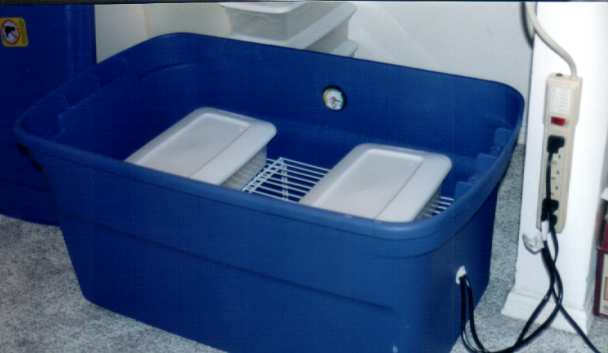 |
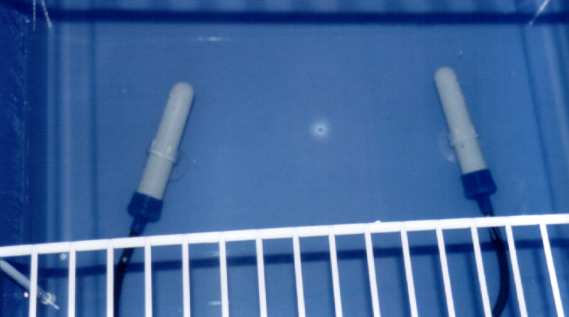
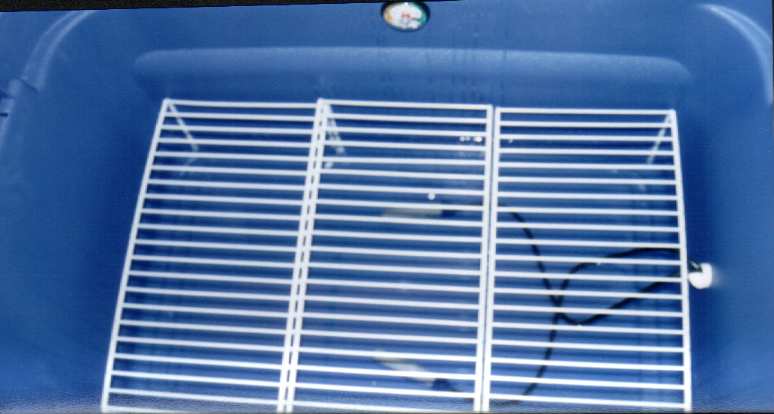
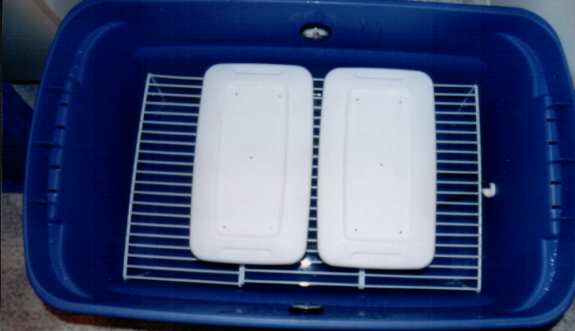
| Basically you just drill a hole in the Rubbermaid tub high enough for the water will not spill out. Set the dial of the heater to 88 degrees. Slide the heater through it and suction it to the bottom (that's the other nice thing about this heater it can be placed on its back). Plug the excess of the hole with tape or something. Fill bottom with water until it covers the heater at least I went a little higher cause it evaporates quickly so you need to check it often. Place your racks in Be sure to use some what of the same type of racks I did cause you want something that the water vapors can pass through you do not want it closed off. stick on the gauges I put them on opposite sides of each other. Plug in the heater. Place the perlite or vermiculite into the shoebox sized Rubbermaid containers. Be sure it is about 2 inches deep you can always take out some when putting in the eggs. Then you just need to put the eggs in. don't place them to close together. Also be careful not to turn the eggs pick them up and set them down in the same position they were laid. then put the containers into the tub on the rack. Be sure to check them often do not put the lids on the shoebox containers but put the lid on the tub. |
| The following pictures and instructions are from Jody at Jungle Shadows |
| First of all thermometers. These things unless a registered product (ie certified as accurate by a national tesing body) are not accurate. We test all our thermometers against those with NATA registration and have found some to be 4 degrees celcius out. For incubation this is significant. So have your thermometers tested. Second Electronic Thermostats. Again these are not accurate as off the shelf. You must test your thermostats with a calibrated thermometer. Once you calibrate the thermostat you will know at what temperature it is switching over. We have $3000 incubators sitting on 40 deg Celcius (according to the thermostat) which are actually only on 32 deg. Thats almost a 10 deg innaccuracy. Enough to be lethal. Always have a tray of water in the incubator as otherwise they are about as humid as a desert. Make sure the room where the incubator is located is at least 5 deg celcius below the temp at which the incubator is set. That is if you are incubating at 28 deg C then the room should be no more than 23 deg C. We use air conditioners for some rooms and also keep five incubators in a fridge. If you don't do this then the incubator bounces around the set temperature and for some species this will cause extended incubation periods and weaker hatchlings. I will add some substrate tricks we have picked up over the years. We use vermiculite, mainly because it is sterile. For most reptiles we use a 1:1 mix by weight vermiculite : distilled water. However, it is not necessary to actually weigh it for most purposes. If you mix in the water and pick up a handful of the mix and squeeze it it should clump together (like thick mud) with no water visible, ie you should not get droplets of water fall out when you squeeze it. At this point you have it close enough. Or if you are worried just weigh it. There are different types of vermiculite available, get the course stuff as the fine stuff sticks to the eggs and lowers oxygen. Personally I recommend against the use of peat moss, however, I know it works so if that is what you prefer go for it. With turtle eggs don't bury them, have them half buried only. Lizards and snakes, bury them completely. Never allow water to build up on an egg shell or you will encourage fungal growth and lower oxygen exchange. Cover the eggs in the incubator, we use what are called here Chinese Food Containers with a few holes burnt through the lid. We also use fishing tackle boxes. This stops water building up in the roof of the incubator dripping onto the eggs. It also creates a buffer cell to maintain a stable temperature and keeps the humidity more constant. Tempting as it is don't look at the eggs every day by opening the incubator, good reason to have a glass or perspex door or lid on your incubator. The less it is opened the more stable it is. Run the incubator for at least a week before using it, ie when you know the reptile is gravid get the incubator ready. They take a while to stabilize once they are turned on. Don't overload them or the eggs actually act as heat cells and buffers preventing an even incubation. As someone in the Asian Turtles Forum once said incubate until it collapses, hatches or explodes. Lastly, for the really technically minded put a probe in it and monitor the temperature. All of ours are hooked up to data loggers with the temperaturs taken every five minutes. We can graph this and even tell when someone opens the door. You don't need that accuracy but if something is going wrong a good temp readout will help you see it before it kills the eggs.This is actually very easy to do and we use those computers that have been assigned as "Road Fill" to run them. I mean it too, we use 286 computers (you remember the ones that came out eight years before the pentium) to monitor the incubators after all they only have to receive a number and record it, a pocket calculator could do it. Advantage is you could probably get one for nothing. Anyway I would be keen to see some of these incubators. If people like I will try to put up some photo's of our incubators so you can see how we do it. |
| The following incubations tips were provided by Scott Thompson of the Australian Capital Territory Herpetological Association |