Venezuela to Panama
Introduction
I am sailing with a French couple Eddy and Cecile on their 39 ft Fidiji catamaran, Adventure Quest. Eddy and Cecile are both true travelers and have camped all over America, Canada, Alaska, Mexico, Europe, and Africa. This was their first trip to the southern Caribbean and my fourth.
Venezuela
The trip started at the Del Caribe boatyard on the central south coast of Margarita Island in Venezuela. The 1st week was not much fun working on the boat all day in the hot dusty boatyard. The boatyard actually crushes red bricks and spreads it around the yard for spills and to mix with the paint dust.
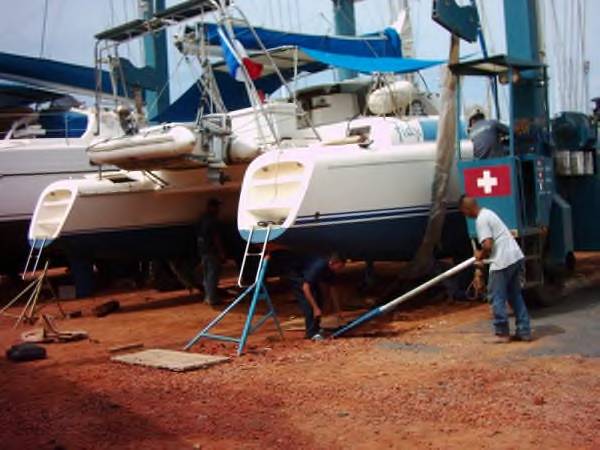
Most of the work centered around freeing a frozen rudder on the starboard side. The catamaran manufacturer mixed several different metals, so all bolts and a coupling, which held the rudder in place, had to be cut off. Some parts had to go to a machine shop to have the old bolts drilled and a completely new coupling had to be made. The rudder also had some cracks, so the boatyard re-glassed part of the rudder. While sanding the bottom paint, we found more cracks and re-glassed the remaining places ourselves. Other projects included repairing a foredeck walkway (above the foredeck net), new anchor fender on the forward cross beam, installed the repaired stereo, bottom job, etc, etc.
With all the heat and dust, we did have pleasant evening and two fun shopping trips into Polamar, the main town on Margarita. We also had a great local resident, from the very small town near the boatyard, which cooked and
delivered our evening meal for next to nothing. Eddy also wanted to add that I drank 3 beers (been cutting way back) last night and saw a star with a red, green, and white light that I though was a plane. Cecile was almost convinced.
Eddy's quote of the week - Turkist men say beat your wife everyday. If you do not know why, she will!
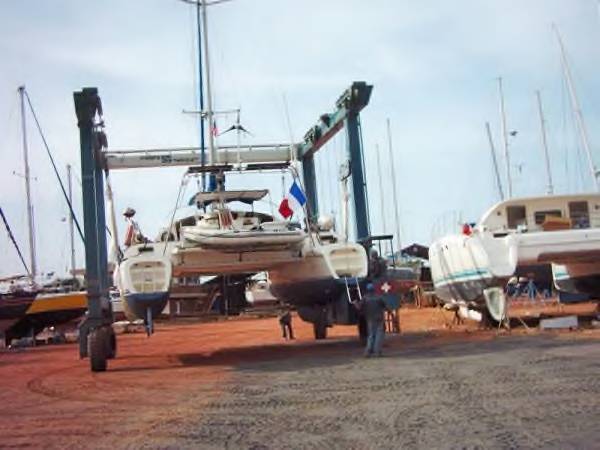
We were all happy to finally get Adventure Quest back in the water and set sail, but neither engine would start. The starboard engine had a bad relay in the starter circuit, coolant leak, and a bad oil leak. Port engine had a bad glow plug (heats up the engine before starting), fuel leak, and overheated once it started. The oil leak on the starboard engine was to be repaired by the Del Caribe boatyard during the 8 month storage, but they only made the problem worst. This gave us a good excuse to stay at their dock (and tie up their lift) until the mechanic that received $250 for the original repair could come back and fix it again. Such is life in Venezuela! The extra time at the dock allowed us time to make the other engine repairs, so everything always works out for the best.
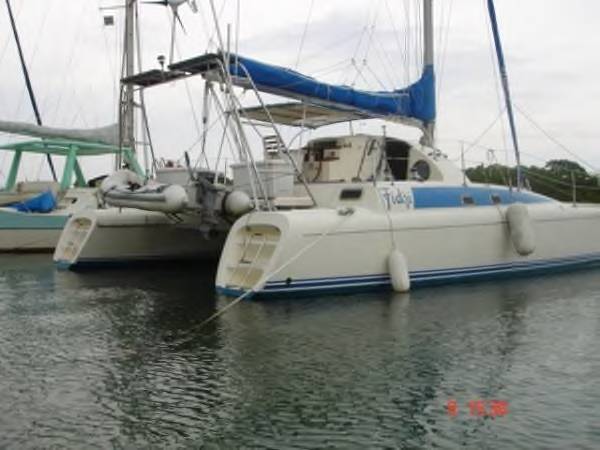
Finally, we were off and had a wonderful sail to
Cubagua, a small island just south of Margarita. The wind was high so we didn't go ashore, but I did catch a small grouper. Cecile was my witness! Anchoring the previous night the starboard engine locked into reverse and we couldn't get it free. After sleeping on the problem we decide to continue on quickly to Bonaire with only one engine. Catamarans with a wide beam don't handle very well with just one engine and cut our top speed under power from 6.5 kts to about 2.5 kts.
Next day we got up early for the 65 nm sail to Tortuga. We had a great start with 20-25 kts winds on a broad reach and were averaging 8 kts with a double reefed main and full jib. Later in the day the wind died to nothing and we had a 360 degree wind shift. Very strange for the trade winds. Everyone was worried about
making the island before dark and we were considering spending the night at sea, so we could safely enter the anchorage during the daylight, but the wind picked up again and we made it with about 1 hour to spare.
Tortuga is a beatiful island with only a few fishermen living on the island, crystal clear water, and pure white sand beaches. It was the weekend and several huge power boats were over from the Venezuela mainland & 6 small airplanes. The air strip was on sand and the only thing that almost looked like a road on the island. There are some very brave Venezuela pilots! Body surfing was almost perfect the 1st day. Surf on the 2nd day dropped a little, but was still fun. Also did a little fishing and caught one keeper.
Next it was a 150nm sail to Aves de Barlavento in light winds (trades ???) flying the spinnaker during the day and jib at night. Along the way we caught a 4-4.5' sailfish
that did a great dance on top of the water. It took almost an hour to get it in and the hook finally broke when we were trying to release it. If it only would have been a Mai-Mai!
We arrived early the next morning in the Aves and anchored near the main island. Aves is a big bird nesting island with hundreds of baby boobies sitting in the mangrove trees just a few hundred yards away. Aves de Barlavento is a reef and island shaped in a backward 'L' with the bottom part of the 'L' the land. Eddy and Cecile were not too interested in snorkeling, so I walked to the end of the island and snorkeled along the reef. This is one of the best reefs in the
Caribbean and the walk and swim back was worth the effort.
Bonaire
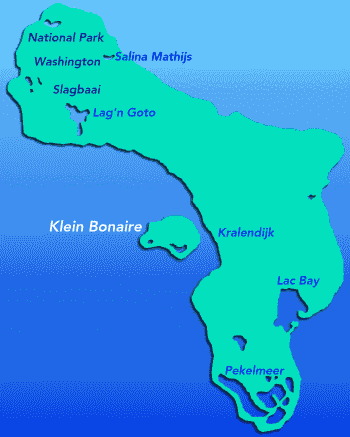
With the starboard engine still stuck in reverse, we decided to sail the last 55nm to Bonaire the following day. We had a good sail in 15-20 kts winds on a broad reach and made the trip about 1.5 hours before dark. In Bonaire, we grabbed a mooring off the main town of
Kralendijk. The best snorkeling in Bonaire is off the small island of Klein
Bonaire.
Bonaire has 2 hardware store and a Budget Marine, so the repairs started again. The transmission was temporarily fixed by hitting it with a block of wood (sound advise from a Volvo mechanic). Both water mufflers were repaired, 4 bad check values were replaced with ball values (we had a few leaks), and a few other problems repaired.
We also discovered a major leak in the salt water cooling pump on the port engine, so
decided to sail to Curacao to get it repaired.
So now you know the definition of cruising - working on boats in tropical places! And everyone probably was thinking we were sitting around drinking beer and watching the sun set. Well, we did a little of that too!
Curacao
The sail over started with light winds on a broad reach using a full main and spinnaker making 4-5 knots. The wind slowly built to where the spinnaker was replaced with a full jib and then the jib was reefed by about 1/3, as we approached Curacao. We had a nice following sea and with the full main and reefed jib we reached our highest boat speed of the trip of just over 11 kts in about 20 kts of wind. Normally, we would have reefed the main sooner, but had only a short distance to go and got there extra quick!
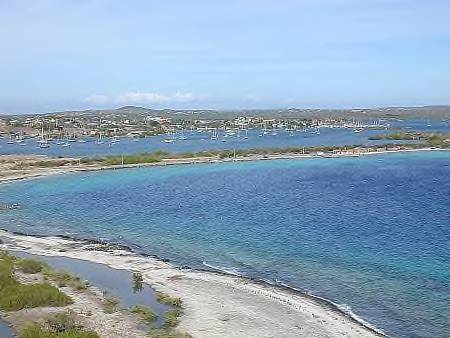
The anchorage in Curacao is in a large lagoon called Spanish Waters which is entered by a very small pass from the ocean. The area around the lagoon has small rocky hills and is a desert like landscape, filled with big expenses houses along the shore line. There are a lot of yacht clubs and private marinas which are off limits to the boat bums like us, but we had access to Sarifunds Bar & Marina and some docks used by the local fishermen. Sarifunds has a happy hour, Monday night movie, water, phone, and washing machines. For everything else we tie up at the fisherman's dock and rode a bus for 30 minutes into the main town of Willemstad. The fishermen's docks are just off the left side of the picture. Caracas Baai, a great snorkeling spot, is in the foreground of the picture.
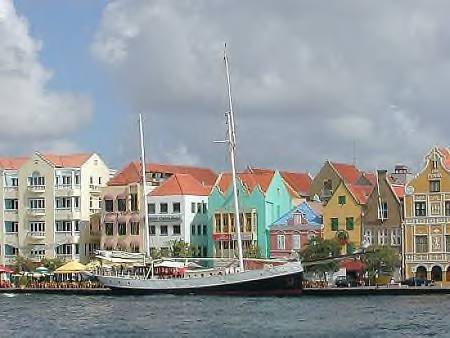
Willenstad is a colorful town with the building painted every different color you can think of, only don't look too close because many need to be painted. Willenstad has the longest barge walking bride in the world across the main
industrial harbor. We get most of our fresh vegetables from boats that come over from the mainland and tie up along a canal in the downtown area. The downtown area is also filled with shops selling everything you can think of except Chess sets and swimming fins.
We finally found a Chess set in another small town and Eddy became the champ.
The 1st step in repairing the pump was to just remove it. Two of the bolts were located in such a bad place you could only barely touch them with the tip of your finger. After about 1 1/2 days of removing more and more parts from the engine and borrowing just the right size tools, we got the pump out. No one at that time wanted to even think about how we were going to get it back together!
Next it was off to the 1st shop who assured us he could fix it in short order. After 10 days, we picked up the pump and carried it to another shop, with the same 'no problem'. 3rd shop was 1 1/2 days later and they only got to keep it 3 days before we ordered a new one from the US. All these shops and mechanic know each other and we are sure, over a beer in the evening, they were comparing notes on our pump - I held the pump for 10 days, but I held it for 3 days and they called me at least 10 times. 1st shop wins the prize! New pump arrived in about one week and was installed with only minor problems. The good news on the Curacao Pump Transport Tour is you get to see lots of different parts of the island!
Curacao claims to be the 2nd best snorkeling spot in the world. No one seems to know were the best spot is (I asked), but maybe their sister island, Bonaire, claimed the title first.
Just across a narrow strip of land from the anchorage is Caracas Baai (pictured
above), which is a solid 10 for snorkeling and one of the best. It is a U shaped
bay with small cliffs where the bay opens to the ocean. The cliffs continue into the water with some small shelves and create some great walls only about 10' below the water. The water is so clear and looking down over the wall into the dark purple, I'm sure China is just out of view. We
snorkeled the entire bay and saw an amazing vary of sea life including turtles, squids, sea snakes, little green sea worms, etc, etc, etc. There are also lots of fish cleaning station around the coral. The fish swim up
and float at about a 45 degree angle to the surface and small yellow fish clean the larger fish.
Once, we scared a nice size grouper lying near the bottom and a small purple and white shrimp slipped
off. It was only about 1/2 inch long and was another cleaner.
One Saturday night we had a big party on a 63' motor sailor anchored in the lagoon. Everyone was invited, so there were 25-30
dinghies tied to the boat at any one time. Everyone came and went at different times, so even trying to find your dinghy and your dinghy line was a big project. Everyone had a great time at the party and the parking problem just added to the fun.
Sail To Panama
So after our 4 day stop in Curacao, which only lasted one month, the boat was repaired and we set sail the San Blas Islands in Panama. The trip started with very light winds on a broad reach flying a spinnaker and doing 2-3 kts. Near the western end of Curacao we had a about a 1 kts current right on the nose, so we decided to anchor for the night at Westpuntbaai. The bay was surrounded by rocky cliffs with a scenic small village in the middle. The holding was excellent, but snorkeling around the bay was only fair. Next morning we were off early and set a course for well off the Columbia coast. On the 2nd or 3 day out (didn't keep up with my log on this leg) we had a pod of whales following the boat. It is hard to say exactly how many there were, but it was a bunch. Mostly you could only see them in the waves behind the boat, but two surfaced very close (maybe 50' or so) and these were about 15' each, which was a little scary. Caught a nice yellow fin tuna, which would just about melt in your mouth! With our NW coarse to avoid the stormy Columbia coast, we wound up just south of a tropical wave and both the wind and seas picked up as expected. The heavy weather lasted for about 36 hours with a peak wind gust of about 30 kts over the deck and 10-12' breaking seas. Highest boat speed (we weren't trying for this) was 14.5 kts surfing down a wave with a double reefed main and about 1/3 reefed jib. Adding the third reef in the main and headed up a little helped keep the boat in better control. The bad news about taking the waves more on our beam was the banging you get in catamaran. This is were the wave hits the bridge deck (area between the hulls) and makes a loud noise and shakes the entire boat. A little scary, but boat received no damage. So after about 7 days at sea we sailed into the San Blas Island.
Panama
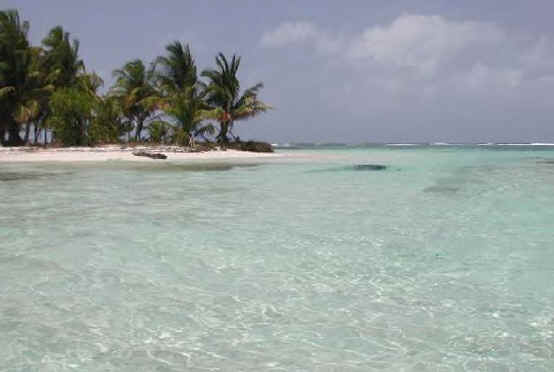
Every wonder where postcard pictures of small islands with palm trees, white sand beaches, and crystal clear water are taken at? My guess now is the San Blas Islands, only add the Panama rainforest and mountains in the background. Panama owns the San Blas Islands, but they are still mostly run by the local Cuna Indians. The Cuna Indians are the last remaining indigenous Indians in the Caribbean and still live a very simple, happy life. All of their boats are hand made dugout canoes that they either paddled or sailed. I only saw one with a small outboard engine.
The Cuna Indians are famous for the Molas they make by hand. The Molas are a layered cloth art work with the colored threads forming different patterns. One of their big money makers is to get all dressed up in their local dresses, paddle out to the yachts, and sell their Molas. They have so many to choose from and there is normally 2-3 different women in the canoes, so you always feel the need to purchase at least one from each. Just when you think you are completely Molaed out, another canoe comes out with more women and many more Molas. I still remember their sad faces when we tried to explain how many we had already purchased and the yacht might sink with even one more Mola onboard. Snorkeling was excellent and there were about 300 different islands to explore, but we decided to push on to the Panama Canal after only 2 days.
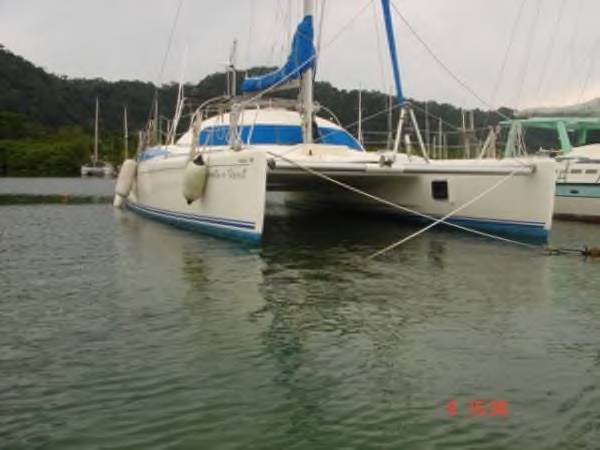
The 24 hour sail to Colon, at the entrance to the Panama Canal, was with light winds on the stern and lots, and lots of big ships all heading for the canal. As we were anchoring near the Panama Canal Yacht Club, the starboard engine
sail drive got stuck in forward gear and pounding on it with a wooden block didn't fix the problem as before. The autopilot was also having some problems, so Eddy and Cecile decided not to continue on thru the Panama Canal and into the South Pacific with the new set of boat problems.
I was missing Cindy and was just about ready to head for home when I met a nice
Frenchman at the Panama Canal Yacht Club looking for crew to help him transit
the Panama Canal, but that is another story....