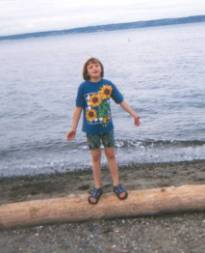
J
Sasha’s Page J
By Kelly McManus
I would like to thank again our family and friends for their generous contributions to help us sponsor Sasha and a special thanks to Dr. Liu for donating the necessary dental care (and there was a lot of it!)
As you may know, last summer I convinced my family to have
a child from Belarus stay with us this summer as a home stay (what’s one more
kid?). This child, Alexandria (or
Sasha), is very special; she is 8-years-old and lives in a small town only 38
miles from the Chernobyl nuclear reactor that exploded on April 26, 1986. This area is highly contaminated with radiation, if it were in
America all the soil would be dug up and buried somewhere remote, but people are
still living there. Because of this radiation most people there are chronically
ill or desperately poor.
Sasha arrived on June 23, 2001. She had the clothes she was wearing, one extra set and a dress that looks like it was made 30 years ago, new hair clips and socks her mom had gotten her, and presents for us; a ceramic bull, a dwarf figurine and a hand woven table runner.

She was a bit dazed and confused
Sasha (9) lives with her mother (Vera, 36) father (Lona,
37), two sisters (Anastasia, 15 and Alena, 10) and brother (Lona, 8).
She lives on a farm in a very small community, her house is two rooms,
one bedroom and one “everything else” room.
She has electricity and a TV but no plumbing and heat is from a wood
stove. Her family has one horse
with a foal, two cows, two pigs, four rabbits, four cats, two dogs and 14
chickens. Sasha and her siblings do
most of the chores, washing the clothes (without a washing machine), weeding the
garden, cooking, and cleaning the house. Sasha’s
mother works as a laborer on a farm and earns $15 - $30 a month.
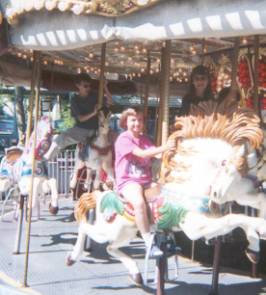
Sasha riding the "Konees" at the King County Fair (yes, Richard is trying to climb onto the neighboring horse, Boy, did she chew us out for that!)
ie:
-
To say
“Kelly, I think mom will be mad if she knows that I have eaten this cookie,
please do not tell her” Sasha would say “Kelly, Mama (Angry-face with hands
in claw shape and growling), No, Cookie.”
-
To say
“Richard, it is rude to burp a the table, I think you should eat in the
kitchen” she would say “Richard! No! Bad! (point to kitchen) Out!
-
To say
“Mama, while you were in Target Richard was bad and honked the car’s
horn.” She would say “Mama! Richard bad! Richard Honk Honk Honk! Bad
Richard.” (one should keep in mind that Sasha was the one to tell Richard to
honk the horn in the first place, “Richard, Honk Honk! Good!
Richard, please, please!”
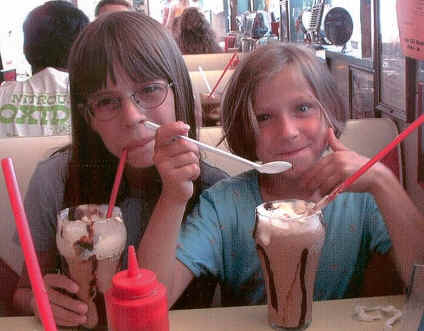
Sasha and I eating chocolate milkshakes at the Triple X drive-in (This is right before I showed her how to blow bubbles in her milkshakes and she misjudged the force needed, causing it explode, leaving everyone at the table covered in chocolate ice cream splatters)
Sasha passed her health checks with flying colors,
not surprising considering she’s a bundle of energy from the time she wakes up
(at an ungodly hour) until she goes to sleep.
Plus she eats twice what we do, except the vegetables that mom wants
her to eat. She was not so lucky at
the dentist. Dr. Liu donated all
the dental work and ended up filling five cavities (and not our wimpy American
cavities either, these were big gaping holes!).
Sasha’s
Firsts:
Riding in a train, bus, plane and car.
Eating ice cream (you should have seen the look she gave us when we told her to eat the brown paste-like substance)
Eating at restaurants and fast food places
Roasting marshmallows
Straws (yes, straws, she saved the one she got from McDonalds for a week)
Swimming (or as she says it “Someen”) - her favorite activity
Water balloons (Richard will curse the day he taught her that)
Helium balloons
Elevators (we made the mistake of the first one being in the Space Needle.)
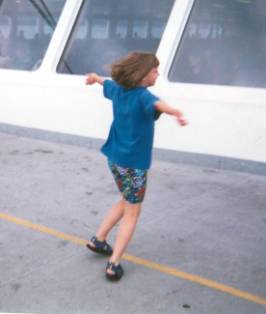
The Ocean – collecting seashells, jumping in the waves and being buried in the sand.
About
“For the Children”
“For the children” is a non-profit organization based in
Washington (the state), which began six years ago.
It works to organize home-stays and medical treatment for the some of the
most impoverished children of Belarus. The
most important thing they need is families who are willing to host a child for
six weeks during the summer. “For
the Children” tries to find host families for about 20 new children between 7
and 12, each year. The children arrive in Washington on June 23rd.
Host families provide for all the children’s needs during their stay,
including trips for medical and dental treatment organized by “For the
Children” in addition to food and clothing.
Many Families continue hosting their child for several summers.
For the Children works to raise all the funds necessary to bring these
children to Seattle, it costs over $1000 per child for airfare, insurance and
medical care. They have
received many grants but rely on the support of the host families, their friends
and neighbors to spread the word about their program and seek additional
donations to the worthy cause.
On April 26, 1986 Chernobyl, a nuclear power plant in USSR, exploded, sending 150 million curies of radiation into the atmosphere. Winds carried the radiation, made of radioactive isotopes of iodine and cesium, across Belarus and into Poland, Sweden and southwestern Russia. To prevent further radiation from being released, a concrete dome, called the sarcophagus, was hastily erected over the damaged reactor. Thirty-six hours after the explosion the area immediately around Chernobyl, which contained the towns of Chernobyl and Prip’yat, was evacuated. Then, 6 days later, 75,000 people living in a 30 km radius from Chernobyl were also evacuated. Later the government decided that the area out side the 30 km zone was also, obviously, contaminated and evacuated about 70,000 people from 1986 to 1993, regrettably many people are still living far too near Chernobyl.
50% of Belarus is described as “highly contaminated” and over 20% of the farmland is completely unusable. Much of the water is polluted by the radiation and the government is too poor to correct the problem.
The effects of the Chernobyl
radiation on the people of Belarus and Ukraine are unclear.
However, the mortality rate of people in the “High Contamination”
zone is 70 percent higher than normal for that area.
People in there have a higher rate of chronic bronchitis,
digestive-system problems, tuberculosis, diphtheria, hypertension, and a
compromised immune system.
One disease that can be directly
attributed to Chernobyl is Thyroid disease. The number of cases of thyroid
disease has increased 22 times in areas affected by radiation, there is up to
300 cases of this extremely rare disease in the areas affected.
The Thyroid Glands, located in on the sides of the neck, create a hormone
that controls metabolism and growth and is very sensitive to radiation.
The best treatment for thyroid disease is rest, fresh air, a good diet,
vitamins and a drug called Thyroxin.
Unfortunately, most victims of Chernobyl cannot afford such luxuries and
the healthcare system is lacking the staff, medicine or money to deal with the
problem.
Another
common illness there is “Chernobyl AIDS”, which is caused by a combination
of malnutrition and the effects of the constant radiation.
It afflicts children living in contamination zones and has the same
effect as real AIDS. Causing them to be very susceptible to diseases such as
chronic ear infections, bronchitis, and pneumonia.
Luckily, a simple cure exists, it has been determined that six weeks of
good food, a healthy environment, and no radiation is enough to totally restore
their immune systems.