McManus Children Save World
Local
Family Discovers Giant Marshmallow Cover-up
Jet
Puff Marshmallow Genetic Engineering Experiment Goes Horribly Wrong
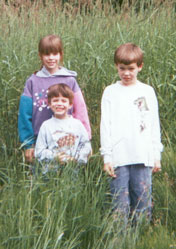 A
local Issaquah family was praised today for their work in uncovering a massive marshmallow
cover up involving the Jet Puff marshmallow
empire. Young Kelly (age 13),
Richard (age 11),
and Michael McManus (age 8)
were presented with community service awards by FBI Seattle Bureau Chief, Bruster Buster.
“These children were instrumental in solving the marshmallow
mystery. We all owe them a great
debt of gratitude.”
A
local Issaquah family was praised today for their work in uncovering a massive marshmallow
cover up involving the Jet Puff marshmallow
empire. Young Kelly (age 13),
Richard (age 11),
and Michael McManus (age 8)
were presented with community service awards by FBI Seattle Bureau Chief, Bruster Buster.
“These children were instrumental in solving the marshmallow
mystery. We all owe them a great
debt of gratitude.”
The
article that follows is the result of the children’s efforts and what this
investigative reporter was able to fill in.
It was the children's dogged pursuit of the truth that
resulted in the discovery that the huge marshmallows showing up in farmer’s
fields everywhere are the result of a twisted experiment gone horribly wrong.
The gigantic white morsels of sweet goo are actually field-grown
marshmallows.
It seems that in early 1990 the Jet Puff Marshmallow
Company, embarked on a program to move marshmallow making out of the factory and
into the farmer’s field via genetic engineering. A young marshmallow research chemist working in the Jet Puff
Poulsbo, Washington marshmallow laboratory had been dabbling with the notion of
genetically altering a pumpkin vine to produce marshmallows.
After some marginally successful backyard experiments, he was able to
convince management that the idea had merit.
Over a period of only two years he progressed from producing soft
off-white pumpkins to growing a single small marshmallow-like object on a potted
vine. Through this success he
garnered millions in funding and a 10,000-acre experimental farm in Yakima,
Washington to continue his misguided work.
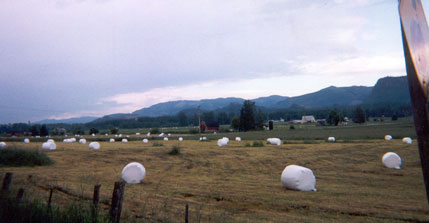
Giant
marshmallows have appeared
throughout
the Pacific Northwest
The young chemist surrounded himself with a team of
research biologists who bought into his mission and were over paid.
Working around the clock, and with an unlimited budget the project
progressed swiftly. By 1995 a strain of vine had been developed that yielded a
pure white fruit in the cylindrical shape of a marshmallow.
Although putrid tasting the team knew that “the look” was half the
battle. Ecstatic over the progress,
management at the highest levels became interested in the project and poured
money into the Yakima experimental farm.
The work was funded under the code name “field
fresh” and drew intense corporate attention.
By 1997 the “field fresh” team began to feel the pressure to produce
a marketable product after having spent over $22.4 million in marshmallow
research moneys. In an industry not
known for innovation, this was a staggering sum.
By comparison, the Jet Puff team that developed the mini-marshmallow, a
favorite of hot chocolate drinkers world wide, spent a paltry $440,000 to take
that idea from a napkin to store shelves everywhere. The “field fresh” project was in trouble.
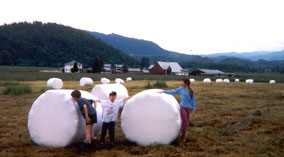
McManus
Children Discover
Experimental
Farm
This led those working in Yakima to take outrageous
risks in their quest to rework the pumpkin vine gene. Biologists sliced and diced genes with the reckless vigor of
a runaway vega-matic. All manner of
bizarre fruit began appearing in Yakima fields.
It was felt that an uncontrolled mutant pumpkin release was unlikely due
to the limited mobility of pumpkin seeds. Unlike
the all too familiar dandelion seed that takes wing on the lightest breath of
wind, the pumpkin seed rarely wanders far from the vine.
The “field fresh” team kept a good supply of Round-Up available to
wipe out errant experiments.
As it turned out, this lack of attention to seed security
had horrible results. In early 1997
the team had progressed to making multiple gene modifications with each
succeeding attempt to create the perfect field grown marshmallow.
This aggressive approach was necessary to speed up the development
process. Under normal circumstances
genetic manipulation is worked one gene at a time.
This provides for careful control of outcomes.
However, working one gene at a time is a slow process. Having the need to
develop taste, shape, texture, and vine characteristics, the process involved
hundreds of genes and was going to take years.
The “field fresh” team knew they did not have that much time.
They began modifying several genes with each new generation
of plant. At first the risky
strategy seemed to pay off. They
developed a plant that had a soft white fruit, almost the right size, with a
sweet marshmallow taste. It had two
short comings; only one marshmallow appeared on each plant, and plant seeds were
clinging to the bottom of marshmallows where they attached to the vine.
In an attempt to correct this problem, gene modifications
were made to eliminate the seeds, creating a seedless vine, and to increase the
number of marshmallow fruit found on each vine. It was this experiment, number 98-00235, and it went horribly
wrong.
At first the team from Jet Puff thought they had a winner.
The seeds appeared to have disappeared from the plant and each plant held
20 to 30 buds - potential marshmallow fruit.
But as the vines grew, they knew this was not the plant they had hoped
for. Only one fruit developed fully
on each vine, and it developed into one huge marshmallow!
The seeds seemed to be gone, however the marshmallow was coated with a
fine white dusting that had the look and feel of powdered sugar.
The coating was a nice touch, but did not make up for the other problems.
As the “field fresh” team went back to the drawing
board, migratory water fowl discovered the sweet fruit. Local hunters noticed that birds they had shot were coated
with the fine white dust. It was
spreading up and down the pacific fly way.
And the fine white dust coating on each marshmallow turned out to be
millions of microscopic seeds. The
conditions were right for an uncontrolled release.
Within months, strange vines began to appear in fields where
conditions of moisture, soil type and sun were just right.
Then came the fruit. Huge,
soft, sweet, sticky marshmallows. Each weighing up to one ton.
Although children loved them, they became a scourge on farming.
Unless removed in the early pre-fruit stage, the large massive fruit was
found to be too sticky to handle with conventional farm equipment.
And to make matters worse, local EPA officials say they may designate the
fruit a hazardous waste that will require transporting to special landfills at a
cost of millions.
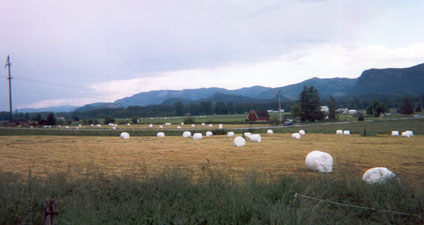
EPA
determines marshmallows
are
hazardous!
This is where the McManus children entered the picture.
They had come across the huge white sweet items while on a family outing.
“We had to know were these things were coming from!”
young Kelly had insisted. So
they had their Mom and Dad drive them all over the Wallamut Valley in search of
the field of origin.
And one Saturday afternoon they found it.
Completely be accident they had wandered onto the Stay Puff property
where the experimental plots were located.
Although security guards chased them off, Richard took several
photographs. Fully comprehending
the threat to our environment these monsters represented, the children took
their evidence to the FBI. And
several weeks later the feds sprung into action.
No arrests have been made.
Today, farmers and land owners want to know who will pay for
the cleanup of these giant morsels. The
problem continues to spread as birds disperse the seeds up and down the west
coast, from Canada to Mexico. Jet
Puff denies the existence of the program.
Home