A Discussion of Article 10.2 – FIDE Laws of Chess (July
2001)
By Robert Wheeler – Chairman Jamaica Chess
Federation Rules Committee
Introduction
Well, here we go. I’ll probably stir up more controversy. My personal opinion is that it’s a lousy rule and the quicker we are able to dump it the better. However, since for the time being we seem to be stuck with it, I agree that players ought to know how it works. I’ve done some considerable research to arrive at the following, and believe me when I say there are a lot of problems involved, not least with players insisting on “theoretical draws” or the attitude of “how can I lose, I’m not playing any more”. I hope that what I have distilled here will help with these points.
A
good rule of thumb is that the award of a win to the opponent should not bring
the game into disrepute.
The arbiter should ask himself who is winning and if the answer is the claimant then he can safely award a draw. If the claimant has a clear path to checkmate his opponent but insufficient time to do so then clearly a draw is in order. But of course in practice it is not always so easy. Sometimes it is not obvious who is winning, due to various factors such as playing strength, nerves etc. The arbiter has to use his best judgment.
I have given a general introduction as to what the article is all about and it’s origins, when and where it applies, and then I have given a lengthy series of examples to illustrate the application of the article in practice.
What
is Article 10.2?
Since 1985 there have been so-called Quick Play (Guillotine) Finish Rules, however this article, in it’s present form, was first introduced in the FIDE Laws of Chess (July 1997). The original purpose of the article was to eliminate adjourned games. The use of computers to analyse has led to the decision to put the onus on the players to finish the games in one session. Of course this has led to Article 10, with increased pressure on the arbiters.
The intention of the article is (a) to protect the player who has a better or superior position and has no time to bring his position to a good end (b) to protect the player with the inferior position who has little time left, but who may have a totally drawn position. The problem is that the arbiter has to decide who is better! Each arbiter will have his own subjective opinion.
Can I
appeal against an arbiter’s decision on Article 10.2?
Since July 2001, this is no longer allowed. The decision of the arbiter is final. Perhaps this was introduced because of the many controversies and disputes generated by the article.
The full text of Article 10.2 of the FIDE Laws of Chess (July 2001) reads as follows:
10.2 If
the player, having the move, has less than two minutes left on his clock, he
may claim a draw before his flag falls. He shall stop the clocks and summon the
arbiter.
(a) If the arbiter agrees the opponent is making
no effort to win the game by normal means, or that it is not possible to win by
normal means, then he shall declare the game drawn. Otherwise he shall postpone
his decision or reject the claim.
(b) If the arbiter postpones his decision, the
opponent may be awarded two extra minutes thinking time and the game shall
continue in the presence of an arbiter, if possible. The arbiter shall declare
the final result after a flag has fallen.
(c)
If the arbiter
has rejected the claim, the opponent shall be awarded two extra minutes
thinking time.
(d) The decision of the arbiter shall be final relating to 10.2
a, b, c.
Under
what conditions does Article 10.2 apply?
Article 10.2 applies in the situation of a quickplay finish in the last phase of a game, when all the remaining moves must be made in a limited time. For example consider the time control: 40 moves in 2 hours with 30 minutes to complete. Once more than 40 moves have been played the players have a limited time in which to complete the game and the Article will then apply.
The Article also applies to rapid-play games, where all the moves must be made in a fixed time from 15 to 60 minutes for each player, but it is specifically stated in Appendix C4 that it does NOT apply to blitz games, where all the moves must be made in a fixed time less than 15 minutes for each player.
The Article does NOT apply to games with time delay modes, or where extra time is added on after each move (the so called cumulative or “Fischer” mode). For example if 30 seconds or another amount of time per move is added, the time for the remaining moves is not limited. This is the reason for the suggestion that in some tournaments time per move will be added in the last time period to avoid the application of Article 10.2.
Is a
claim made under Article 10.2 a draw offer?
A claim of a draw under 9.2 (three time repetition), 9.3 (50 move rule) or 10.2 (quickplay finish 2 minute rule) shall be considered to be an offer of a draw. This offer cannot be withdrawn and remains valid until the opponent accepts it, rejects it orally, rejects it by touching a piece with the intention of moving or capturing it, or the game is concluded in some other way.
Black claims a draw under
Article 10.2, but White declares he can win. The arbiter allows play to
continue, postponing his decision. White then blunders and no longer wishes to
try to win. He then offers a draw. What if Black now refuses the draw?
If Black refuses the draw, he loses all his draw claim rights and if his flag falls he loses. However it is possible that he may make another draw claim later on.
&nbbsp;
&nbbsp;
HHow should the Article be applied?
&nbbsp;
The arbiter is not expected to adjudicate a position, but should make himself aware of the circumstances, usually by watching a few moves. For example, if a player:
(a) makes tangible progress before his opponent's flag falls, he will be awarded a win
(b) makes no progress, either because of lack of ability or because of his opponent's sound defence, the player will not be awarded a win
(c) makes no progress because his opponent makes little effort to move, the player will be awarded a win when his opponent's flag falls.
Some chess
judgement is required. This is not an adjudication but an attempt to determine
the probable result of the game. The benefit of any doubt should be given to
the opponent of the claimant.
When
should the opponent get extra time if a draw claim is made under Article 10.2?
If the
arbiter postpones his decision, he MAY award two extra minutes to the
opponent. Here the arbiter is not sure about the correctness of the claim
and has his doubts. If he considers the claim disturbing he awards two extra
minutes to the opponent.
If the
arbiter has rejected the claim, he SHALL award two extra minutes to the opponent.
Here he is sure that the claim is wrong. He is of the opinion that the opponent
was disturbed by an incorrect claim. Therefore he gives compensation of two
minutes to the opponent.
The arbiter should refrain from awarding extra time unless it is an unreasonable claim. Remember that the claimant might benefit due to the time taken to reset the clocks.
And now on to the practical examples.
In a rapid game between two players, White has K+R
and Black has K+R+B. Black has 20 minutes left, while White has 1 minute and 30
seconds. White (to move) stops the clock and summons the arbiter, claiming that
the position is a “theoretical” draw. What should the arbiter do?
&nbbsp;
Firstly, at this point Black could accept the offer of a draw. Secondly, it is not the duty of the arbiter to know what a “theoretical draw” is. The arbiter must determine whether the Black is making no effort to win by normal means or if it is not possible to win by normal means (this is really saying that the only way Black could win is if White’s time runs out). If the arbiter had been observing the game earlier and seen that Black was just shuffling pieces waiting for White’s time to run out, then this is not winning by normal means and he should declare the game drawn. However, in the situation given it is possible that Black can win by normal means in the event that White does not know how to draw. It would not be reasonable, however, for the arbiter to reject the claim until he has observed how the game is actually progressing.
If the arbiter observes that Black was really trying to
win “normally” (for example setting traps for White to fall into), or had not
seen the game previously, then he should postpone his decision (instruct the
players to continue the game), and he has the option of awarding two extra
minutes to Black (the non-claimant). The arbiter then has to observe the game
and wait for either flag to fall, when he will make his decision.
It should be noted
that If Black continues to play then he is deemed to have rejected the draw
offer, taking the risk to win, and should he subsequently blunder it is
possible for him to now lose! Also remember that the possibility still exists
to claim a draw under the three times repetition of position or the 50 moves
rule. It should also be noted that should Black’s flag fall, the result will
still depend on the arbiter’s decision.
&nbbsp;
Suppose now that White either does not make any further move, or makes only two or three moves this means that the arbiter has no way to decide whether the opponent did make efforts to win or not. In this case a flag fall means that the game is lost, provided of course that the opponent has material to checkmate the player.
In a rapid game
between two players, White has K+B and Black has K+N+P. Black has 20 minutes
left, while White has 1 minute and 30 seconds. White (to move) stops the clock
and summons the arbiter, claiming that the position is a “theoretical” draw.
The arbiter postpones his decision and White then allows his flag to fall, not
making any move. What should the arbiter do?
When
the arbiter postpones his decision to declare the game drawn, the claimant
really has to show that his claim is justified. The only way to show this, is
by making moves, not by starting a discussion with the arbiter. If the player
makes no moves or only one or two moves, the arbiter has no ability to develop
a well founded opinion about the position. A flag fall means in this situation
that the game is lost, provided of course that the opponent has material to
checkmate the player.
There
is however a problem – suppose White had waited to claim a draw when he has
only one second left on his clock. To postpone his decision and to continue in
the game in his presence is almost impossible. This situation might be resolved
by giving each player some extra time, say two minutes each and asking that
play continue until the arbiter has reached a conclusion, but this is only my
opinion.
|
|
Black
has less than two minutes and he claims a draw under Article 10.2. The arbiter
postponed his decision, asking the players to continue. The game went on
1…Kg8 2. Rg2, Kf8 3 Rf2 Ke8 4 Re2 Kd8 5 Rd2 Kc8 6 Rc2 Kb8 7 Rb2 Ka8 8 Ra2 Kb8
9 Rb2 at which point Black’s flag fell. What should be the arbiter’s
decision? |
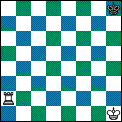
It is
clear that White was making no effort to checkmate his opponent, that is, to
win the game by normal means. The game should be declared drawn.
|
|
White
has less than two minutes and he claims a draw under Article 10.2. The arbiter
postponed his decision, asking the players to continue. The game went on 1.
Bxc4. What should be the arbiter’s decision? |
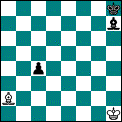
There
are some positions in which neither player can win, for instance K vs. K, K + N
vs. K, K + B vs. K + B with the Bishops on the same-coloured squares. At the
moment one of these positions appears on the board the game is drawn according
to Article 9.6.
9.6 The game is drawn
when a position is reached from which a checkmate cannot occur by any possible
series of legal moves, even with the most unskilled play. This immediately ends
the game.
|
|
White has less than two minutes
and he claims a draw under Article 10.2. The arbiter postponed his decision, asking
the players to continue. The game went on 1. Bxc4. What should be the
arbiter’s decision? |
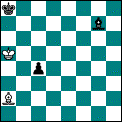
In
this case really unskilled play could lead to a mate, e.g. 1…Be5 2.Ka6 Bb8
3.Bd5. The arbiter should postpone his decision and watch to see if Black moves
his King out of the corner and away. The moment he does then the arbiter should
declare a draw.
|
|
In a rapid game Black has less than ten seconds and he
allows his flag to fall. What should be the arbiter’s decision? |
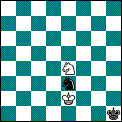
Unfortunately
for Black he loses, since he did not make a claim under Article 10.2. Also
unfortunately it is possible for Black to really play without skill and fall
into a mate, e.g. 1…Nf1 2.Kf2 Nh2 3.Ng3 which means that the position is not
automatically drawn according to Articles 6.10 and 9.6 of the Laws of Chess. Of
course the strange thing about this is that if Black did not have his Knight
the game would be drawn. Sometimes the rules lead to really odd decisions. A
lot depends on how the position arose. It is worth remembering Article 12.1 in
this regard. If I saw two players playing out a long series of moves in a
position like this one I would seriously consider stepping in and declaring the
game drawn.
12.1
The players shall
take no action that will bring the game of chess into disrepute.
The
following list gives cases where both sides have K + piece. In all cases White
runs out of time ( ‘+’ means Black wins, ‘=’ means draw).
|
+ |
= |
|
K+Q vs. K+Q K+Q vs. K+R K+R vs. K+R K+R vs. K+N K+B vs. K+B (different colour square bishops) K+N vs. K+N |
K+Q vs. K+B K+Q vs. K+N K+R vs. K+B K+B vs. K+B (same colour square bishops) |
If a
player has little time remaining, he should claim a draw under Article 10.2 in
normal and rapid games. Normally the arbiter will agree, if there is no forced
mate and the arbiter knows what the players should not do to be mated (e.g., to
move the king in the corner).
White claims a draw
under Article 10.2. The arbiter postpones his decision. But then Black blunders,
e.g., he loses his queen. Now White is in a winning position and suddenly
starts to play for a win. But then White’s flag falls. What is the result?
When
White claimed a draw, Black did not agree to the draw. At that moment Black
assumed the risk of losing the game. White then plays for a win after Black’s
blunder. Apparently there were a lot of possibilities in the position and it
was possible to blunder and so the position was not a dead draw. Then White’s
flag falls. The arbiter can now decide the result of the game: draw or win for
Black (not possible is a win for White, remember he claimed a draw!). The
result does not depend of the position, but on the way the game was continued.
The arbiter should decide for a win for Black.
Is it possible to
claim a draw under Article 10.2 based on previous moves and can the arbiter be
required to examine the scoresheet?
It is
possible to claim a draw based on what happened before, e.g., the opponent was
not making any effort to win the game by normal means. The arbiter has the
authority to examine the scoresheet, but he cannot be forced to do so. If he
postpones his decision, he can base his decision after the flag fall on what
was written on the scoresheet and what he noticed during the continuation of
the game.
|
|
In a position where
each side had K+R+P, Black claimed a draw under Article 10.2. White said that
he thought he could win. So the arbiter postponed his decision. White was
unable to show a winning method and Black's flag fell. The diagram shows the
position on the board after Black's flag had fallen. What possible
decision could the Arbiter make? |
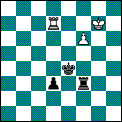
The
arbiter should decide that the game is drawn. An arbiter should never judge the
position, because this is not his duty. Most essential is the position at the
moment of the claim and the most important factor is the continuation of the
game. Note that Article 10.2(b) says that the game shall continue in the
presence of an arbiter, if possible; this clearly indicates that the
continuation is essential.
|
|
A position is such that
White has K+R+2P and Black K+R+3P (all pawns on one side). Black claims a
draw under Article 10.2 and the arbiter postpones his decision. Black then
plays well but his flag falls in the diagram position. Should the arbiter
give a draw or declare the game lost for Black? |
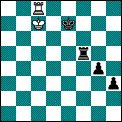
It
seems clear that White did not try to win by normal means. The game is a draw.
Further Examples
In each case, White claims a draw under Article 10.2. What would your decision be as the Arbiter?
|
(1) |
(2) |
(3) |
|
|
|
|
|
(4) |
(5) |
(6) |
|
|
|
|
|
(7) |
(8) |
(9) |
|
|
|
|
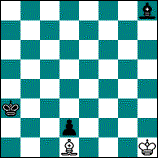
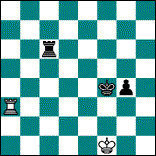
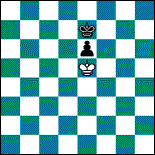
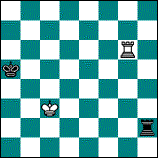
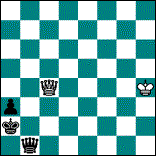
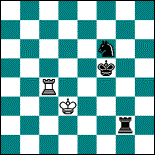
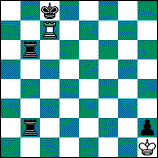
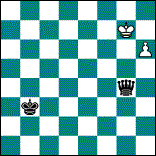
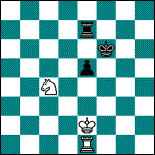
My opinions are given below.
Answers
(1) Draw
(2) Postpone & Play on. Even though it is a draw White must show it.
(3) Postpone & Play on. Even though it is a draw White must show it.
(4) Draw
(5) Postpone & Play on. Count moves for the 50 move rule.
(6) Postpone & Play on. Count moves for the 50 move rule.
(7) Postpone & Play on to see if White keeps checking on the 7th rank.
(8) Postpone & Play on. White should lose.
(9) Draw
|
|
Finally one last example.
Here Black, short of time, made a claim under Article 10.2. The arbiter
postponed his decision, asking that he continue. Black immediately played
1…Re1 and after 2.Re1 Be1 3.Kb3 Kb5 4.c4 Kb6 5.Ka4 Kc6 6.c5 Bf2 a draw was
agreed. |
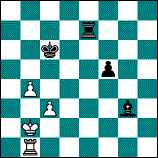
If Black had not immediately exchanged rooks the outcome might have been different. What this shows is that the claimant has to demonstrate that he knows how to draw by his actions, not his words. Whereas previous examples were much simpler positions, in more complicated situations such as this there are obviously many ways to go wrong, or blunder. In a position with many pieces the arbiter’s best way forward is to postpone his decision and watch the game carefully to form his opinion on whether the opponent is just trying to win on time or not.